
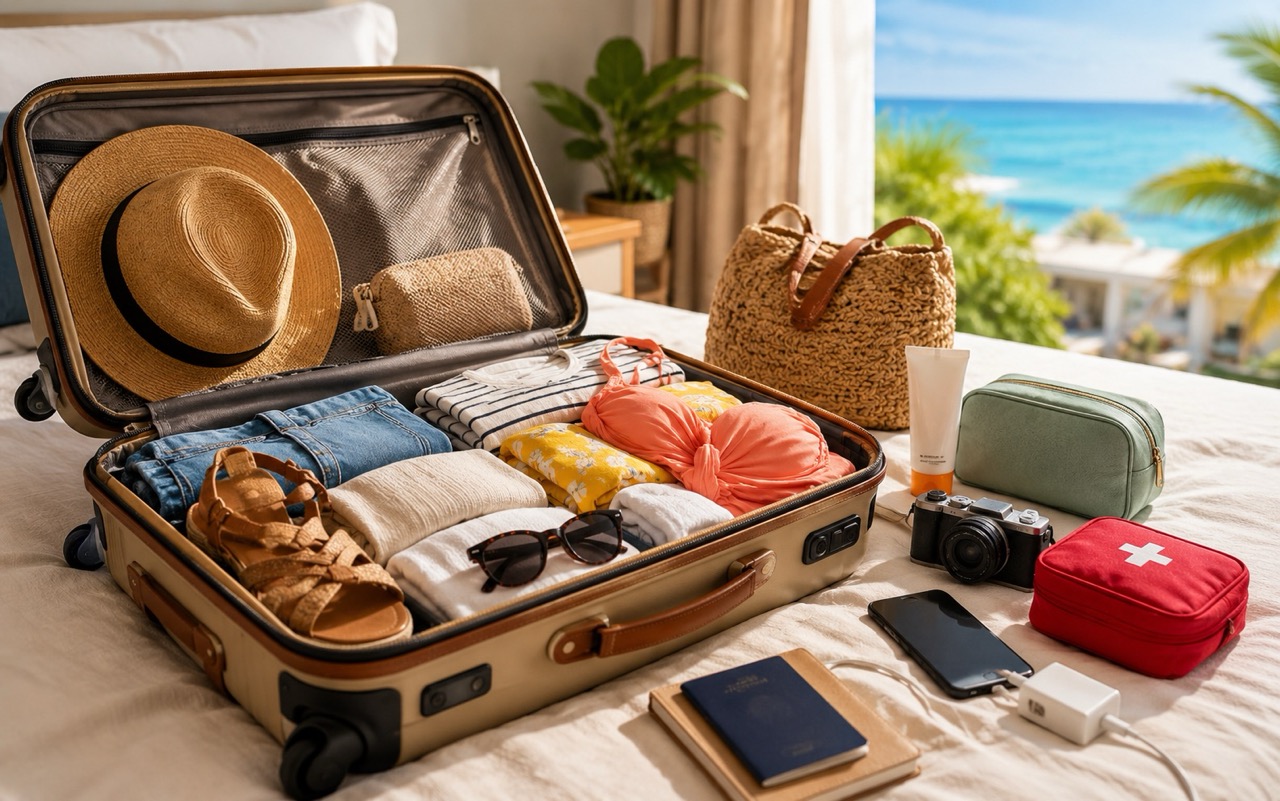
Packing well can determine whether your holiday is relaxing or whether you spend the first day looking for a charger, medicine, swimwear or sunscreen. Packing effectively is not about taking as much as possible, but about bringing exactly what you will actually need based on your destination, transport, the weather and the type of trip.
For your holiday, make sure you pack identification and travel documents, a payment card, cash, a phone and charger, a basic first-aid kit, weather-appropriate clothing, toiletries, sun protection, comfortable shoes and anything specific to your trip. Always keep essential items, medicines, documents and electronics in your hand luggage, not in checked baggage.
The basic rule: documents, medicines and money first
When packing, it makes sense to start with the things that are hardest to replace abroad. You can usually buy T-shirts or shampoo almost anywhere, but a lost passport, forgotten medicine or missing payment card can complicate your holiday from the outset. Documents, medicines, money and your phone should therefore form a separate category that you check first.
If you are travelling within the European Union, a national identity card is often sufficient. For travel outside the EU, however, check your passport, visa requirements and the minimum required validity of your document in advance. The Ministry of Foreign and European Affairs of the Slovak Republic notes that travel outside the EU generally requires a passport that remains valid for at least six months after the expected end of your stay, although the specific rules may vary by country [1].
What to pack in your hand luggage
Your hand luggage is your safety net if your checked suitcase is lost, delayed or unavailable immediately after landing. It should contain not only things to keep you entertained during the journey, but also everything you would need to function normally on your first day. This is especially important when flying, as your checked suitcase is no longer under your control once you hand it over.
Pack the following in your hand luggage:
- national identity card or passport,
- tickets, accommodation confirmation and travel insurance documents,
- a payment card and a small amount of cash,
- a phone, charger and power bank,
- medicines you take regularly,
- basic toiletries in travel-size containers,
- spare underwear and a T-shirt,
- glasses, contact lenses or other personal aids,
- headphones, a book or another small item for the journey.
Liquids on planes
If you are flying, remember the restrictions on liquids in hand luggage. On standard flights within the EU, liquids, gels, creams, pastes and aerosols in the cabin must be carried in containers with a maximum capacity of 100 ml and placed in a transparent plastic bag with a maximum capacity of one litre. Larger containers belong in checked baggage, although exemptions apply to items such as medicines and baby food [2].
In practice, this means that large bottles of shampoo, shower gel, sunscreen or perfume cannot go in your hand luggage if their capacity exceeds 100 ml. It does not matter if the bottle is almost empty; the container's capacity is what counts. If you are travelling with hand luggage only, consider buying small travel bottles, solid shampoo, solid deodorant and travel-size toiletries.
Travel documents and important paperwork
Never keep your documents exclusively in your large suitcase. It is best to carry the originals with you and store copies separately, such as in another section of your luggage or in secure online storage. If your documents are lost, a copy will not replace your passport, but it can make dealing with the police, consulate or insurance company much easier.
Before departure, prepare the following:
- a national identity card or passport,
- a driving licence if you plan to drive,
- a European Health Insurance Card,
- proof of travel insurance,
- accommodation booking confirmation,
- plane tickets, boarding passes or train/bus tickets,
- visas or entry forms if required by the destination country,
- contact details for your accommodation and insurer, plus emergency numbers.
Travelling with children
When travelling with children, you need to think about more than clothing and toys. Every child needs their own travel document as required by the destination country and mode of transport. When travelling outside Slovakia, it is also a good idea to carry basic health documents, any medicines the child usually takes and, for young children, enough supplies for the first few hours of the journey.
A child's hand luggage should include spare clothes, wet wipes, a favourite toy, a snack, a bottle to fill after security, fever medicine and something to keep them entertained. If you are flying, baby food and essential medicines are exempt from certain liquid restrictions, but it is sensible to pack them so they can be presented easily during security checks.
Holiday clothes: fewer items, more combinations
The most common packing mistake is filling a suitcase with things you might need “just in case.” With clothing, it is better to think in combinations. Every item should work with at least two or three others. Instead of packing seven unrelated outfits, choose a smaller number of versatile pieces that you can layer, wash and rotate according to the weather.
For a week-long summer holiday by the sea, the following is usually enough:
- 5 to 7 pairs of underwear,
- 5 to 7 pairs of socks, if you will wear them,
- 4 to 6 T-shirts or tops,
- 2 to 3 pairs of shorts or skirts,
- 1 pair of trousers or another light, long garment for the evening,
- 1 sweatshirt, jumper or light jacket,
- 1 smarter outfit for dinner,
- 2 swimsuits,
- pyjamas,
- a hat or other head covering,
- a light scarf or shawl for protection from the wind and sun.
Clothing for different types of holiday
A seaside holiday requires different things from a sightseeing trip, hiking holiday or wellness break. For the seaside, focus on swimwear, breathable clothing, sun protection and sandals. For a city break, comfortable shoes, a small backpack, layers and clothing suitable for a full day of walking are more important.
If you are going hiking, do not underestimate the importance of technical clothing, a waterproof layer and good-quality footwear. Mountain weather can change quickly even in summer, so do not pack based only on the temperature in the town below. For a wellness break, remember swimwear, flip-flops, comfortable clothes for moving around and perhaps your own bathrobe if the accommodation does not provide one.
Footwear takes up the most space, so choose carefully
Shoes are among the bulkiest items in your luggage, so keep their number under control. For a typical holiday, one pair of comfortable shoes for travelling and walking, one pair of lightweight sandals or flip-flops and perhaps one smarter pair for restaurants or formal evenings will usually be enough.
Never take completely new, unworn shoes as your main pair on holiday. Even beautiful shoes can cause blisters after a few hours and make the rest of your stay uncomfortable. Pack shoes in a separate bag and use the space inside them for socks, belts or small items so that they do not take up more room than necessary.
Toiletries and cosmetics
A simple rule applies to toiletries: take what you genuinely use every day, not your entire bathroom. You can buy most everyday toiletries at your destination, but it is better to bring favourite or specialist products with you. When flying, separate the items going into your hand luggage from those going into your checked suitcase.
A basic toiletry bag can include:
- a toothbrush and toothpaste,
- deodorant,
- shower gel or soap,
- shampoo,
- a comb or hairbrush,
- face cream,
- sunscreen,
- lip balm with sun protection,
- shaving supplies,
- menstrual products,
- small scissors or a nail file if you are not travelling with hand luggage only,
- cotton buds, cotton pads or make-up removal products,
- hand sanitiser or disinfectant wipes.
Sunscreen and sun protection
Sunscreen is something you can buy at your destination, but you should not rely on dealing with it only after arrival. Especially by the sea, in the mountains or in southern countries, you can get sunburnt on your first day. In addition to sunscreen, pack sunglasses, a hat or cap and light clothing that covers your shoulders.
For children, fair skin or long periods outdoors, keep sunscreen in your day bag at all times. Remember that it must be reapplied regularly, especially after swimming, sweating or drying off with a towel. Sun protection is not just about comfort; it also helps prevent sunburn, heatstroke and a needlessly ruined holiday.
Travel first-aid kit
A travel first-aid kit does not need to be large, but it should cover the most common situations: pain, fever, digestive problems, allergies, minor injuries and any medicines you take regularly. The Public Health Authority of the Slovak Republic recommends preparing carefully for travel, particularly when visiting a more distant destination, encountering different food, travelling with children or managing chronic medical conditions [3].
A basic first-aid kit can include:
- medicines you take regularly,
- painkillers and fever-reducing medicine,
- anti-diarrhoea medicine,
- probiotics or digestive remedies,
- travel sickness medicine,
- an antihistamine for allergies,
- wound disinfectant,
- plasters in different sizes,
- a bandage or sterile gauze pads,
- tweezers,
- insect repellent,
- gel or cream for insect bites,
- a thermometer,
- nose or eye drops as needed.
Keep medicines with you
Medicines that you need to take regularly belong in your hand luggage. If your suitcase is delayed, you do not want to be left without essential medication for high blood pressure, allergies, asthma, diabetes or another condition. Prescription medicines should ideally remain in their original packaging. For certain medicines, you should also carry a copy of the prescription or a doctor's letter, particularly when travelling outside the European Union.
If you take several medicines, do not pack exactly the number of tablets required for the length of your stay. Bring extra in case of a delayed flight, an extended stay or another unexpected situation. The same applies to contact lenses, medical devices and specialist supplies that may not be readily available abroad.
Electronics and chargers
Electronics are often forgotten until your phone has only a few per cent of battery remaining. Before departure, gather everything in one place and check that you have the correct cables. If you are travelling outside Europe, check the type of electrical sockets used at your destination and pack a travel adapter if necessary.
The most useful electronic items usually include:
- a phone,
- a phone charger,
- a power bank,
- headphones,
- a smartwatch charger,
- a laptop or tablet charger,
- a camera and memory card,
- a travel adapter,
- an extension lead or small multi-plug adapter,
- offline maps and documents saved on your phone.
Your power bank should be in your hand luggage, not in your checked suitcase. Before travelling, also download an offline map of the area and save your tickets, accommodation confirmations and important contact details. Mobile internet abroad may not work immediately after landing, and relying on finding everything online at the last minute is not always wise.
What to pack for the seaside
Luggage for a seaside holiday often fills up with swimwear and summer clothes, while people forget the practical little things that can improve the entire stay. A good beach day is not just about swimwear, but also sun protection, water, getting around comfortably and having dry clothes after swimming.
Pack the following for a seaside holiday:
- at least two swimsuits,
- a beach towel,
- sunscreen,
- after-sun cream or gel,
- sunglasses,
- a hat or cap,
- flip-flops,
- a beach bag,
- a water bottle,
- a waterproof phone case,
- a book or e-reader,
- light clothing to wear over your swimwear,
- a small bag for wet swimwear.
If you are visiting a destination with pebbly beaches, water shoes are very useful. For sandy beaches, a larger beach bag is helpful for carrying towels, water, sunscreen and small items without having to hold everything in your hands.
What to pack for sightseeing trips and city breaks
Comfort is the most important consideration on a short city sightseeing trip. You may walk more kilometres in one day than you normally do in an entire week, so good-quality footwear matters more than another smart outfit. Your suitcase can be smaller, but your day bag should be carefully planned.
For a city break, pack:
- comfortable shoes,
- a small backpack or crossbody bag,
- a water bottle,
- a light jacket or raincoat,
- a power bank,
- headphones,
- documents and a payment card,
- admission reservations,
- offline maps,
- a small folding umbrella,
- comfortable clothes for the whole day.
For a city break, pack clothes that are comfortable enough to wear all day but still appropriate for a restaurant, museum or theatre. Rather than bringing many items, it is better to have a few versatile pieces and one extra light layer, as air-conditioned buildings, the metro and evenings can be cooler.
What to pack for a driving holiday
A driving holiday gives you more space, but also more responsibility. You can often take more with you, but that should not mean filling the car with unnecessary items. Keep the things you need during the journey within easy reach rather than buried at the bottom of the boot.
Useful items for a car journey include:
- vehicle documents,
- a driving licence,
- a Green Card or proof of insurance,
- motorway vignettes or information about tolls,
- high-visibility vests,
- a first-aid kit and mandatory safety equipment,
- water and food for the journey,
- a car charger,
- a phone holder,
- wet wipes,
- rubbish bags,
- a blanket or small pillow,
- cash for small expenses.
Before departure, check the tyre pressure, fluids, lights and general condition of the car. If you are travelling abroad, check the rules of every country you will pass through. Mandatory equipment, fees and regulations can vary, and a fine abroad can be an unpleasant start to your holiday.
How to pack efficiently and avoid chaos
The best way to avoid packing badly is not to start during the final hour before departure. Prepare a list at least a day or two in advance and tick off items gradually. When packing clothes, it helps to plan by outfit: think about specific days and activities, not just the number of T-shirts in your wardrobe.
You can roll your clothes, place them in packing cubes or separate them by category. Small bags for underwear, electronics, medicines and toiletries will significantly reduce chaos in your suitcase. When everything has its place, it is easier to see what is missing, and you will not have to rummage through the entire suitcase every day of your holiday.
What not to pack
Do not pack too many things that you might “possibly” need. If you did not wear an item of clothing at home, you probably will not start wearing it on holiday. Large toiletry containers, too many pairs of shoes, heavy books, entire jewellery boxes, expensive items with no practical purpose and anything whose loss would seriously upset you are also unnecessary.
When it comes to valuables, less is more. Expensive jewellery, large amounts of cash and unnecessarily costly electronics can increase both stress and the risk of theft. Your luggage should serve you on holiday, not the other way around.
Pre-departure checklist
Run through a short checklist the day before departure. Check your documents, passport validity, tickets, accommodation, insurance, medicines, chargers and money. Look up the weather at your destination, your airline's baggage rules and the time you need to leave for the airport or station.
Before locking your home, remember to:
- switch off unnecessary appliances,
- check the windows,
- take out the rubbish,
- adjust the heating or air conditioning,
- water the plants or arrange for someone to look after them,
- check the refrigerator,
- put valuables away securely,
- take your keys, documents, phone and wallet.
Video: How to pack a suitcase efficiently
Short, practical suitcase-packing demonstrations can be especially helpful if you want to save space and reduce creasing.
The most common holiday packing mistakes
The most common mistake is packing without a plan. People then take too many clothes but forget a charger, medicine or important document. Another frequent mistake is underestimating the weather. Even by the sea, a light layer is useful in the evening, and rain can catch you by surprise even on a summer city break.
Packing essential items in checked baggage is another major problem. If your medicines, documents, keys, electronics or only change of clothes end up there, a delayed suitcase can become a serious source of stress. Always imagine that your checked suitcase will arrive a day later. Everything you would genuinely need during that day belongs in your hand luggage.
Conclusion: packing well is not about filling your suitcase
You do not need to pack half your home for a holiday. It is more important to have your documents, money, medicines, electronics, basic toiletries, suitable clothing and a few practical items for the type of trip. Dividing everything into essential, useful and unnecessary categories will give you a lighter suitcase and a more relaxing holiday.
The best luggage contains everything you need but is still easy to carry. If you are unsure whether to take something, ask yourself a simple question: will I genuinely use it, or am I packing it only because I am afraid it might possibly come in handy? That question often determines whether you pack practically or overload your suitcase unnecessarily.
Sources
- Ministry of Foreign and European Affairs of the Slovak Republic – Where You Can Travel with Only a National Identity Card
https://www.mzv.sk/sluzby/ak-cestujete-do-zahranicia/kam-mozete-cestovat-iba-s-obcianskym-preukazom - Your Europe – Luggage restrictions
https://europa.eu/youreurope/citizens/travel/carry/luggage-restrictions/index_en.htm - Public Health Authority of the Slovak Republic – Healthy Summer: Recommendations for Holidaymakers and Travellers
https://www.uvzsr.sk/web/uvz/aktuality_uvz/-/asset_publisher/rjlr/content/zdrave-leto-odporucania-pre-dovolenkarov-a-cestovatelov - CDC Travelers’ Health – Pack Smart
https://wwwnc.cdc.gov/travel/page/pack-smart

Jana
I like turning curiosity into words, and writing articles is my way of capturing ideas before they slip away — and sharing them with anyone who feels like reading.


