
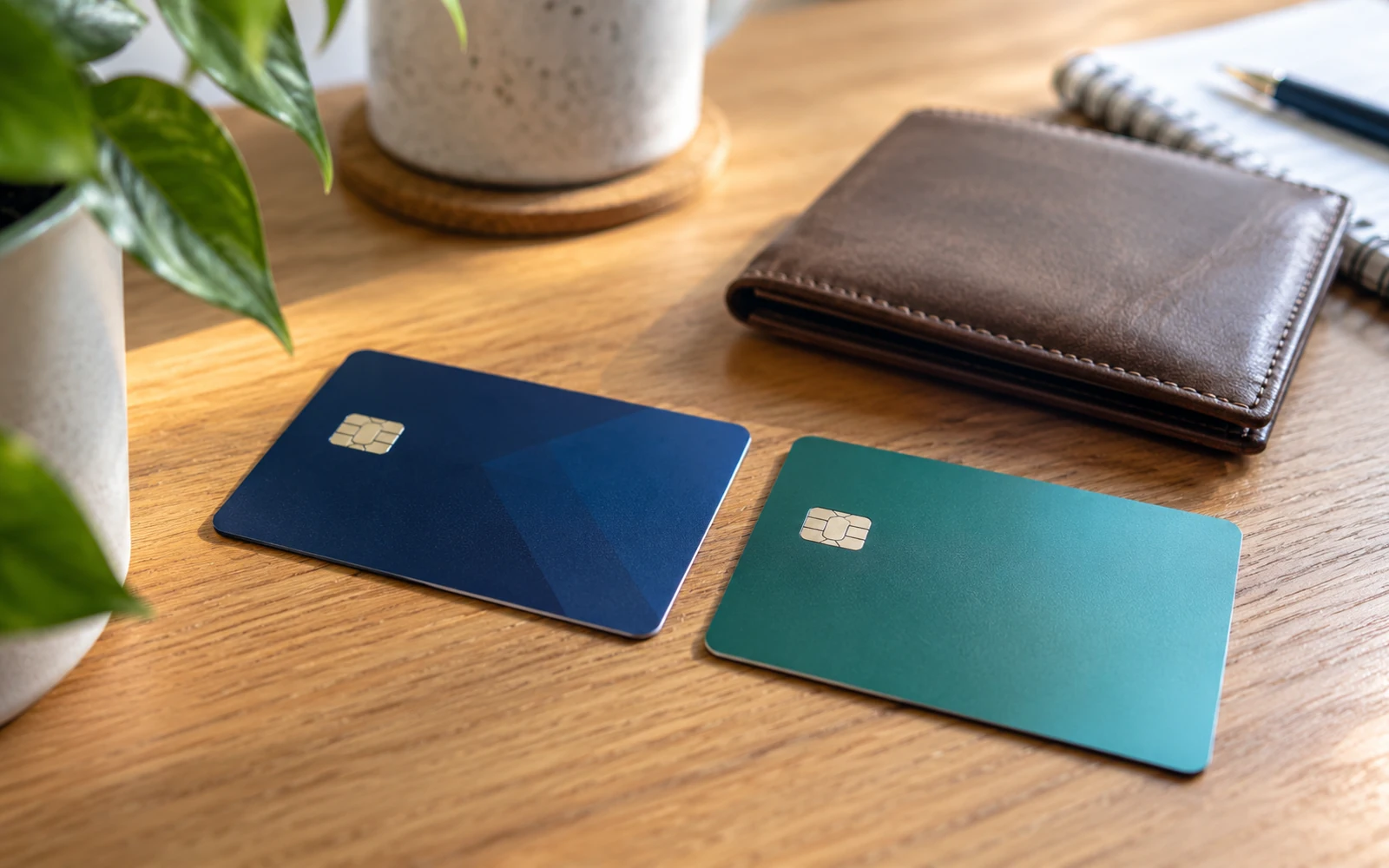
At first glance, they look almost identical. You can tap both cards at a payment terminal, use them for online purchases and usually add them to a mobile wallet. The difference becomes clear when you ask whose money you are actually spending. That determines repayment, interest and what the available limit shown in your banking app means.
With a debit card, you generally pay using money in your current account, whereas with a credit card, you use credit provided by the bank. A credit card is therefore not another account containing your own savings: any debt you incur must be repaid under the terms of the agreement. With some cards, you can avoid interest on purchases by paying the full amount on time, but this depends on the product terms. Both cards can work contactlessly and online.
Debit card: you primarily pay with your own money
A bank will usually issue a debit card with a current account. When you pay for a purchase, the amount is deducted from or temporarily held against the available balance in your account. If you have €250 in your account and pay €40, you will generally have €210 left for further everyday payments. Your app may show the booked balance and available balance separately, as card transactions may not be posted immediately.
An exception is an authorised overdraft: if you have one arranged, you can spend some borrowed money when using your debit card. A debit card therefore does not automatically guarantee that you will never go into debt. The terms of the particular account and its credit services are what matter.
Credit card: the bank provides you with a credit limit
With a credit card, payments are made from your credit limit. If your limit is €1,000 and you make a €100 purchase, you will generally incur a debt of €100 and your available limit will fall to around €900. Once you repay it, the credit limit becomes available again under the bank’s rules. This is not money you set aside in advance in your own account.
The bank regularly issues a statement showing the amount due, the minimum payment and the payment due date. The minimum payment is not the same as settling the entire debt. If you pay only the minimum, interest may continue to accrue on the remainder and the total cost may increase.
How the interest-free period works
Some credit cards offer an interest-free period for purchases. However, what matters is not only the number advertised, but also the requirement to repay the full amount owed by the specified deadline. The length of the period may depend on the purchase date and the statement closing date. If you have unpaid debt from a previous billing cycle, the interest-charging rules may be different.
The interest-free treatment of purchases may also not apply to cash withdrawals, transfers from a credit card or other special transactions. Before using the card, check the fee schedule, interest rate and specific exceptions. Foreign rules described in general articles may not be identical to the agreement with your Slovak bank.
What is different about withdrawing cash from an ATM?
When making a standard withdrawal with a debit card, you are withdrawing money from your account. A fee may apply, however, depending on the bank’s pricing, the type of ATM and the country. When withdrawing cash with a credit card, you are usually borrowing money in a way that may not come with the same benefits as an in-store purchase. In addition to a separate fee, interest may start accruing from the moment of withdrawal.
For this reason, you should not think of a credit card as a debit card with a larger balance. The same piece of plastic can be associated with entirely different costs. When paying in another currency, watch exchange rates and any currency-conversion offer at the terminal for both types of card.
Which card should you use to book a hotel or car?
Some hotels and car rental companies require a credit card for the security deposit, while others also accept debit cards. However, there is no universal rule requiring every rental company to accept every credit card. Before booking, check requirements concerning the cardholder’s name, the amount held, the type of card and the deposit refund terms.
With a debit card, a hold can temporarily reduce the money available in your account. With a credit card, it reduces your available credit limit. The practical effect is similar in both cases: while the hold is in place, you may not have that amount available for further payments.
How to read the terms before using a credit card
Find out whether the card has a monthly or annual fee and under what conditions it can be waived. Check the interest charged if you do not repay the full amount, the minimum payment, the cash-withdrawal fee and the rules for the interest-free period. It is also important to know whether the bank allows you to set up automatic payment of the full amount owed and what happens if there is not enough money in the account.
Imagine you pay €300 with a credit card. If you repay the full amount on time under the bank’s terms, the purchase may be interest-free. If you pay only part of it, the terms for charging interest on the remaining balance change. This example explains the mechanism, not the offer of a specific bank: check the current terms with your bank/insurance company.
Video: the basic difference between a credit card and a debit card
Educational materials from the National Bank of Slovakia link to a video comparing the use of your own funds with using credit. For specific fees and interest rates, always follow your bank’s current fee schedule.
The basic difference lies in where the money comes from, not in appearance
A debit card is linked to a current account, while a credit card is linked to a credit limit. Both can be useful in different situations, but a credit card comes with an obligation to monitor your statement and due date. Before deciding, do not focus only on the card’s colour or marketing benefits; also consider the source of the money, the repayment method and the overall fees.
This text is for informational purposes only and does not constitute financial advice.
Sources
- National Bank of Slovakia – Take care of your money: the difference between a debit and credit card – https://www.nbs.sk/_img/documents/_publikacie/ostatnepublik/staraj_sa_o_svoje_peniaze.pdf
- Consumer Financial Protection Bureau – How are prepaid cards, debit cards, and credit cards different? – https://www.consumerfinance.gov/ask-cfpb/how-are-prepaid-cards-debit-cards-and-credit-cards-different-en-433/
- Consumer Financial Protection Bureau – What is a grace period for a credit card? – https://www.consumerfinance.gov/ask-cfpb/what-is-a-grace-period-for-a-credit-card-en-47/
- National Bank of Slovakia – Workbook: Do you know how to use your payment card? – https://5penazi.sk/wp-content/uploads/2020/11/NBS_pracovny-zosit_Vies-pouzivat-svoju-platobnu-kartu.pdf

Gabriel Čatár
I'm interested in everyday things we encounter but don't always understand. From technology and personal finance to practical guides and fascinating facts about the world. At Offpitch, I focus on topics worth exploring in greater depth, checking the facts and explaining them in a clear, accessible way. My goal is to make sure readers take away something useful from every article.


