
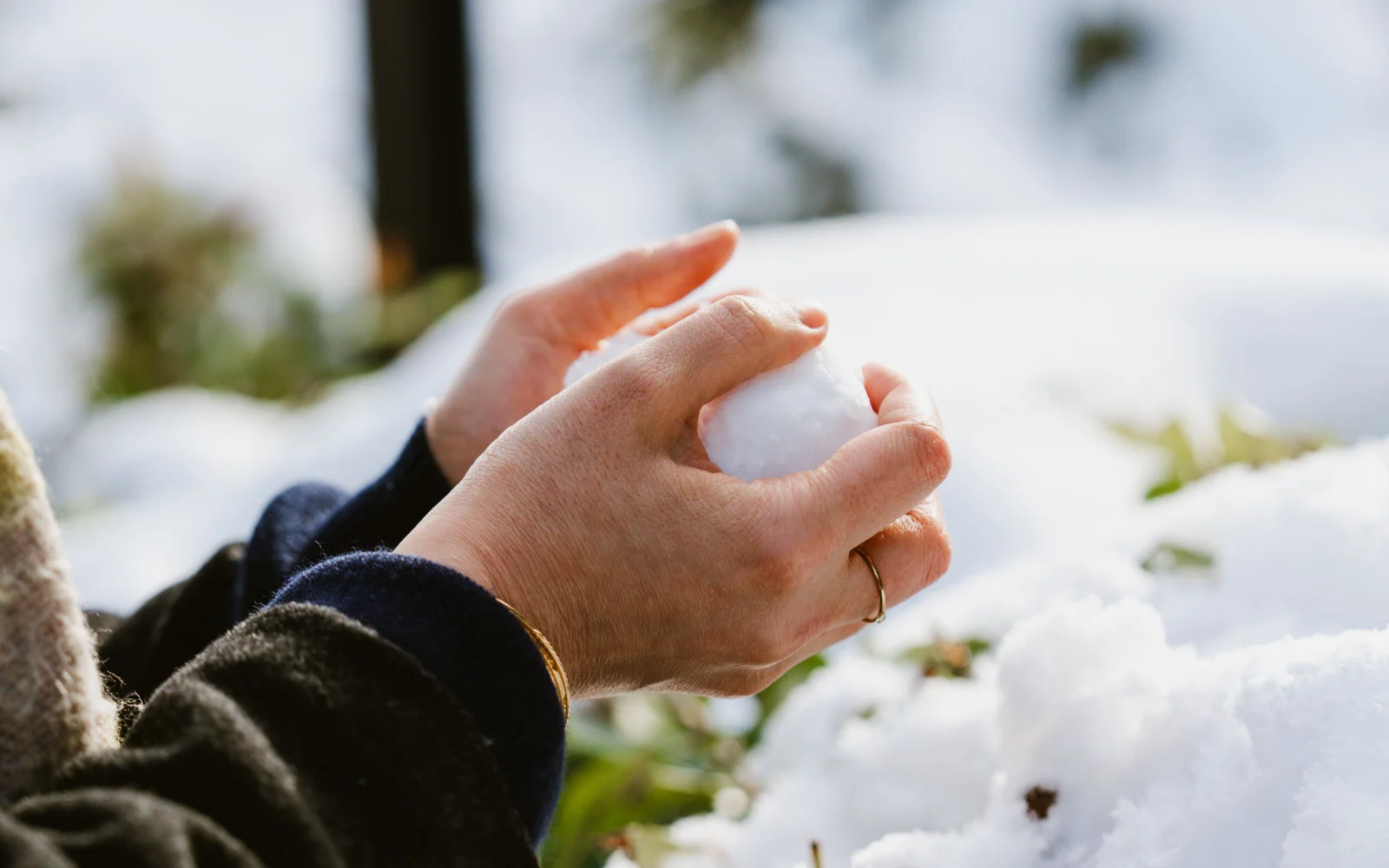
Sometimes you cannot make even a small ball from it; other times it clings to gloves, boots and a shovel like glue. The snow may not look very different, yet its behavior depends mainly on its temperature, the amount of liquid water between the grains, and how the individual ice crystals respond when compressed.
Snow is often sticky at temperatures close to freezing because it contains a small amount of liquid water. This creates tiny connections between the ice grains, allowing them to hold together when compressed. Very cold, dry snow tends to crumble, while overly wet snow turns into slush. Air temperature alone is not enough, however: what matters is the actual condition of the snowpack.
The difference is water, not some special variety of snow
Snow consists of ice crystals and air. The crystals can have different shapes and change while on the ground. When it is cold enough, there may be almost no liquid water between the grains. As a result, powder snow behaves differently when scooped up and compressed than wet snow after a thaw.
When the snow temperature approaches its melting point, a thin layer of water may appear on the surface of the grains. Where two grains touch, the water forms a meniscus: a curved surface that helps draw them together through capillary forces. It is similar to the principle by which a wet glass sticks to a surface. This does not mean that all the snow has melted and then immediately frozen again.
The Avalanche.org snow science encyclopedia distinguishes dry, moist, wet and very wet snow according to the amount of liquid water it contains. Moist snow can already be easily compressed into a ball. As the amount of water increases further, its behavior changes again. The term “sticky” therefore describes a particular range of conditions, not every situation in which the temperature is exactly 0 °C.
Why a snowball made from dry powder falls apart
If you reach into fresh powder during a hard freeze, the snow grains will often fall apart as soon as you open your hand. They do not contain enough liquid water to hold them together during brief compression. That does not mean dry snow cannot form strong bonds at all: ice grains can gradually bond even without liquid water.
This process is known as snow sintering. Ice bridges form between the grains and can grow over time. Crystal rearrangement, water-vapor transport and mechanical compaction all contribute. This is why even older dry snow can form a relatively cohesive layer, although fresh powder gathered in your hand will not hold together.
When making a snowball, however, you need results within seconds, not after hours or days. A small amount of water between the grains therefore makes a dramatic difference. When snow has the right moisture level, compressing it reduces air gaps, increases the number of contacts between grains and creates a compact shape.
What happens when there is too much water?
You may also have experienced the opposite extreme: wet snow initially sticks to your palm, but when squeezed more firmly, water runs out and the ball loses its shape. It is no longer ideal material for firm snowballs. Excess water fills the gaps between the grains, and the snow loses some of the properties of a solid, porous material.
Avalanche.org describes a gradual transition from moist snow through very wet snow to snow slush. Both the amount of water and whether it can move freely between the grains matter. If you can easily squeeze water out of the snow, it is not in the same state as a slightly moist, easily shaped snowball.
This kind of material is not only unpleasant on gloves. On roofs and trees, wet snow can be significantly heavier than light powder with the same snow depth and can therefore create a load. On steep slopes, the presence of water also changes the strength of the snowpack. However, you cannot determine slope safety from a simple snowball experiment; avalanche risk requires a separate expert assessment.
Why looking at the thermometer is not enough
The air may be one degree above freezing, while snow that has spent the entire night in the shade may still be cold and dry. Conversely, even in a light frost, the snow surface in a sunny spot can warm up and become wet locally. Previous weather, rain, sunlight and wind also play a role.
Snow grains also change shape after they fall. Fresh star-shaped flakes gradually lose their sharp points, clump together or form new bonds. Once snow freezes after a thaw, it can turn into a hard crust. So even if your phone shows 0 °C, that may not be enough to make a snowman.
The simplest home test is to gently scoop up clean snow, squeeze it briefly and see whether it holds its shape. If it crumbles, it is probably too dry or has an unsuitable structure. If water runs out of it, it is too wet. This is a practical observation, not a precise meteorological measurement.
Why wet snow also sticks to shovels and boots
The principle is similar to that of a snowball, but the surface of the material also comes into play. Water can create contact between wet grains and a sole, metal or plastic. If some of the water turns back into ice against a colder surface, the attachment can become even stronger. The result depends on the temperature of the shovel, its surface finish and the snow itself.
This does not mean there is a universal trick for every kind of wet snow. When clearing snow, it is wiser to use smaller loads because water increases the weight of the material being moved. If snow sticks to your tools, pushing harder will not always help: often, you are simply picking up too much heavy material at once.
A short answer for young snowman builders
The best snow for a snowman is snow that forms a firm ball when gently compressed but does not release water. You will usually find it during a thaw or at temperatures around freezing, but that is not guaranteed. A hard freeze often produces beautiful powder for skiing, but it is usually uncooperative for snowball fights. The difference is not explained by a secret ingredient: it comes down to the physics of ice, water and air.
Sources
- Avalanche.org – Water content (snow moisture levels and snowball formation) – https://avalanche.org/avalanche-encyclopedia/snowpack/snow-metamorphism/melt/water-content/
- Avalanche.org – Bonding (or Sintering) (formation of strong bonds between snow grains) – https://avalanche.org/avalanche-encyclopedia/snowpack/snow-metamorphism/bonding-or-sintering/

Gabriel Čatár
I'm interested in everyday things we encounter but don't always understand. From technology and personal finance to practical guides and fascinating facts about the world. At Offpitch, I focus on topics worth exploring in greater depth, checking the facts and explaining them in a clear, accessible way. My goal is to make sure readers take away something useful from every article.


