
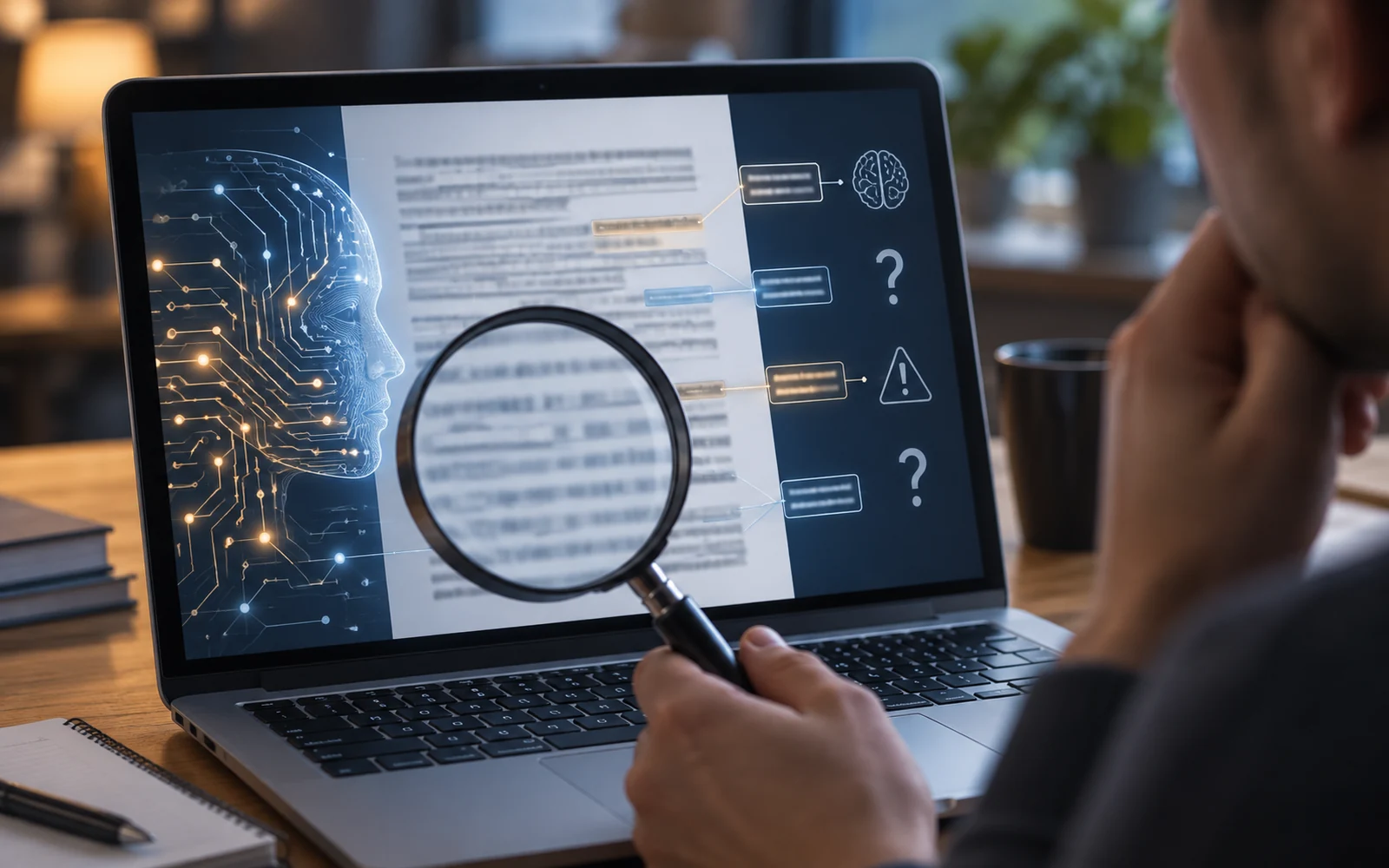
A teacher receives an unusually polished essay, a company receives a cover letter without a single mistake, and a reader comes across an article full of general statements. Is that proof that the text was created by artificial intelligence? No. Language models can now imitate many styles, while people may write very consistently, use templates, or revise their text with a grammar checker.
From a finished text alone, it is usually impossible to prove reliably whether it was written by a person or AI. Repeated phrases, perfect grammar, or an impersonal tone are only weak clues. Automated detectors are not conclusive evidence either: they may label human writing as machine-generated, and vice versa. It is more important to verify the facts, the origin of the source materials, the creation process, and the specific rules of the assignment.
Why a simple list of signs does not work
Guides circulating online claim that AI uses certain expressions, too many dashes, a perfect structure, or excessive summaries. The problem is that these features also appear in advertising copy, corporate documents, school assignments, and professionally edited articles. In addition, language models change, and a user can ask them to write in a more natural style. The supposed signs then disappear without the origin of the text changing.
Sometimes, conversely, a very clumsy or grammatically incorrect text seems suspicious. Yet that proves nothing either: mistakes can be made by a person, machine translation, or a language model given an unsuitable prompt. A trace in the form of a single word or punctuation mark therefore cannot support a conclusion about authorship.
There is a difference between an estimate and proof. You may notice that five articles use the same outline, nonsensical examples, and repeated wording. That may justify further review of the editorial process, but not an automatic accusation that a particular author has committed fraud. The same template may have been prescribed by an editor or teacher.
What an AI detector actually does
A text detector attempts to estimate whether a sample resembles the output of a generative model. It works with statistical patterns or its own learned recognition system. The result may be a percentage, a verbal label, or highlighted passages. However, such output is not a digital signature of the author and usually does not show a direct record of how the text was created.
In January 2023, OpenAI introduced its own AI text classifier, but withdrew it in July 2023 because of its low accuracy. In its original testing, it identified only some genuinely machine-generated texts as likely machine-written, while also incorrectly labeling texts written by people. These historical figures are not a measure of the accuracy of all current detectors, but they clearly illustrate the risk that every similar tool must address.
The length and language of the sample also matter. A short headline or paragraph provides little information. Moreover, a detector trained mainly on English cannot be considered reliable for Slovak without independent testing. If a service claims that it can “detect 100% of AI texts,” examine how that promise was verified, when the tests were conducted, and which group of texts was used to measure it.
Why detectors can harm honest authors
Research published in the journal Patterns in 2023 highlighted a problem involving English texts by people whose native language is not English. Several detectors more often incorrectly classified their work as AI-generated. The conclusion applies to the tools, languages, and conditions studied, not automatically to every application on the market. However, it is crucial when detectors are used in schools or in hiring.
Imagine a student who uses simple sentences because they are still learning a foreign language. A machine tool may label such writing as too predictable, even though it was produced honestly. If a teacher reaches a disciplinary conclusion based only on the resulting percentage, they are confusing an uncertain technical estimate with evidence of a person's conduct.
A similar problem arises with texts revised by a proofreading tool, translation service, or corporate template. Moreover, the question “Did the author use AI?” needs a definition: does it mean automatic typo correction, rephrasing one sentence, research, or creating the entire work? Without clear rules, it is impossible to assess fairly what was actually supposed to happen.
What can be more useful than a detector percentage
For a school or work text, it helps to examine the process. A genuine author can often explain their arguments, defend their choice of sources, describe their method, and show notes or earlier versions. These signs are not absolute proof either: a person may work without saving drafts along the way, and a prepared cheater can fabricate records. However, they provide more context than a single automated result.
In an editorial setting, it is particularly worthwhile to check claims, citations, dates, and links. Machine-generated text may contain correct information, and a human author may make mistakes; origin is therefore no substitute for fact-checking. If an article refers to a scientific study, verify that it actually exists and supports the stated conclusion. Fabricated citations are an editorial problem regardless of who created the text.
If an organization needs to regulate the use of AI, it should establish clear rules and proportionate verification in advance. Different requirements make sense for a personal essay, a technical guide, and texts in which the assistance of digital tools is explicitly permitted. Changing the rules retrospectively after work has been submitted would create unnecessary disputes.
Can AI-generated text be identified by non-existent sources?
A non-existent book, an invented section number of a law, or a link to a page that never contained the claimed information are reasons to take notice. However, they are not an unambiguous AI signature. An author may have recorded a citation incorrectly, a link may have moved, or they may have copied information from another website without checking it. What matters is verifying the specific fact and correcting the error.
Likewise, perfect references do not prove human authorship. A language model can be given genuine documents and produce a text based on them. A person may then check everything thoroughly. In that case, the issue is transparency under the rules of the assignment and the quality of the output, not the search for a magical list of suspicious words.
What to do if a detector labels your own text as AI
First, keep the original text, the assignment, and any available version history. Check which tool produced the result, which language it is intended for, and what its percentage means. You can ask the evaluator to explain the procedure, allow you to provide evidence of your work, and arrange an independent assessment. Do not mechanically change word order simply to make an unknown app show a green result.
If you did in fact use AI assistance, the specific rules of the school, workplace, or commission are what matter. In some places, language proofreading is allowed; elsewhere, even help with an outline must be disclosed; and in other cases, the work must be entirely independent. You can disclose the exact extent of the assistance without devaluing all of your own effort.
In 2026, the most accurate answer to the question of identifying AI text remains caution: a detector can serve as a prompt for review, but not as a verdict on its own. Authorship should be decided on the basis of multiple pieces of evidence, and a text's quality should be assessed by what it actually contains.
Sources
- OpenAI – New AI classifier for indicating AI-written text (announcement of the tool’s withdrawal and its limitations) – https://openai.com/index/new-ai-classifier-for-indicating-ai-written-text/
- Patterns – GPT detectors are biased against non-native English writers – https://doi.org/10.1016/j.patter.2023.100779

Gabriel Čatár
I'm interested in everyday things we encounter but don't always understand. From technology and personal finance to practical guides and fascinating facts about the world. At Offpitch, I focus on topics worth exploring in greater depth, checking the facts and explaining them in a clear, accessible way. My goal is to make sure readers take away something useful from every article.


