
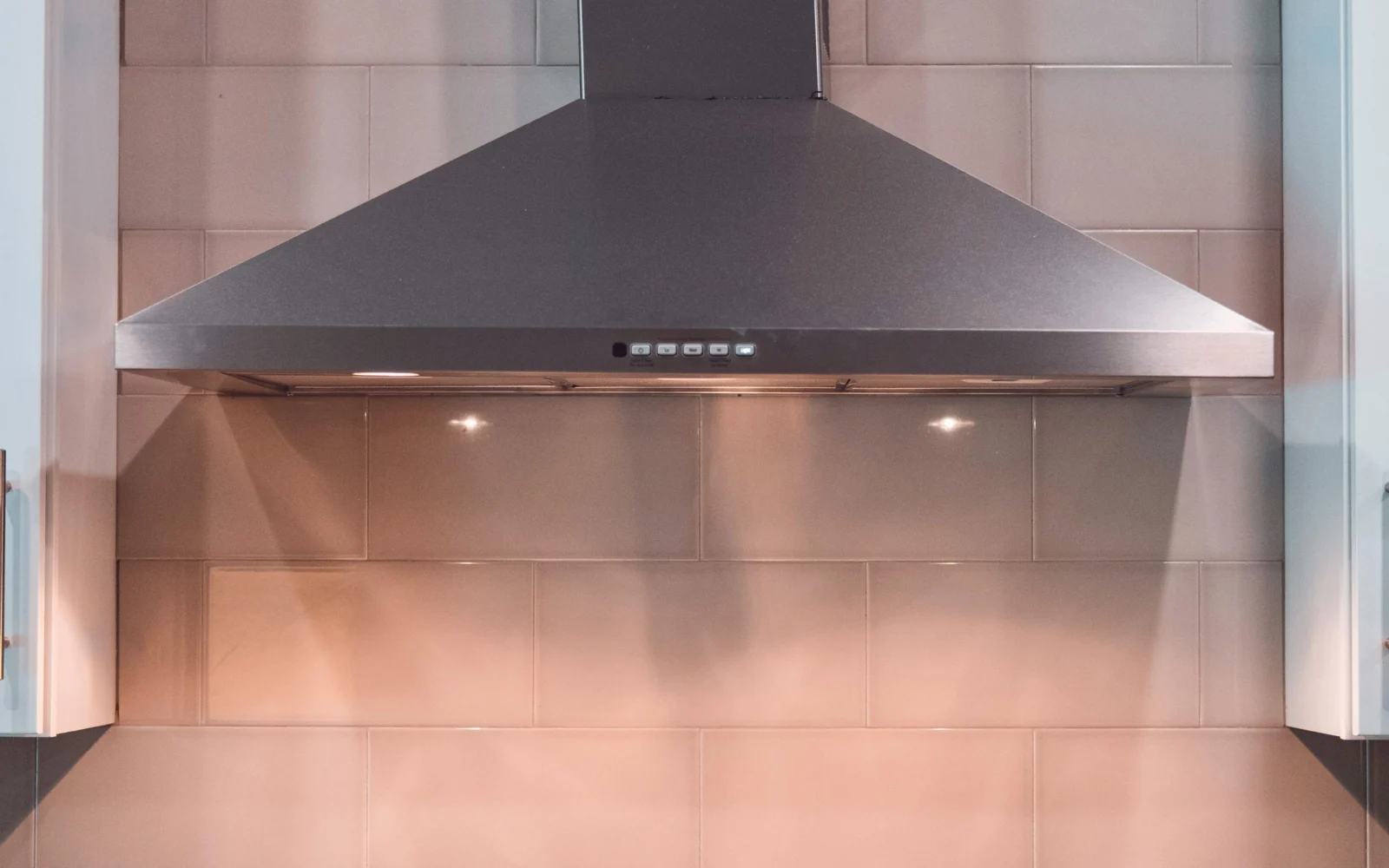
A range hood may look clean, yet leave a sticky film on your fingers when you touch its lower edge. Grease collects not only on the metal grille, but also around the filter, controls and cabinet surface. Regular maintenance is not just about appearance: a clogged filter impairs airflow, and grease creates an unwanted buildup while cooking.
Clean a greasy range hood only after switching it off and allowing it to cool, and first consult the instructions for your specific model. Wash the removable metal grease filter using a method approved by the manufacturer, wipe the surface with a mild degreasing solution and dry it thoroughly. A carbon odour filter requires different care: not every one can be washed or regenerated. Never pour water onto electrical or motor components.
First, find out which type of range hood you have
A ducted range hood vents air outdoors through ducting. A recirculating hood filters the air and returns it to the room. Bosch explains that a grease filter is used to capture grease in both cases, while recirculating operation also requires an odour filter. This difference determines the maintenance required and what you can expect from a freshly cleaned appliance.
If you are unsure about the filter type, check the model label and manual. The metal mesh is often removable and washable, whereas a standard carbon filter is usually designed to be replaced. The manufacturer may also offer special regenerable versions, which have a specific procedure. Do not apply instructions intended for a metal grille to these filters.
In addition to a clogged filter, a ducted range hood may have an issue with the ducting, backdraft damper or air supply. Cleaning visible parts may therefore not eliminate every cause of weak extraction. Consult a professional before dismantling built-in components.
Preparing the work area safely
Switch the appliance off and allow it to cool. If its design and instructions allow it, disconnect it from the power supply. Place a cloth or paper beneath the hood to catch drips and loosened grease. Do not start cleaning immediately while cooking, when the filters and surrounding surfaces are hot.
Prepare a soft cloth, a soft brush, a container of water and a product approved for the relevant surface. Harsh abrasives can scratch stainless steel, painted finishes and glass. A strongly alkaline oven cleaner may be unsuitable for aluminium components, so do not automatically use it on everything that is greasy.
Some grease filters have sharp edges. Hold them with both hands when removing them and follow the catches specified in the manual. If the filter does not release easily, do not pry it loose with a knife. The loosened part could become deformed, or you could damage its mounting.
How to wash a metal grease filter
Bosch states in its guide that the grease filters in its range hoods are dishwasher-safe. However, this cannot be assumed without checking for every older or different model. Before using a dishwasher, make sure the manufacturer permits it and check which programme it recommends. The appearance of some metals may change without significantly affecting their function, but the specific instructions must be followed.
For hand-washing, use warm water and a suitable degreasing product. Soak the filter only for as long as the instructions permit, then gently clean both sides. Do not try to scrub every opening with a hard metal brush: damaged mesh may not fit properly and may fail to capture grease effectively.
Rinse the filter thoroughly after washing and allow it to dry completely. Do not put a wet grille back in place assuming that the running fan will dry the remaining water. Especially with a range hood above a gas cooktop, make sure the filter is securely fastened and that all components are in place before cooking again.
Cleaning the underside, controls and cabinet
Once the filter is removed, you can see the greasy edges of the opening and surfaces that are inaccessible during routine wiping. Use a soft damp cloth to remove visible residue from the surface. Do not soak control buttons, electrical contacts, lighting or internal wiring. Liquid could reach areas that are not intended for wet cleaning.
For stainless steel, test the cleaner in an inconspicuous spot and wipe in the direction of the grain. With painted parts and glass, it is important to avoid abrasive powder and metal scouring pads. If the product leaves streaks, wipe away any residue with a clean, slightly damp cloth and dry the surface.
Do not forget the lower edge of the kitchen cabinet, the handles and the area behind the control panel, if it can be accessed safely. Grease settles outside the grille itself as well during extraction. However, do not insert brushes or spray cleaners into the inaccessible motor compartment; substantial buildup inside calls for servicing.
What about the carbon filter?
A carbon filter primarily deals with odours during recirculating operation, rather than basic grease capture. Bosch distinguishes between standard odour filters and longer-lasting regenerable variants. Depending on the type, a standard filter is replaced rather than washed together with the metal filter. Only a filter whose instructions explicitly allow it may be regenerated.
If the range hood still sends odours back into the kitchen after the metal filter has been washed, the odour filter may be saturated. Replacing it may not be necessary in every ducted system; check the operating type. Buying a universal insert without checking compatibility can result in poor performance or incorrect fitting.
How often should you clean a range hood?
There is no single interval for every household. Much depends on how often you fry food, your cooking habits, the filter type and the manufacturer's recommendation. The most practical approach is to monitor buildup and any filter-saturation indicator. If a noticeably sticky coating forms on the filter mesh, do not wait for the annual deep-cleaning day.
A quick, regular wipe of the exterior is easier than removing old, dried-on grease. If it has been neglected for a long time, repeat the process rather than replacing pressure on the cloth with a scraper. The goal is a clean, undamaged component, not a perfectly polished surface at the cost of ruining its finish.
When cleaning is not enough
Weak performance despite clean filters, unusual noise, overheating, a tripped circuit breaker or an electrical burning smell are not reasons to continue dismantling the appliance. Switch it off and arrange for a professional inspection. With a ducted range hood, the cause may be outside the visible part, for example in the ducting or backdraft damper.
Refitting all parts correctly is also essential for proper operation. Check that the filter is secured, the lighting works and the hood operates correctly according to the manual. If the range hood does not extract steam even after maintenance, the next step is diagnosis, not the use of increasingly aggressive chemicals.
Sources
- Bosch – Range hoods: installation and frequently asked questions (cleaning and operating modes) – https://www.bosch-home.com/sk/produkty/varenie-a-pecenie/odsavace-par/instalacia-caste-otazky
- Bosch – Range hood buying guide (grease and odour filters) – https://www.bosch-home.com/sk/produkty/varenie-a-pecenie/odsavace-par/sprievodca-odsavace-par

Gabriel Čatár
I'm interested in everyday things we encounter but don't always understand. From technology and personal finance to practical guides and fascinating facts about the world. At Offpitch, I focus on topics worth exploring in greater depth, checking the facts and explaining them in a clear, accessible way. My goal is to make sure readers take away something useful from every article.


