
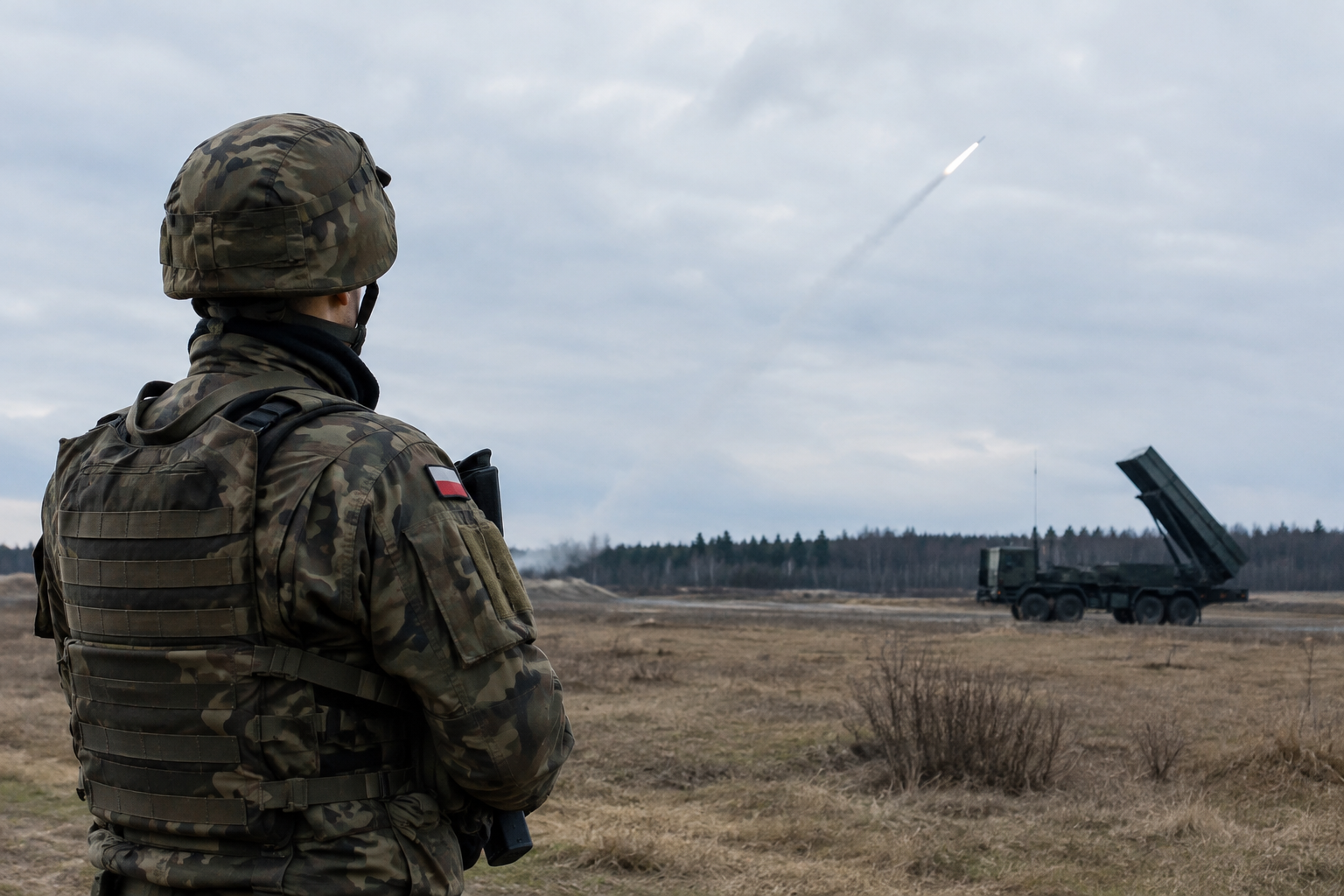
Polish authorities are investigating the impact of three Russian objects in the country’s southeast during the night of 20 November 2026. The incident occurred amid a large-scale Russian air attack on Ukraine. Prime Minister Donald Tusk subsequently spoke by phone with NATO Secretary General Mark Rutte and announced talks on strengthening security on the alliance’s eastern flank.
One object has been confirmed as a Russian Kh-101 cruise missile. Polish authorities have provisionally described the second as another missile and the third as a likely jet-powered drone. No one was injured, and no damage to critical infrastructure was reported. Contact with NATO does not automatically mean Article 5 will be invoked or that a collective military response will begin.
What landed on Polish territory
The three impact sites are near the towns of Nowy Lipowiec, Rudnik nad Sanem and Mołodycz in southeastern Poland. The area is closer to the Ukrainian border, where Poland’s air defences closely monitor the airspace during Russian attacks on Ukraine.
According to Poland’s Ministry of National Defence and National Security Bureau, a Russian Kh-101 missile was identified in Nowy Lipowiec. So far, it is the only one of the three objects for which authorities have released an unambiguous identification of the specific type.
According to preliminary findings, the object found near Rudnik nad Sanem was another missile. Authorities provisionally consider the third object, which landed near the village of Mołodycz, to be a jet-powered drone. The investigation into their exact type is continuing, so it is not yet accurate to speak of two definitively identified missiles and one confirmed drone.
Tusk said the objects’ Russian origin had been confirmed. Questions remain over the exact type of two of them, their flight path and the circumstances in which they entered Polish airspace. The Polish government is also considering the possibility of a deliberate provocation, but this is an assessment by the country’s officials rather than a final conclusion of the investigation.
The government also mentioned a possible link to a Coalition of the Willing military exercise near Nowa Dęba. However, it described that connection only as a hypothesis. The available findings therefore do not yet make it possible to conclude whether the objects were headed for a specific target in Poland or entered its territory for another reason.
Allies also took part in protecting the airspace
Polish F-16 fighter jets and Swedish Gripens were airborne during the incident. They were supported by a Dutch aerial refuelling aircraft and a Polish Saab early-warning aircraft. Patriot, Poprad and Pilica+ ground-based air-defence systems were also activated.
The deployment of several types of equipment shows that protecting Polish airspace is no longer solely a national task. Poland is part of NATO’s joint defence system and also uses allied aircraft and other capabilities to monitor the eastern flank.
Polish authorities reported no injuries or damage to critical infrastructure. That does not diminish the event’s security significance: three foreign military objects entered the airspace of a NATO member state and landed on its territory. In addition to identifying the debris, investigators must reconstruct their flight and assess how the objects were detected by defence systems.
Why Tusk called the NATO Secretary General
Donald Tusk contacted Mark Rutte because the incident directly affected the territory of an alliance member. Poland wants to discuss specific ways of strengthening security on the eastern flank with its allies, particularly the capabilities needed to detect and stop missiles and drones.
NATO can increase the number of fighter jets in the region, deploy additional reconnaissance aircraft or reinforce ground-based air defences. Such measures do not require the alliance to declare the incident an armed attack or invoke Article 5. They are defensive steps NATO can take in response to growing risks at its borders.
The phone call between Tusk and Rutte itself does not constitute a formal invocation of Article 4. This article of the North Atlantic Treaty allows a member state to request consultations of the North Atlantic Council if it believes its territorial integrity, political independence or security is under threat.
As of 21 November, it had not been confirmed that Poland had formally invoked Article 4 over the incident. Consultations with allies and talks on additional defences can take place without such a step. Article 4 does not automatically send troops into combat; it provides a framework for jointly assessing the situation and agreeing on further measures.
Why Article 5 is not triggered automatically
Article 5 governs collective defence following an armed attack against one or more NATO members. However, not every border violation, flight of a military object or impact of debris is automatically declared to be an armed attack.
The circumstances are assessed individually. What matters is what happened, what consequences the incident caused, and what the investigation determines about its origin and intent. The state under attack must also request or agree to collective assistance. Even the invocation of Article 5 does not mean that all allies must respond with the same military measures; each takes the action it considers necessary to restore security.
At this stage, Poland is focusing on identifying the objects, establishing the circumstances of the airspace violation and strengthening its defences. No decision has been confirmed that the incident constituted an armed attack within the meaning of Article 5.
What the incident means for Central Europe
The impact of the objects in Poland increases the importance of air defence across NATO’s eastern flank. Missiles and drones used in attacks on Ukraine may also pose a risk to neighbouring states, whether through deliberate deployment, a navigation error or other circumstances. The investigation is to determine which explanation applies in this case.
For Slovakia and other countries in the region, the key issue is the joint monitoring of airspace and the ability to rapidly integrate data from radars, early-warning aircraft, fighter jets and ground-based systems. Defending against low-flying missiles and smaller drones requires multiple layers of protection; no single type of system can cover every possible threat.
The incident does not mean that NATO has entered a direct conflict with Russia. However, it shows why Poland is seeking additional defensive capabilities and why protection against drones and missiles has become a shared concern for countries in Central and Eastern Europe. Further conclusions will depend on the results of debris analysis and the reconstruction of the flight paths of all three objects.
Sources
- Office of the Prime Minister of Poland – Russian objects violated Polish airspace. Another stage of Russian escalation: https://www.gov.pl/web/premier/rosyjskie-obiekty-naruszyly-polska-przestrzen-powietrzna-kolejna-odslona-rosyjskiej-eskalacji
- Polish Ministry of National Defence – Deputy Prime Minister W. Kosiniak-Kamysz on the violation of Polish airspace: https://www.gov.pl/web/obrona-narodowa/wicepremier-w-kosiniak-kamysz-o-naruszeniu-polskiej-przestrzeni-powietrznej
- Polish National Security Bureau – Violation of Polish airspace. Commentary by the Head of the National Security Bureau: https://www.bbn.gov.pl/pl/wydarzenia/10584,Naruszenie-polskiej-przestrzeni-powietrznej-Komentarz-Szefa-BBN.html
- NATO – The consultation process and Article 4: https://www.nato.int/en/what-we-do/introduction-to-nato/the-consultation-process-and-article-4
- NATO – Collective defence and Article 5: https://www.nato.int/en/what-we-do/introduction-to-nato/collective-defence-and-article-5

Marcel Macko
I’m most interested in technology, the internet, bizarre news, and stories that make you stop and think, “There’s no way this can actually be true.” I follow what’s happening both at home and around the world and pick the topics I think are worth paying attention to. On Pitchoviny, I try to present them simply, factually, and without unnecessarily sensational headlines.


