
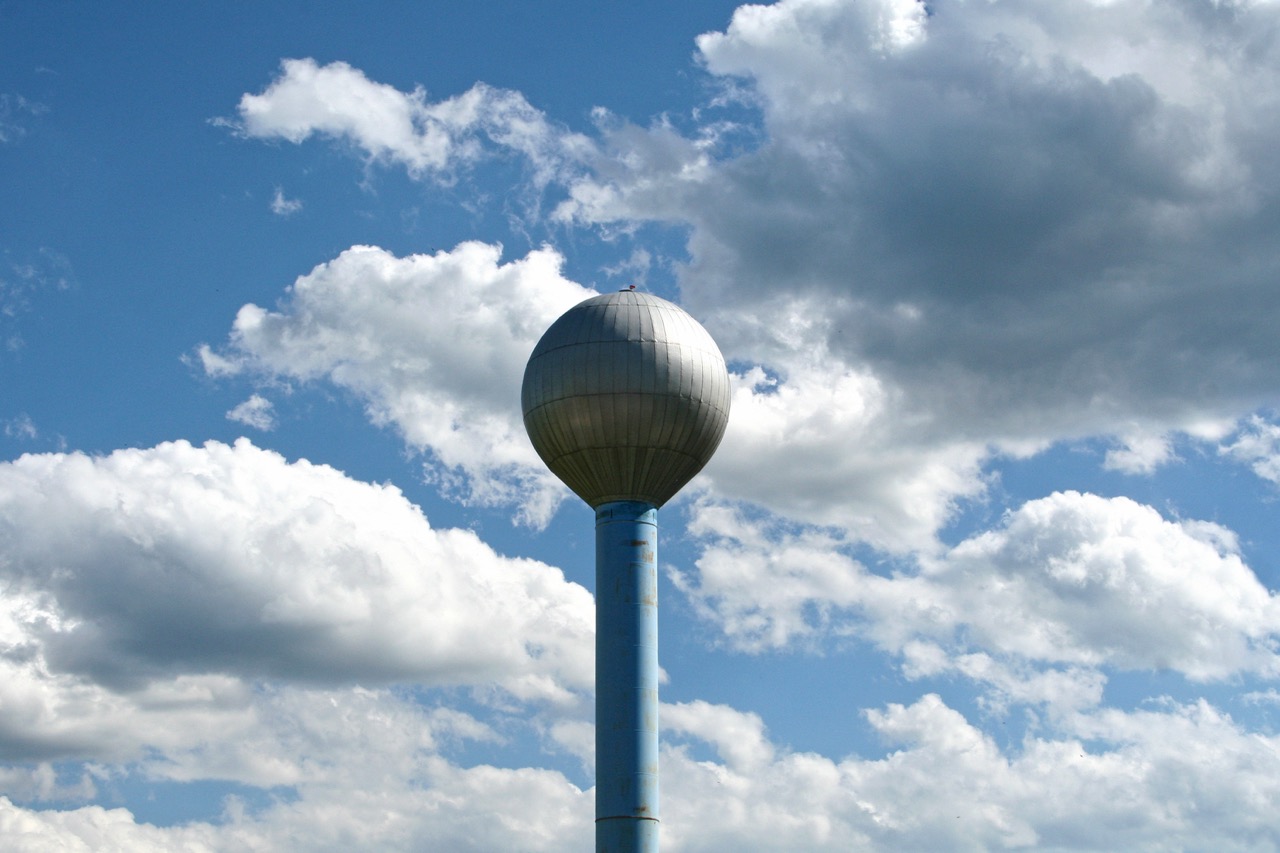
A spherical water tower is a type of elevated reservoir that most people picture as a large ball or ball-shaped tank mounted on a tall support column. In reality, it is not merely an unusual piece of engineering or an interesting landscape feature. It is an important part of water infrastructure, helping supply homes, businesses, and municipalities with water at a stable pressure.
A spherical water tower stores water while also helping maintain pressure in the water distribution network. Water is pumped into it mainly during periods of lower demand and can flow back into the network when demand rises. The number of milliliters it contains depends on the capacity of the particular reservoir. For example, 150 m³ equals 150,000,000 ml of water.
What is a spherical water tower?
A spherical water tower is an above-ground reservoir, most commonly made of steel or reinforced concrete, with a tank that is spherical or roughly spherical in shape. It often stands on a tall supporting structure, placing the water above the surrounding terrain. This height is very important because water stored at a higher elevation can use gravity to create pressure in the pipes.
At first glance, a spherical water tower looks simple: a column topped by a large round tank, often with a ladder, maintenance platform, or antennas around it. Inside, however, it is a piece of technical equipment connected to the water distribution network. It has inlet and outlet pipes, valves and fittings, safety devices, level gauges, ventilation, and maintenance access. It is therefore not simply a “ball filled with water,” but part of a system designed to provide a reliable water supply.
The spherical shape has been used for water towers mainly because it is structurally efficient. For the same capacity, a sphere has less surface area than many other tank shapes, water pressure is distributed more evenly, and a steel structure can have an elegant, clean technical appearance. In practice, cylindrical, conical, underground, and multi-chamber reservoirs are also used. A sphere is only one possible shape, but it is among the most distinctive.
What is a spherical water tower used for?
A spherical water tower performs several functions at once. Put simply, it is a water reservoir that balances the difference between how much water is pumped into the system and how much people are using at any given time. Water consumption is not constant throughout the day. Demand tends to be higher in the morning, in the evening, and on hot days, while it is often lower at night.
When consumption is low, pumps can refill the reservoir. When consumption is high, water from the reservoir helps meet the increased demand. This means the pumps do not have to respond abruptly to every change in consumption, allowing the entire system to operate more smoothly. The reservoir therefore helps protect equipment, stabilize operations, and reduce the risk of interruptions to the water supply.
Its second major function is maintaining pressure. Water stored at an elevated level has potential energy and naturally flows downward. A water tower can therefore help maintain pressure in the pipes even when the pumps are not operating at full capacity. It is not an unlimited source of water because it must be refilled, but it can be very useful during short-term fluctuations, equipment failures, or power outages.
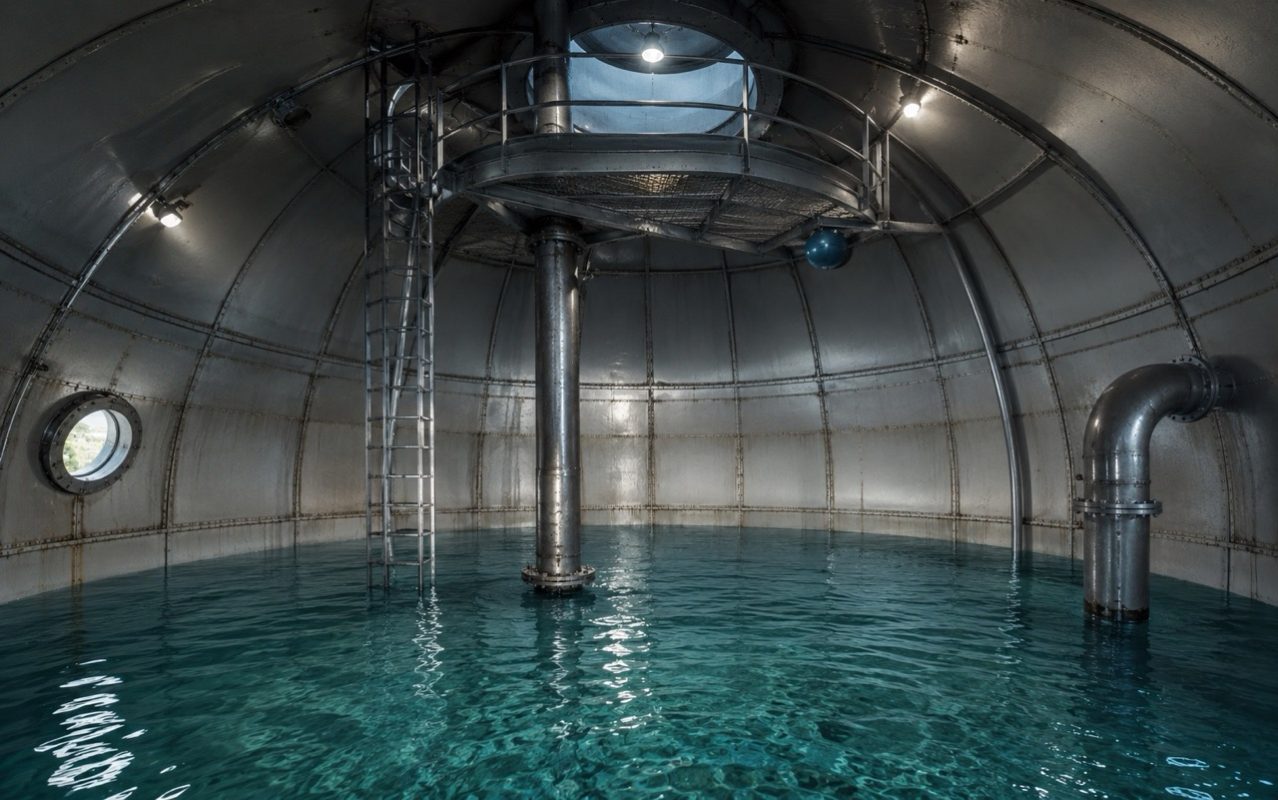
Why is a water tower built so high?
The height of a water tower is not arbitrary. The higher the water level is above the point of use, the more pressure the water can generate in the pipes. As a simplified rule, approximately 10 meters of water-column height corresponds to about 1 bar of pressure. If the water level in the tower is 30 meters above a consumer, for example, it can help generate roughly 3 bars of pressure, excluding pipe losses and variations in terrain.
Elevated water towers are therefore used mainly where it is not possible or practical to place a reservoir on naturally high ground. In hilly areas, a similar function can be performed by an underground or partially buried reservoir built on a hill. On flat terrain, however, the water must be raised artificially, which is precisely the purpose of an elevated water tower.
Height also helps divide a water distribution network into pressure zones. A municipality or city may not have the same elevation throughout, so pressure could be too low in some places and unnecessarily high in others. Reservoirs, pumping stations, and control devices therefore work together to create a system that delivers water safely and at an appropriate pressure.
How many milliliters of water does a spherical water tower hold?
There is no single universal answer to how many milliliters of water a spherical water tower holds. It depends on the internal capacity of the particular reservoir. Water tower capacity is normally stated in cubic meters or liters, not milliliters. Milliliters are impractical for such large volumes because the resulting numbers are enormous.
The conversion is very simple:
1 m³ of water = 1,000 liters
1 liter = 1,000 ml
1 m³ of water = 1,000,000 ml
This means that a reservoir with a capacity of 150 m³ can contain up to 150,000,000 ml of water. A 500 m³ reservoir holds 500,000,000 ml. Larger reservoirs can contain hundreds of millions or even billions of milliliters.
Examples of converting water tower capacity to milliliters
A smaller reservoir with a capacity of 50 m³ can hold 50,000 liters, or 50,000,000 ml of water. A 100 m³ reservoir can hold 100,000 liters, or 100,000,000 ml. If an elevated water tower has a capacity of 150 m³, it can hold 150,000 liters, or 150,000,000 ml of water.
In larger municipalities or water supply systems, a reservoir might have a capacity of 500 m³. That equals 500,000 liters, or 500,000,000 ml of water. A reservoir with a capacity of 1,000 m³ would hold 1,000,000 liters, or 1,000,000,000 ml. These figures clearly show why cubic meters rather than milliliters are used in technical practice.
How can the capacity of a spherical water tower be calculated?
If the reservoir were a perfect sphere, its volume could be calculated using the formula for the volume of a sphere:
V = 4/3 × π × r³
In this formula, V represents volume and r is the sphere’s internal radius. If the diameter is known, the radius is obtained by dividing it by two. For water towers, the internal dimensions of the tank are what matter, because the external diameter also includes structural material, insulation, or cladding.
Imagine a spherical water tower with an internal diameter of 7.5 meters. Its radius is 3.75 meters. Substituting this into the formula gives a volume of approximately 220.9 m³. That is about 220,900 liters of water, or approximately 220,900,000 ml. In reality, however, the usable capacity may be slightly lower because the tank may not be filled completely to the top and technical components may occupy part of the space.
Why capacity may not equal the current amount of water
When a reservoir is said to have a capacity of 150 m³, this does not mean it contains exactly 150,000,000 ml of water at all times. This figure represents its maximum or design capacity. The actual water level changes throughout the day depending on consumption, pumping, and operating conditions.
The reservoir may be refilled at night, its level may fall in the morning due to higher demand, and it may be adjusted again during the day. Water utilities monitor water levels, pressure, and quality to ensure that the water in the tank is regularly replenished and does not remain stagnant for too long. With drinking water, capacity alone is not enough; the water must also remain safe for consumption.
Is the water in a water tower safe to drink?
If the water tower is part of a public drinking water system, the water inside should be potable and must meet drinking water quality requirements. The reservoir stores water that has already been treated; it is not usually where the main water treatment takes place. Treatment occurs beforehand, for example at the water source or a water treatment plant.
The reservoir must nevertheless be kept hygienically secure. Watertight construction, protection against contaminants, proper ventilation, regular inspections, maintenance, and cleaning are all important. If water remains in the tank for too long or contaminants enter the system, its quality may be affected. Water tower management therefore involves not only capacity and pressure, but also water turnover and operational hygiene.
Not every spherical water tower is necessarily intended for drinking water. Some tanks may store process water, firefighting water, or water for industrial purposes. However, conventional elevated municipal water towers are generally part of the drinking water supply system.
Why are some water towers spherical?
A sphere is an interesting shape from an engineering perspective. In tanks exposed to pressure, it is beneficial for forces to be distributed evenly. A spherical or approximately spherical shape is therefore a natural choice for tanks that must hold large amounts of water while withstanding internal pressure, wind, temperature changes, and their own weight.
Another advantage is the ratio of volume to surface area. For a given volume, a sphere has a very small surface area compared with many other shapes. Less surface area can mean less material, a smaller area to maintain, and reduced thermal effects. In practice, however, manufacturing costs, assembly methods, material availability, project requirements, and local conditions also influence the choice.
Spherical water towers are also prominent landmarks. On flat terrain, they can be seen from a great distance and often become part of the visual identity of a municipality or urban district. Today, some are viewed not only as technical structures but also as architectural landmarks, even though their original purpose was entirely practical.
What happens inside a water tower during the day?
The water level in a water tower fluctuates throughout the day. When people get up in the morning, shower, cook, run washing machines, or prepare to leave for work, water consumption rises. The reservoir then helps meet this increased demand. Without water storage in the system, pumps would have to be sized for the highest demand peaks and would operate under much greater strain.
The reservoir is refilled during periods of lower consumption. This often happens at night or during off-peak hours. The cycle benefits the water distribution network by balancing differences between water production, pumping, and consumption. It also creates a reserve for unexpected situations, such as a broken pipe, pump failure, or increased water demand during a fire.
A water tower is not merely a passive container. The operator monitors its condition and adjusts pumping as needed. Modern water supply systems may remotely monitor levels, pressure gauges, flow rates, and alarms. This allows the operator to quickly detect an unusually rapid drop in the water level or a problem in the network.
Can a spherical water tower supply a municipality during a power outage?
Yes, but only to a certain extent. A major advantage of an elevated reservoir is that water can flow from it into the network by gravity. If the power goes out and the pumps stop working, the water tower can continue helping maintain the water supply and pipe pressure for a certain period.
How long this reserve lasts depends on the amount of water in the reservoir, the size of the municipality, current consumption, and the network’s technical design. A small reservoir may empty quickly when demand is high, while a larger one provides a longer reserve. However, if the outage continues and there is no way to refill it, the stored water will gradually run out.
This is why a water tower is important primarily as a balancing and safety component of the system, not as an independent, unlimited source of water. Its water must come from a source, treatment plant, or pumping station. The reservoir helps make the supply more stable, but the entire water system depends on several components working together.
How can you visualize the amount of water in a water tower?
When expressed in milliliters, the figures for water towers sound almost absurd. A standard bottle of water holds 1.5 liters, or 1,500 ml. A 150 m³ reservoir holds 150,000,000 ml of water. That is equivalent to approximately 100,000 1.5-liter bottles. A 500 m³ reservoir would hold roughly the equivalent of 333,000 such bottles.
It is even easier to visualize a water tower’s capacity in liters. A volume of 150 m³ equals 150,000 liters of water. Based on the average daily consumption of a household, that volume could meet the needs of many households for at least a certain period, although the exact number depends on the number of people, type of housing, season, and local habits. In practice, a reservoir is not designed to remain full and then empty all at once, but to meet the needs of the entire water distribution network.
A spherical water tower is more than a landscape feature
A spherical water tower may look simple, but it plays a major role. It stores water, balances demand, helps maintain pressure, and creates a reserve for unexpected situations. Its height allows it to use gravity, one of the most reliable principles in water infrastructure. Even though modern systems use pumps, sensors, and automation, elevated water storage still has an important place.
The number of milliliters it contains depends on its capacity. The simple conversion to remember is that every 1 m³ equals 1,000,000 ml of water. A 150 m³ reservoir therefore holds 150 million ml of water, while a 500 m³ reservoir holds 500 million ml. A perfectly spherical water tower with an internal diameter of 7.5 meters would have a volume of approximately 220.9 m³, or about 220.9 million ml of water.
Video: How reservoirs and water towers work
This short technical explanation shows why water towers are tall, how they help maintain water pressure, and why they are useful during periods of peak demand.
Sources
- U.S. Environmental Protection Agency – Distribution System Water Quality: Finished Water Storage Facilities
https://www.epa.gov/system/files/documents/2022-04/ds-toolbox-fact-sheets_sfi_final-508_revised.pdf - U.S. Environmental Protection Agency – Drinking Water Distribution Systems
https://www.epa.gov/dwsixyearreview/drinking-water-distribution-systems - Practical Engineering – How Water Towers Work
https://practical.engineering/blog/2019/3/9/how-water-towers-work - Public Procurement Office – Technical Report SO303 Water Reservoir, an example of an AKVAEL VV150/30/3 elevated water tower with a capacity of 150 m³
https://www.uvo.gov.sk/vyhladavanie/vyhladavanie-dokumentov/download/621644/239603?cHash=8123c7e1ea9201633cd5efd628a44a8f - EduPage – Word problems on the volume and surface area of a sphere, including an example of a spherical water tower with a diameter of 7.5 m
https://cloud7s.edupage.org/cloud?z%3ATLNrYldDPMHO%2FFB1ghcozoWkIhZPT%2BI3XmA3L01zl4Oqo975j%2FEW5NqgyQgzeh67=

Jana
I like turning curiosity into words, and writing articles is my way of capturing ideas before they slip away — and sharing them with anyone who feels like reading.


