
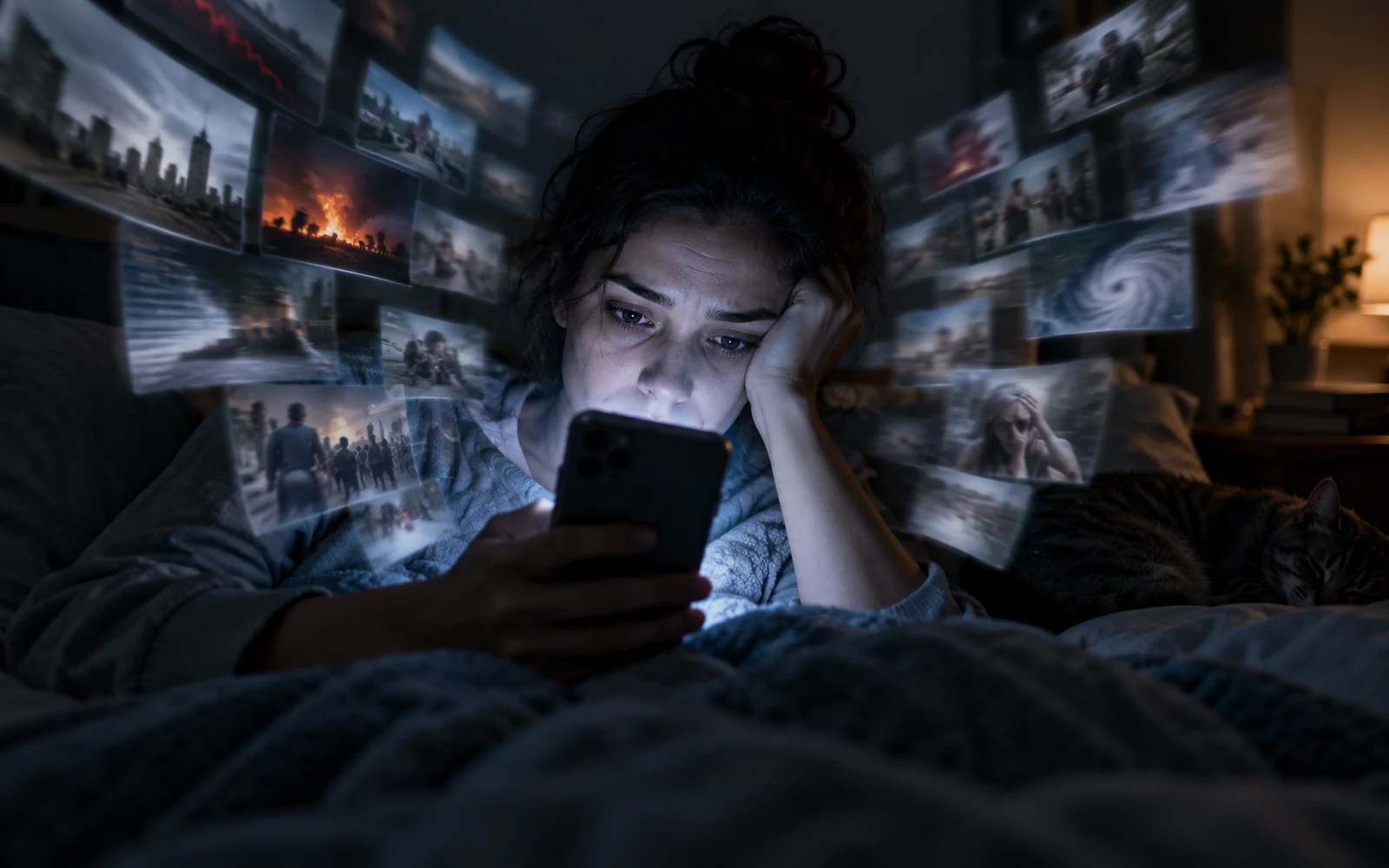
You open the news to find out what happened. Twenty minutes later, you are still scrolling and feel that the world is even worse than it was a moment ago. It sounds paradoxical: the content upsets us, yet instead of closing the app, we look for more. The English term doomscrolling has become established for this habit. It is not a diagnosis, and it does not mean that following the news is inherently bad.
Doomscrolling is the repeated, often hard-to-stop browsing of disturbing news and posts. A person may feel they need another update to gain control over an uncertain situation, even though the content worsens their mood. It can help to become aware of your own habit, set aside specific times for news, and choose reliable sources instead of an endless feed.
What exactly does doomscrolling mean?
The English word doom suggests destruction or a bleak future, while scrolling refers to moving through content on a screen. It does not mean reading every unpleasant news story. What matters is the pattern: you repeatedly move from one negative piece of information to another, lose track of time, and continue despite growing discomfort.
It may involve war news, disasters, economic worries, conflicts on social media, or comments full of anger. The key is the form of behavior, not one particular topic. Some people doomscroll in the morning after waking up, others during a break at work or in bed before sleep. Sometimes it becomes a habit to automatically open an app whenever there is a moment of silence.
The term became especially widespread during the years when people closely followed pandemic and other crisis-related news. Today, it is also used in relation to political events or everyday browsing of comments. However, it is important not to label everyone who follows serious events as addicted.
Why are we drawn to negative news?
When something uncertain or potentially dangerous is happening, information can help us make sense of the situation. The problem arises when more and more updates bring no useful new insight, but merely repeat the same threat in different words. You may tell yourself: just one more article, and I will finally know what will happen. That same feeling often returns after the next article.
Social media adds endless scrolling, notifications, and personally ranked content. You do not have to consciously search for every story: the next one appears on its own. If you linger on a disturbing topic, the platform may register it as a signal of interest, but the exact workings of recommendations differ by service and cannot automatically be attributed to a single universal algorithm.
Fear of missing an important development also plays a role. The feeling that “I should be informed” can be reasonable as long as you follow essential, verified information. Constantly refreshing an app, however, is not the same as being prepared for a specific event.
What is the difference between staying informed and a harmful habit?
Following the news in an informed way has a purpose. You read a current overview, verify the facts, and know whether you need to do anything. Doomscrolling is more recognizable by automatic continuation, without a clear answer to what you actually want to find out. You may feel tense, tired, or compelled to check the screen again.
Cleveland Clinic identifies stress, anxiety, mental fatigue, and disrupted sleep as possible consequences of this habit. However, one evening spent on the phone cannot be used to diagnose a mental health disorder. The connections are complex, and someone who is already experiencing anxiety may seek out negative news more often, rather than it working only the other way around.
Research on doomscrolling includes questionnaire-based studies as well as observations tracked over time. One study involving a sample of social media users found associations with psychological distress, but findings from a specific sample cannot simply be generalized to every user, and an association alone does not prove a simple cause.
Why is scrolling before bed especially unpleasant?
In the evening, we often want only a quick update. But if one alarming piece of information leads to another, we delay putting down the phone and remain emotionally activated. Instead of resting, we think about what we have read or return to more discussions. The problem can therefore involve timing, content, and repeatedly waking up because of notifications.
It is not only about the light from the screen itself. Turning off blue light will not solve the problem if you are following a live conflict or reading dozens of upsetting comments. It is often more useful to set an end point for following the news and leave time before sleep without further updates.
If you need to keep safety alerts enabled because of an exceptional situation, you do not have to turn off every notification. Distinguish important warnings from the endless stream of comments and speculation. The same applies to jobs where following the news is part of your responsibilities.
How to stop doomscrolling without disconnecting from the world entirely
First, try to name the reason you are opening the app right now. Do you want to verify one report? Do you need information that will affect a decision today? If you do not have an answer, you can choose another activity before you start scrolling automatically.
It helps to limit checking the news to preselected times. Instead of following a constant feed, open a few reliable sources and close them once you have read them. Remove notifications that have no real time-sensitive value, and move the app away from the most easily accessible part of your screen. You can also use built-in screen-time limits on your phone.
If you catch yourself starting another round, do not try to judge every minute afterward as a failure. A more practical question is whether you gained useful information or simply more tension. A short walk, a conversation, or a concrete plan for what you can influence is often more meaningful than another series of posts.
When to seek help
If browsing negative content persistently disrupts your sleep, work, or relationships, or is linked to significant anxiety, it may be helpful to speak with a psychologist or another qualified professional. You do not have to wait until the problem is “serious enough.” A professional can help distinguish a habit from broader difficulties and suggest an individualized approach.
Keeping up with what is happening in the world is important. The difference is whether information helps you understand events and act, or keeps you trapped in a loop of increasing distress with no result.
Sources
- Cleveland Clinic – Caught in a Doomscrolling Loop? Here’s How To Break Free – https://health.clevelandclinic.org/everything-you-need-to-know-about-doomscrolling-and-how-to-avoid-it
- PubMed – Doomscrolling Scale: its Association with Personality Traits, Psychological Distress, Social Media Use, and Wellbeing – https://pubmed.ncbi.nlm.nih.gov/36275044/
- PubMed – Doomscrolling and mental well-being in social media users: A serial mediation through mindfulness and secondary traumatic stress – https://pubmed.ncbi.nlm.nih.gov/38429976/

Gabriel Čatár
I'm interested in everyday things we encounter but don't always understand. From technology and personal finance to practical guides and fascinating facts about the world. At Offpitch, I focus on topics worth exploring in greater depth, checking the facts and explaining them in a clear, accessible way. My goal is to make sure readers take away something useful from every article.


