
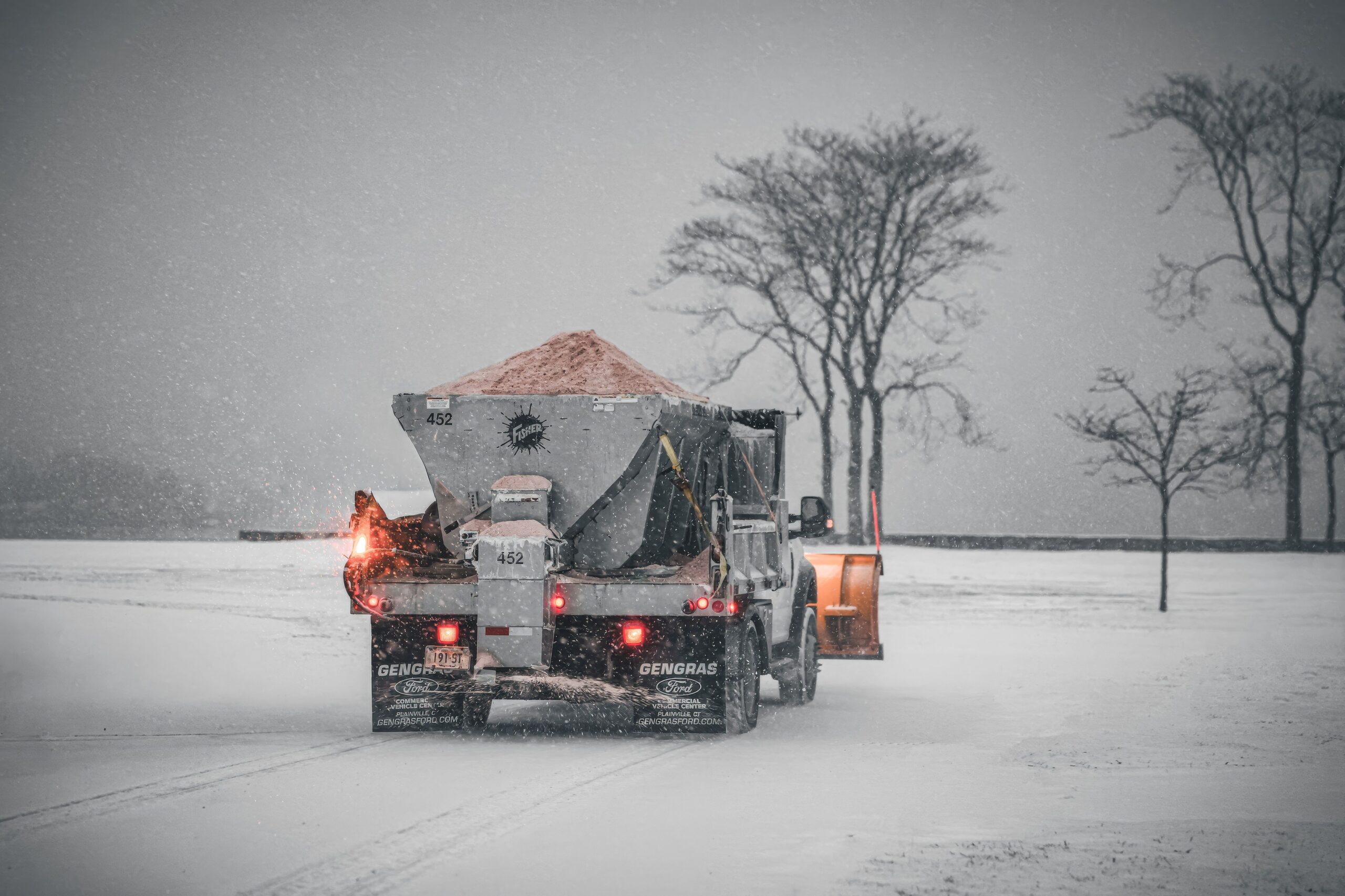
Snow lies on the pavement, the road is covered in wet slush, and a salt truck drives by. It may look as though salt simply melts the snow, but its role is more precise. It changes how water behaves as it freezes and helps road crews prevent ice from bonding firmly to the road surface. However, this effect also comes with environmental consequences.
Roads are salted because dissolved salt lowers the temperature at which water freezes and helps disrupt or prevent the formation of a solid layer of ice on the surface. When applied at the right time, it also makes subsequent snowplowing easier. However, it is not a universal solution for every frost: its effectiveness depends on temperature, concentration, water, and weather conditions, while excess salt can burden soil and aquatic ecosystems.
What happens when you put salt on snow?
Pure water freezes at around zero degrees Celsius under normal atmospheric pressure. When salt dissolves in it, it forms a solution that can remain liquid at lower temperatures. This is why ice can turn into salty water or slush where salt comes into contact with moisture. It does not heat the road: salt is not a heater, and the asphalt does not start producing heat.
The effect can also be understood in reverse. When snow or freezing rain is about to stick to the road surface, an appropriately applied chemical treatment makes it harder for a strong bond to form between the ice and the pavement. The U.S. Federal Highway Administration describes this principle as the basis of preventive treatment intended to keep the surface wet or slushy rather than covered with firmly bonded ice.
The amount of water also matters. Dissolved salt creates a solution with a certain concentration, which can be diluted and washed away by further snowfall or rain. A single application therefore does not have the same effect in all conditions and does not replace weather monitoring.
Why do road crews sometimes salt before it snows?
When the road is already covered by a thick layer of icy snow, removing it can be difficult. Preventive treatment aims to stop that layer from bonding firmly to the surface in the first place. When timed correctly, mechanical plowing can then remove the snow more easily. This approach is called anti-icing treatment, and it often uses a salt brine.
It is not true that the earlier a salt truck goes out, the better. Applying material too early before heavy rain can result in it being washed away before temperatures fall. Applying it too late, on the other hand, will not prevent the formation of a layer that has already had time to freeze onto the surface. Road crews therefore monitor the forecast, surface conditions, and the expected start of precipitation, adapting their methods to the specific situation.
Salt is also often combined with mechanical snow removal. The purpose of treatment is not to miraculously remove every centimeter of snow from the road; one of its major benefits is that it helps keep snow and ice separable from the surface underneath.
Why doesn’t salt work as well in severe cold?
The effectiveness of chemical treatment is not unlimited. Dissolution, solution concentration, and the behavior of ice all depend on temperature. At very low temperatures, ordinary road salt can be substantially less effective, and using it regardless of conditions may not result in a safe road surface. Maintenance operators therefore choose materials and application methods according to local conditions.
Available moisture is important as well. Salt crystals need contact with water to form an effective solution. A dry application on a very cold, dry surface behaves differently than it does in wet snow slush. However, this does not mean there is a reliable household rule such as “below one particular temperature, salt never works”; the actual effect depends on several factors at once.
If a road surface looks shiny, that does not automatically mean it is merely wet and safe. Conditions can change over a short distance on some stretches, such as on bridges or in shaded areas. Even after salting, speed and following distance should be adjusted to the actual road conditions.
Salt or grit? They do not serve the same purpose
Chemical treatment affects freezing and the adhesion of ice. Sand or stone grit, by contrast, is used mainly to mechanically improve traction on the surface; it does not chemically melt water in the same way. In practice, road authorities may use different materials or combinations of them depending on temperature, traffic, road type, and maintenance requirements.
For everyday drivers, it is useful not to rely on the color or amount of material spread alone. Brown grit can improve traction in places that remain frozen, but only while it stays where it is needed. Salty slush, meanwhile, does not mean ice cannot appear on the next stretch of road.
What is the environmental cost of road salting?
Some of the salt applied to the road does not remain there. As snow melts and rain falls, it drains into soil, ditches, streams, and groundwater. Chlorides can accumulate in the environment and, at higher concentrations, negatively affect aquatic organisms and water quality. The U.S. Geological Survey therefore studies the link between road-salt use and changes in chloride concentrations in water.
Road treatment can also contribute to corrosion of vehicles and metal structures. However, the solution is not simply to ban maintenance of slippery roads without an alternative approach. It is a matter of balancing traffic safety, weather conditions, and the amount of chemicals used. Precise dosing, appropriate timing, and mechanical snow removal can help limit unnecessary applications.
After the winter season, drivers can inspect and, following the manufacturer’s recommendations, wash the vehicle’s underbody, especially if they frequently drive on salted roads. Salt on the bodywork is not a reason for immediate panic, but neglecting dirt buildup and the protection of metal parts over the long term is not advisable.
Why can a road still be slippery after salting?
Chemical treatment does not change the basic rules of winter driving. With further snowfall, the layer builds up again, the solution can become diluted, and temperatures can vary significantly even between neighboring sections of road. A salt truck cannot cover every road at the same time, and the surface can be slippery even where it visibly appears wet.
Salt is therefore primarily a winter-maintenance tool, not a guarantee of traction. It works best as part of timely forecasting, correct application, plowing, and cautious driver behavior. That is why winter tires suited to the conditions, an appropriate speed, and sufficient following distance remain important even on salted roads.
Sources
- Federal Highway Administration – How Do Anti-Icing Methods Work? (freezing-point depression and preventive road treatment) – https://ops.fhwa.dot.gov/weather/resources/publications/tech_briefs/antiicin.htm
- U.S. Geological Survey – Evaluating chloride trends due to road-salt use and its impacts on water quality and aquatic organisms (chlorides and impacts on water) – https://www.usgs.gov/centers/upper-midwest-water-science-center/science/evaluating-chloride-trends-due-road-salt-use-and

Gabriel Čatár
I'm interested in everyday things we encounter but don't always understand. From technology and personal finance to practical guides and fascinating facts about the world. At Offpitch, I focus on topics worth exploring in greater depth, checking the facts and explaining them in a clear, accessible way. My goal is to make sure readers take away something useful from every article.


