
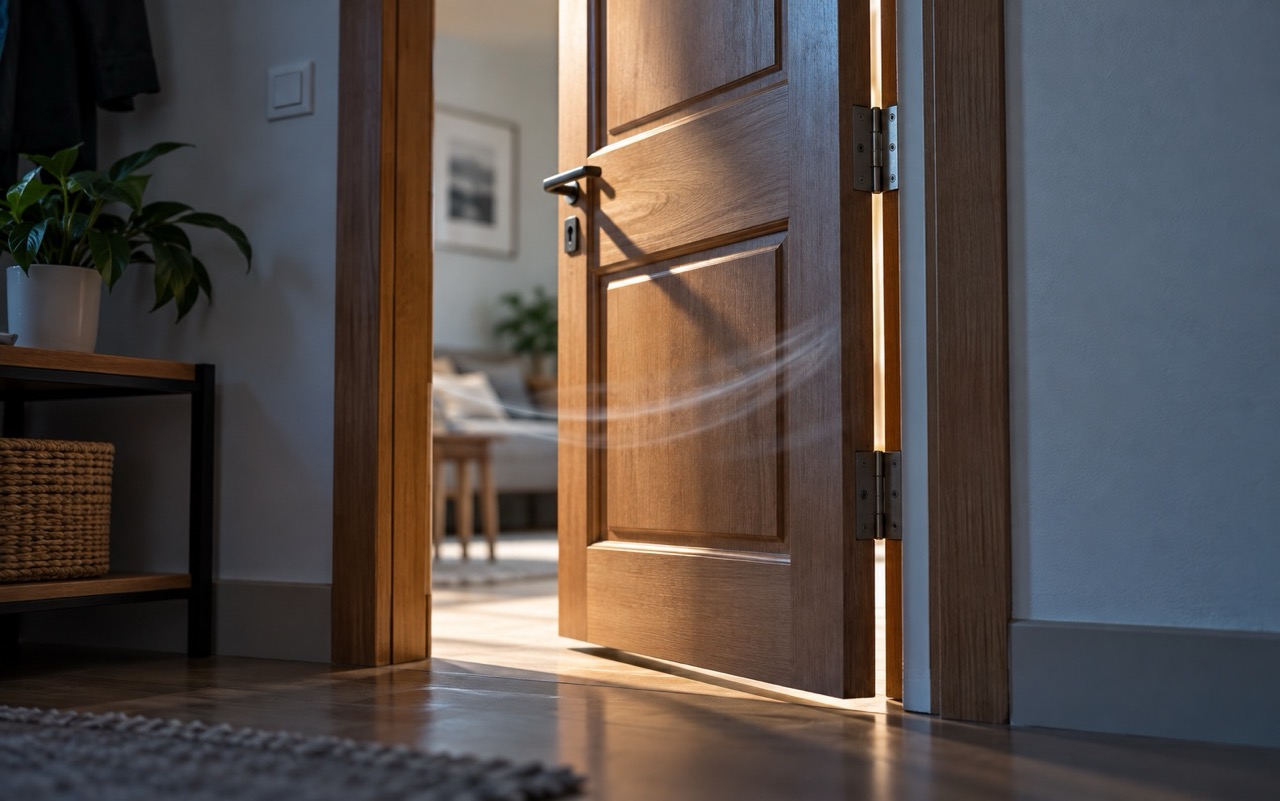
You leave a door slightly ajar, walk away to get a glass of water, and it closes behind you on its own. Or it slowly opens even though nobody is in the room. Rather than a mysterious draft, the cause may be simple geometry: the hinge axis is not vertical. Not every door movement has the same cause, however, and the issue may sometimes be the door closer or improperly adjusted hardware.
Interior doors often move by themselves because their hinge axis is not perfectly vertical: gravity pulls them toward a particular position. Other possible causes include loose screws, a warped door frame, pressure differences between rooms, or an adjustable door closer. First, determine whether they always move in the same way, even when the windows are closed.
The most common cause: the hinges are not on the same vertical axis
A door leaf rotates around the line formed by its hinges. If this axis is tilted, some positions of the leaf are more energetically favorable than others. The door may therefore slowly start moving in one direction and stop only at the frame or door stop. The floor does not need to be visibly sloped; the position of the hinges is what matters.
This can happen after imprecise installation, building settlement, or when screws become loose. The hinges may be fine, but the door frame may have been installed out of plumb. On older doors, the hinges themselves can also shift over time. From the outside, everything may still look almost level.
A simple test: open the door to about one-quarter, then halfway, and finally almost all the way. Carefully let go in each position and observe whether it moves in the same direction. If the result is repeated with the windows closed and ventilation switched off, a geometry issue becomes more likely. Perform the test safely, and remember that heavy doors can strike someone.
Loose screws and worn hinges
If the door leaf has visibly sagged at the handle side, catches on the floor, or its gaps around the frame are changing, check the hinges first. A screw that merely spins in the wood does not hold the hinge securely. Simply tightening it may help, but if the hole is worn out, it must be repaired properly according to the material of the door and frame.
Professional door repair guides recommend first distinguishing between a loose hinge, a worn hinge, and a problem with the position of the frame. Randomly bending the hardware may increase friction, but it can also disrupt the gaps or damage the door leaf. For adjustable hinges, follow the manufacturer's instructions. After every small adjustment, check that the door closes easily and the latch engages securely.
High friction is not a universal solution. If the door originally moved on its own because of a tilt, forcing the hinge tighter may only mask the problem. It will also make the door less convenient to use and put extra strain on the hinges. Correcting the geometry is better than creating artificial resistance at any cost.
Could a draft or ventilation be the cause?
Yes, especially with lightweight doors and a greater pressure difference between rooms. An open window, range hood, fan, or intensive ventilation can create airflow through the gap beneath the door. The door may then behave differently depending on which window is open, whether the ventilation is running, and which side the airflow comes from.
To tell the difference, close the windows and temporarily switch off ordinary fans, if it is safe to do so. Repeat the test at several opening angles. If spontaneous movement occurs only when a window is open or the range hood is running, a pressure-related cause is more likely. However, do not block ventilation openings intended for the safe operation of appliances.
Sometimes there is a combination of causes: a slightly tilted hinge slowly sets the door in motion, and a draft suddenly slams it shut. In that case, both issues need to be addressed, not just one.
Watch out for doors with self-closing mechanisms
Entrance doors, fire doors, and some office doors may have a door closer or spring hinge. Their return to the closed position is usually intentional. However, if they slam shut, the latch does not engage, or they stick, there may be an adjustment problem or damage to the mechanism.
With fire doors, do not prop the door leaf open with a wedge or disconnect the closer simply because it is inconvenient. Its correct operation may be an important part of fire safety. In an apartment building, any intervention should be handled with the building manager or an authorized service provider. Ordinary interior doors without closers are a different case.
What to do at home without causing unnecessary damage
Start by observing. Carefully open the door to three positions and note which way it moves. Inspect whether the gaps between the leaf and frame are even. Visually check the screws, cracks, rubbing against the floor, and whether any hinge is visibly bent.
If you have a spirit level, check whether the frame is plumb and, where possible, the direction of the hinge axis as well. The floor or the top edge of the door leaf cannot be used as the only evidence. The door and frame may be incorrectly aligned with each other even if the individual surfaces look level.
For slightly loose, accessible screws, carefully tightening them with a suitable tool may help. If the screws spin freely, the door is heavy, it has concealed hinges or security hardware, it is wiser to call a carpenter or service technician. Do not remove all hinge pins at once unless the door leaf is properly supported. A falling heavy door can cause injury.
When it is a problem that needs repair
A door opening by itself is inconvenient, but it is particularly dangerous where it could strike a child, block an escape route, or prevent a room from closing properly. Damaged frames, cracking hinges, and doors whose latches no longer engage are also more serious issues.
If the movement appeared suddenly after renovation work, check the installation first. If it gradually worsens and rubbing or cracking has been added, look for looseness or deformation. The cause can often be identified through a simple test, an inspection of the hinges, and a plumb check—without randomly readjusting the entire door.
Sources
- This Old House – How To Fix Loose Door Hinges (causes of looseness and self-closing) – https://www.thisoldhouse.com/doors/sure-cure-for-loose-hinges
- The Home Depot – How to Fix an Interior Door (checking hinges, gaps, and alignment) – https://www.homedepot.com/c/ah/how-to-fix-an-interior-door/9ba683603be9fa5395fab9016815bceb

Gabriel Čatár
I'm interested in everyday things we encounter but don't always understand. From technology and personal finance to practical guides and fascinating facts about the world. At Offpitch, I focus on topics worth exploring in greater depth, checking the facts and explaining them in a clear, accessible way. My goal is to make sure readers take away something useful from every article.


