
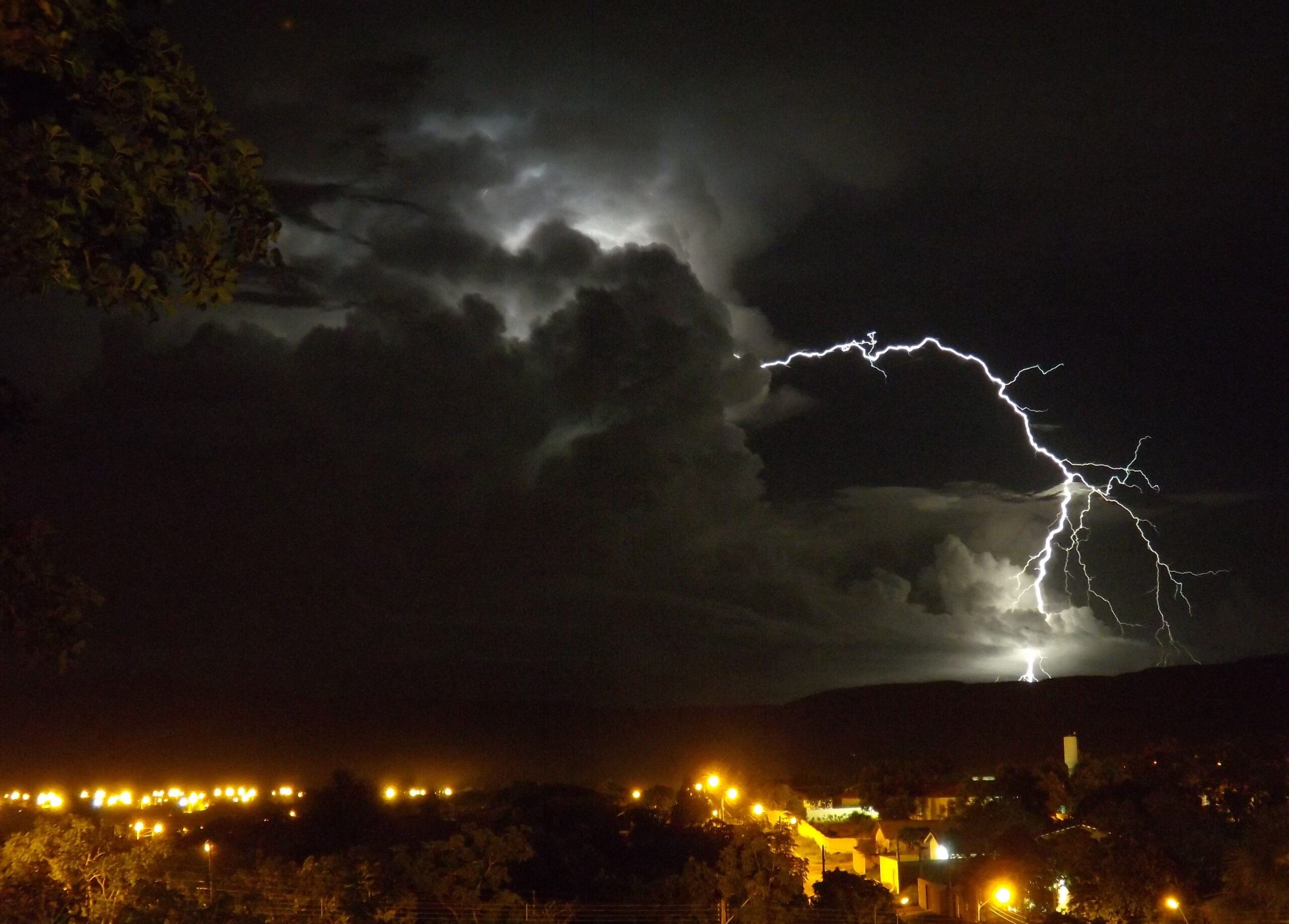
The sky may be completely clear in the morning, with inconspicuous cumulus clouds appearing around midday, followed suddenly by lightning, heavy rain and gusts of wind in the evening. This is not a strange coincidence with summer thunderstorms. The atmosphere changes throughout the day, creating favourable conditions for certain types of storms only after several hours of sunshine.
Summer thunderstorms often arrive in the afternoon or early evening because the sun heats the ground and the air above it for hours. The warm, moist air then rises, cools and may form a towering thundercloud. Heat alone is not enough for a thunderstorm to develop, however: moisture, atmospheric instability and a mechanism to lift the air are also needed.
A thunderstorm does not begin only when thunder is heard for the first time
A cumulonimbus thundercloud needs time to grow. At first, it may be visible only as an ordinary cumulus cloud. If the rising air has enough energy and moisture, the cloud expands upward, and the processes needed for heavy rain, hail and electrical discharges gradually develop within it. By the time we hear thunder in the early evening, the atmosphere has often been working on it since late morning.
The US National Oceanic and Atmospheric Administration (NOAA) describes three basic ingredients for thunderstorm formation: moisture, unstable air and lift. Moisture supplies water vapour, instability allows warmer air to keep rising, and lift provides the initial trigger. It can be caused, for example, by a mountain slope, the meeting of air masses or uneven surface heating.
This also explains why a hot day alone does not guarantee a thunderstorm. If the air is very dry, or if warmer air in a higher layer prevents air from rising from the ground, the sky may remain calm even at exceptionally high temperatures. Weather does not depend only on the thermometer outside the window.
What the sun does to the air during the day
The sun first heats the ground, asphalt, roofs, meadows and forests. The air warms from the surface, may become lighter than the surrounding air and begin to rise. As it rises, it expands and cools; when it reaches the right temperature, water vapour condenses and a cloud begins to form. With further ascent, the cloud may gradually turn into a towering thunderstorm cloud.
Surface heating is usually strongest during daylight hours, but the surface and the lower atmosphere do not necessarily respond immediately. In many places, the most favourable combination of sufficient warmth and cloud development does not occur until the afternoon. Some thunderstorms therefore peak when the sun is already sinking toward the horizon, even though the energy had accumulated earlier.
As the cloud grows, the condensation of water vapour releases latent heat, which can support the rising air. This can allow a thunderstorm to sustain itself for some time even after direct solar heating weakens. However, it does not have an unlimited energy supply; changes in wind, the supply of moisture and the surrounding atmosphere also matter.
Why a thunderstorm forms over one hill but not a few kilometres away
A mountain slope can force air to rise. In Slovakia, terrain can therefore contribute to the local formation of cumulus clouds and thunderstorms, although the specific development depends on airflow and moisture. On open plains, boundaries between warmer and cooler air, or lines where winds converge, can play a similar role.
The surface also makes a difference. Forests, fields, bodies of water and overheated cities do not exchange heat and moisture with the atmosphere in the same way. However, it makes no sense to claim that every city automatically produces a thunderstorm: it is only one possible influence within a complex system. That is why one village may be under a downpour while a neighbouring one remains dry.
As the first storm cell breaks down, cooler air from its precipitation can spread out along the ground. At its edge, more warm air is forced upward, and new storm cells may sometimes form. An evening thunderstorm therefore does not have to be a single cloud that kept growing throughout the afternoon; it may be a system that develops progressively.
Thunderstorms can also arrive in the morning or late at night
The explanation based on daytime heating fits many local summer thunderstorms, but not all of them. When a cold front passes through, the movement of large air masses is important. A front may arrive in the morning, at midnight or in the afternoon, and the thunderstorm will follow its timing rather than the hands of the clock.
Night-time thunderstorms can also draw energy from air in higher layers or from organised storm systems that formed far away and travel tens to hundreds of kilometres. A thunderstorm may develop over one area in the afternoon and not reach another until the middle of the night. So it is not true that the danger has passed after sunset.
The season also matters. Spring and autumn thunderstorms are often associated with stronger fronts and more pronounced airflow. A simplified rule about an “evening summer thunderstorm” would be misleading in these cases. The exact timing and risk should be assessed according to forecasts and warnings, not based on the previous day's experience.
Why wind sometimes arrives before rain in the evening
In a thunderstorm, descending cooler air can create a gust front. Its arrival is felt as a sudden wind and a drop in temperature even before the first raindrops. What seems like a pleasant breeze after a hot day may not signal the end of the muggy weather, but an approaching thunderstorm. When strong rising air is also present, intense precipitation and, under certain conditions, hail can form.
A dark sky alone does not indicate how strong a thunderstorm will be. It is much wiser to monitor warnings and current radar, especially if you are planning hiking, swimming or working outdoors. Radar shows precipitation that already exists, not a reliable forecast of every new cloud that has yet to form.
How to behave when a thunderstorm approaches during an evening walk
If you hear thunder, lightning activity is already within range and outdoor activities should be stopped. A substantial building or an enclosed hard-topped vehicle offers safer shelter; a lone tree, an open shelter or the top of a hill is not a safe refuge. Do not wait until it starts raining directly above you. Lightning can strike outside the core of the precipitation.
Before a hike, check not only the sun symbol in the forecast, but also the probability of thunderstorms, the timing and official warnings. If conditions are expected to worsen later in the day, plan your return with time to spare. During a thunderstorm in the mountains, there is no simple trick that can replace getting to suitable shelter in time.
Evening thunderstorms are therefore the result of weather development throughout the day, not a mysterious rule that the atmosphere waits for sunset. That is precisely why, under the right conditions, a sunny morning can be the beginning of a stormy evening.
Sources
- NOAA NESDIS – What Causes a Thunderstorm? – https://www.nesdis.noaa.gov/about/k-12-education/severe-weather/what-causes-thunderstorm
- NOAA National Severe Storms Laboratory – Severe Weather 101: Thunderstorm Basics – https://www.nssl.noaa.gov/education/svrwx101/thunderstorms/
- National Weather Service – Weather Spotter's Field Guide: Thunderstorm Ingredients – https://www.weather.gov/spotterguide/ingredients
- National Weather Service – Overview: Lightning Safety – https://www.weather.gov/safety/lightning-safety-overview

Gabriel Čatár
I'm interested in everyday things we encounter but don't always understand. From technology and personal finance to practical guides and fascinating facts about the world. At Offpitch, I focus on topics worth exploring in greater depth, checking the facts and explaining them in a clear, accessible way. My goal is to make sure readers take away something useful from every article.


