
You leave home in a winter coat in the morning, are surprised by heat in the car at noon, and encounter rain or hail on the way home. April has a reputation as a month that cannot decide whether it belongs to winter or summer. Yet this is not nature acting on a random whim: these rapid changes have quite understandable causes.
April weather is changeable because central Europe is still where cold air from the north meets increasingly warm air from the south. Stronger daytime sunshine warms the ground and encourages showers, while low-pressure systems and upper-atmospheric airflow can bring a rapid exchange of air masses. However, not every April has to be rainy or cold.
Spring Is a Transitional Season, Not an Instant Switch to Summer
In spring, days grow longer and the Sun rises higher in the sky. The land surface receives more energy than it does in midwinter, so it can warm up quickly on a clear day. At the same time, the ground, mountainous areas, or air arriving from the north of the continent may still be cold. It is precisely the contrast between them that creates the conditions for abrupt changes.
The term “April weather” therefore does not mean that the atmosphere follows different laws of physics in April. It is a popular name for a period when different air masses are close together and the boundary between them can shift. Similar changeable periods also occur in autumn, although the daily temperature cycle and solar heating look different then.
On some days, a stable high-pressure system may prevail over Slovakia, and the weather can remain pleasant for several days. At other times, one front follows another and the forecast changes. The month’s name alone is not a forecast; what matters is the current distribution of pressure systems and the direction of airflow.
Why Can the Sun Be Shining and Then Rain a Moment Later?
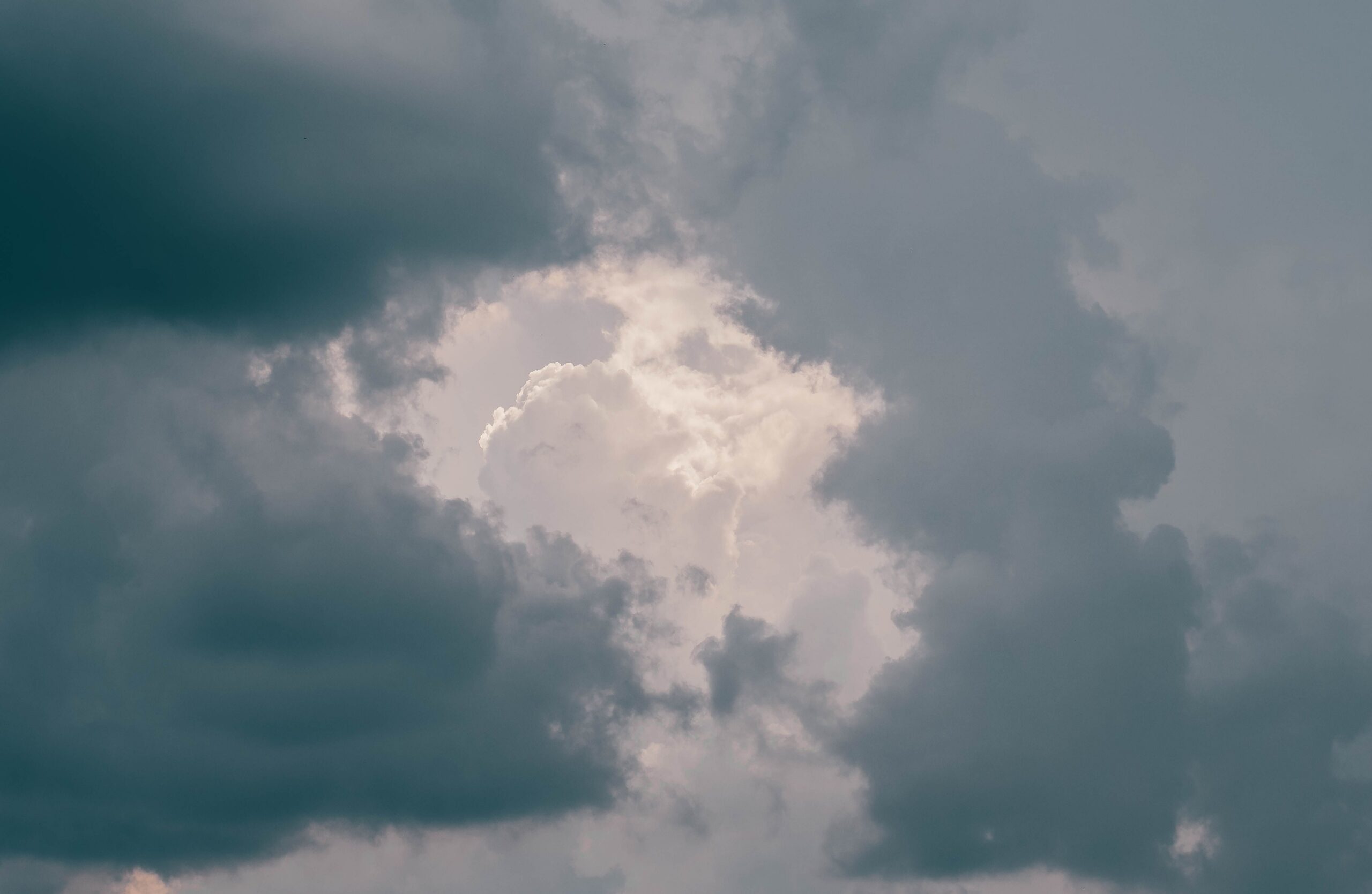
Spring sunshine warms the Earth’s surface, which in turn warms the air. Warmer air can rise, cool as it rises, and cause the water vapour it contains to condense into cloud droplets. If there is enough moisture in the atmosphere and conditions support further uplift, cumulus clouds and showers form.
Such clouds do not have to cover an entire region. It may be raining over one village while, a few kilometres away, people are sunbathing on a bench. A shower can sometimes move through quickly, with sunshine returning behind it. Unlike an extensive band of rain associated with a front, convective showers tend to be unevenly distributed across an area.
When explaining April showers, the Met Office points to the combination of stronger solar heating and still relatively cold air at higher altitudes. This combination promotes instability, but it does not in itself guarantee rain every day. Moisture and suitable airflow are also needed.
Why Can It Still Snow in April?
To assess the chance of snow, it is not enough to look only at the temperature on the thermometer outside the window. Temperature conditions throughout the entire layer of atmosphere through which precipitation falls are crucial. If it is cold enough, snowflakes can reach the ground even during a period when the preceding days already felt like summer.
When a cold front passes through, the air can cool rapidly. Fresh snow cover can therefore form in the mountains while rain or sleet falls in the lowlands. The difference is caused by elevation, the position of the zero-degree isotherm, and precipitation intensity. A brief return of winter weather does not mean that spring is over.
Likewise, a morning frost does not rule out a relatively warm afternoon. On a clear, calm night, the surface can radiate a great deal of heat, while colder air collects in valleys. Once more intense warming begins after sunrise, the air temperature near the ground can change considerably.
What Role Does the Jet Stream Play?
High above us, a narrow band of strong wind known as the jet stream flows through the atmosphere. It helps determine the paths taken by low-pressure systems and fronts across the Atlantic and Europe. In spring, the temperature difference between polar and warmer regions changes, which can also affect the jet stream’s position and strength.
When low-pressure systems pass through one after another, they bring alternating precipitation, wind, cooling and subsequent clearing. Under a stable high-pressure system, by contrast, the weather can settle down. It would be wrong to explain every April rain shower solely by the jet stream; surface heating and moisture also play a decisive role in local showers.
When reading a forecast, it is therefore useful to watch not only the sunshine or rain icon, but also the timing of precipitation, the chance of showers, wind, and temperature trends. A forecast of “showers in places” can be accurate even if it does not rain on your street all day.
How to Dress and Plan Time Outdoors
For hiking and spending extended time outdoors, layered clothing is more practical than a single heavy jacket. A warmer layer may be needed in the morning, while being able to remove it is useful in the sunshine. A lightweight waterproof layer is a better solution for a brief shower than relying on a sun icon in a mobile app.
For mountain trips, check the forecast separately for the elevation and route. Strong winds, thunderstorms, snow or ice can turn an apparently easy walk into a risky situation. Alerts from the Slovak Hydrometeorological Institute can also help before you set out; April’s climatic reputation is no substitute for current information.
April is therefore “crazy” mainly from our perspective: temperature, sunshine, wind and precipitation can alternate more quickly than we have time to change clothes. For meteorologists, however, it is a combination of well-known processes, not an inexplicable exception.
Sources
- Met Office – April showers: Is there any truth to the saying? – https://www.metoffice.gov.uk/blog/2026/is-there-any-truth-to-april-showers
- Met Office – Do changing seasons affect the jet stream? – https://www.metoffice.gov.uk/blog/2026/do-changing-seasons-affect-the-jet-stream

Gabriel Čatár
I'm interested in everyday things we encounter but don't always understand. From technology and personal finance to practical guides and fascinating facts about the world. At Offpitch, I focus on topics worth exploring in greater depth, checking the facts and explaining them in a clear, accessible way. My goal is to make sure readers take away something useful from every article.


