
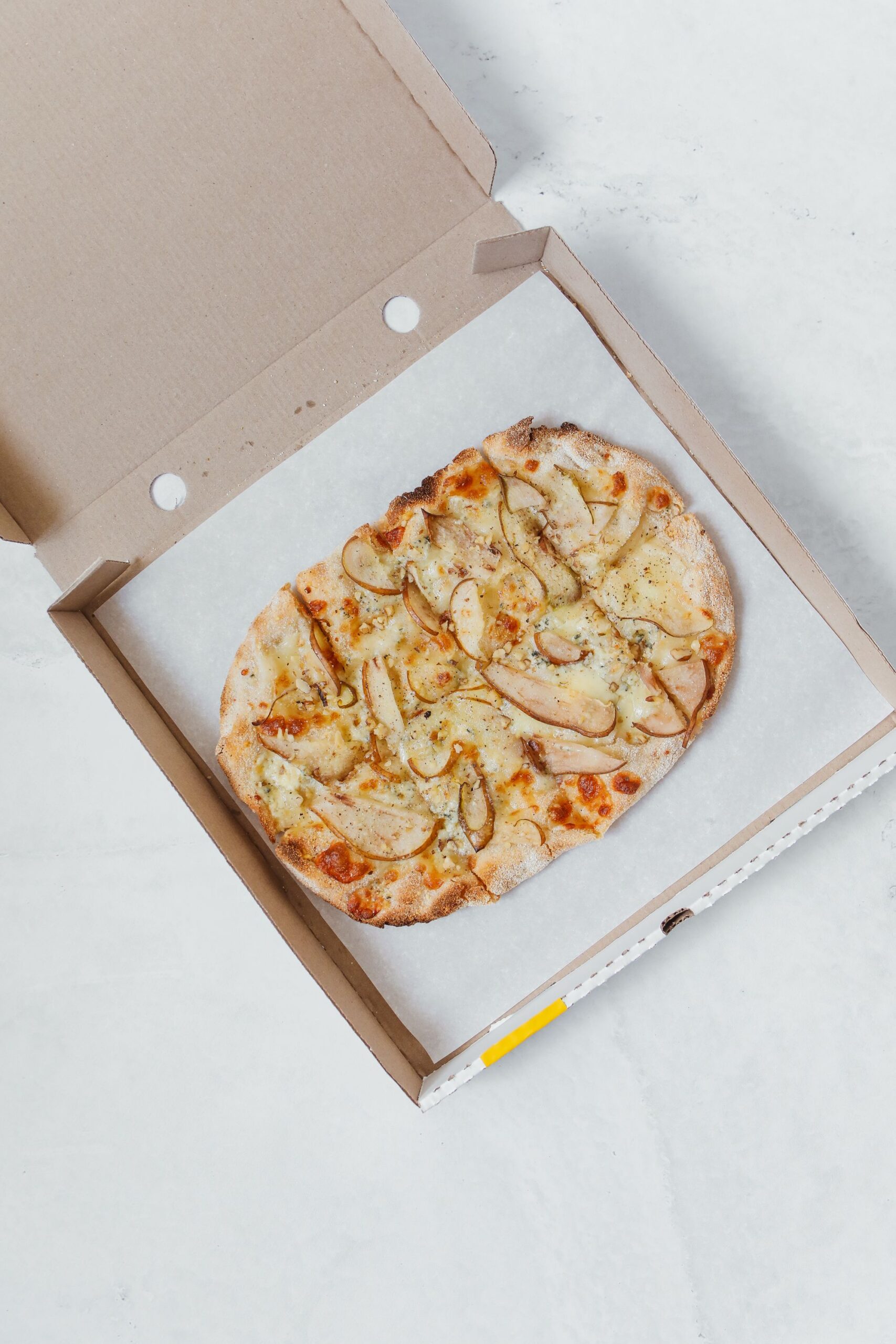
A round pizza, a square box and a triangular slice: one lunch, three geometric shapes. It may look like a design joke, but each serves a different practical purpose. The pizza has to be made and cut, while the packaging must be produced by the thousands, folded quickly, carried safely and keep the food usable after the journey home.
Pizza is usually placed in a square box because this type of packaging is easy to make from flat cardboard, fold, store and stack. A round pizza does not need a box of the same shape; it simply needs to fit without being damaged. Round and other specially shaped packages do exist, but square cardboard boxes are a proven compromise between cost, strength and practical handling.
It all starts with a flat piece of cardboard
A typical pizza box does not arrive at a pizzeria as a ready-made three-dimensional structure. The manufacturer cuts a shape from cardboard, scores the fold lines and supplies flat blanks that can be assembled as needed. Straight walls, folds and locking tabs allow for fast production and assembly without time-consuming joining of parts.
For a small business, it matters that hundreds of flat blanks take up less space than hundreds of assembled boxes. When an order comes in, a worker folds the packaging, puts in the pizza and closes the lid. There is no need to assemble a round sidewall or find separate lids.
That does not mean the box has to be a mathematically perfect square. Many packages have a rectangular footprint, chamfered corners, rounded cutouts or special closures. What matters is simple geometry that works well on production machinery and in everyday use.
Wouldn’t round packaging use less material?
At first glance, a round box might seem smaller: its edges would follow the pizza more closely and the empty corners would disappear. But cardboard consumption is not calculated solely from the finished footprint. It also depends on what shape must be cut from the original sheet, how much material remains outside the cutout, how many complex folds are needed and how the package is manufactured in large runs.
A square box is often made from a single flat piece. A fully round package with a rigid curved wall may require a more complex design, more operations or special tooling. In huge production runs, even small differences in manufacturing and storage time affect the total price. Without comparing two specific designs, however, it cannot be claimed that every round package uses more cardboard than every square one.
Packaging manufacturers emphasize the simplicity of die-cutting, folding and handling. The empty space saved inside does not necessarily offset a more demanding manufacturing process. That is why packaging should be assessed as a whole process, not merely from a photograph of an open box.
Why is a square box practical for delivery?
Straight side walls are easy to place next to one another on a shelf, in a delivery bag and on a car seat. A flat lid makes it possible to stack several boxes, provided the packaging is strong enough and the pizzas are not damaged. Straight edges are predictable to handle while carrying, and a pizzeria does not have to change its entire packaging system for every size.
The fluted inner layer of corrugated cardboard adds rigidity to the structure and partly separates the hot product from the outside environment. Shape alone, however, is not enough. A weak box can bend under the weight of other packages, causing the lid to touch the cheese. Some pizzerias therefore use a small support beneath the center of the lid or a sturdier design.
The box must also be slightly larger than the pizza’s diameter. If the dough or toppings rested against the walls, they could be damaged when the box is closed and carried. Empty corners are not the main reason for the square shape, but in practice they provide extra room for handling.
The biggest enemy is not geometry, but steam
A freshly baked pizza is hot and contains water in its dough, sauce and toppings. Once closed inside the box, it releases water vapor. If that vapor remains trapped in the package for too long, moisture can soften the crust. But if all the heat and steam escape quickly, the pizza arrives at the table cold. Delivery is therefore a compromise between retaining heat and removing moisture.
An Eater article explains that the modern cardboard pizza box is designed specifically to balance heat, moisture and protection of the product. There are also patented solutions with ventilation openings and separate compartments that attempt to remove steam from beneath the pizza. A patent, however, demonstrates the existence of a technical design, not that a particular product works better in every situation.
You may have noticed small openings on the sides of some boxes. Their purpose is to allow air exchange and reduce the buildup of steam. During a long delivery in a closed insulated bag, however, the openings alone will not work miracles. The entire transport method, the pizza’s temperature and the properties of the cardboard used all matter.
Why is pizza usually round?
Traditional pizza is made from a ball of dough that the pizza maker stretches from the center toward the edges, rotating it as they work. This naturally creates a roughly round disc. Its advantage is that it can be rotated with a simple movement while the crust is formed evenly. But it is not the only possible shape for the food.
There are rectangular pizzas made on baking trays, square portions and other regional styles. When dough is baked in a square pan, the result is usually square. Pizza’s shape therefore depends on the method of preparation, tradition and the desired portion size, rather than on any universal physical requirement.
Triangular slices result because, with a round pizza, it is easy to cut through the center and divide it into wedges. There are exceptions here too: some establishments use a grid cut to make small squares. None of these options, however, requires the box to match the cut.
Are there round pizza boxes too?
Yes. Manufacturers and restaurant chains have experimented with round, octagonal and multi-part packaging. Some designs aim to reduce the footprint, while others address grease runoff, steam removal or easier recycling. Such packaging can make sense for a particular product and operation, but its benefits must be considered alongside production costs, material availability and the logistics system.
If you are wondering why the world has not long since switched to round boxes, the answer is straightforward: square packaging already solves most practical problems well enough. Pizza remains round because of how it is prepared, while the box is angular because of manufacturing and delivery. What seems like a geometric absurdity actually separates two different tasks.
Sources
- Eater – The Low-Tech Genius of the Cardboard Pizza Box (design, heat, moisture and history) – https://www.eater.com/2016/9/28/13065010/pizza-box-design
- Rocket Industrial – Why is a Pizza Box Square? (manufacturing, folding and logistics) – https://www.rocketindustrial.com/blog/post/why-is-a-pizza-box-square
- Google Patents – US9994354B2, Ventilated pizza box (patented ventilated packaging design, not an effectiveness test) – https://patents.google.com/patent/US9994354B2/en

Gabriel Čatár
I'm interested in everyday things we encounter but don't always understand. From technology and personal finance to practical guides and fascinating facts about the world. At Offpitch, I focus on topics worth exploring in greater depth, checking the facts and explaining them in a clear, accessible way. My goal is to make sure readers take away something useful from every article.


