
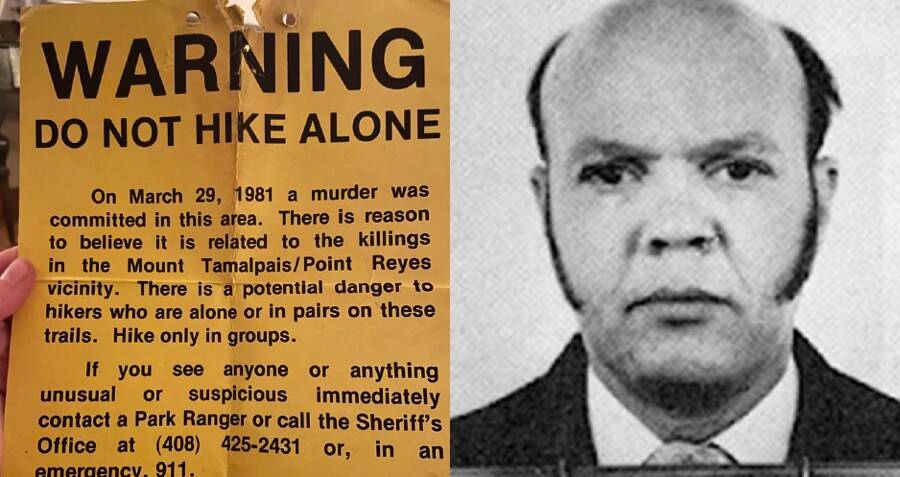
Predator of the forest trails: how David Joseph Carpenter terrorized California
A light mist hung in the valley near Mount Tamalpais in the early morning hours when, on August 19, 1979, a single shot rang out in the dense greenery. A few hours later, investigators found the body of 44-year-old hiker Edda Kane, a .44-caliber bullet in her head. At the time, they had no idea this was the first confirmed victim of the man who, two years later, would earn the nickname Trailside Killer—a serial murderer the public long confused with the Zodiac. (en.wikipedia.org)
Early years: violence at home and the first attacks
David Joseph Carpenter was born on May 6, 1930, in San Francisco into a household marked by alcoholism and physical punishment. By age seven he had a severe stutter, classmates bullied him, and his mother forced him into ballet and violin lessons. Two of the three warning signs in the Macdonald triad—bedwetting and cruelty to animals—were already evident in his teens. At 17, he was imprisoned for the first time for sexually abusing his cousins. (aetv.com, criminalminds.fandom.com)
In 1960, he attacked coworker Lois Rinna (mother of actress Lisa Rinna), tied her up in the woods at the Presidio, and—after stabbing her—would likely have killed her if a military police officer hadn’t interrupted the assault. Rinna survived; Carpenter received seven years, but even then it was clear how quickly he could strike without warning. (sfchronicle.com)
A second start after release
After his release in 1969, experts assessed Carpenter with an IQ of 125 and antisocial personality disorder, yet he was granted parole thanks to good behavior. He worked briefly at a print shop and later as a typesetting instructor, but he also expanded his pattern of sexual assaults—between January and February 1970 he kidnapped and raped three women, and in the last attack he stabbed the victim in front of her child. (investigationdiscovery.com)

Murders on hiking trails (1979–1981)
Between August 1979 and May 1981, he killed at least eight people, mostly women aged 18 to 44. The investigation showed he used two tactics:
- Close-range shooting—in attacks in nature preserves (e.g., Mount Tamalpais, Point Reyes), he shot victims in the head or chest.
- Physical overpowering—he stabbed some women with a knife or beat them with a hammer and then raped them.
A hand-drawn map of routes and eyeglasses found near Barbara Schwartz’s body led police to a list of former inmates with vision prescriptions; Carpenter slipped through only because he had managed to buy new glasses and no longer matched the initial description. (aetv.com)
Capture and trial
The breakthrough came after the disappearance of 20-year-old Heather Scaggs (May 2, 1981). When she didn’t come home, the FBI checked staff at the printing school—Carpenter was the last person to see her alive. In his car, they found park map brochures and, in a hidden case, a .38-caliber revolver. The bodies of Heather and four other victims were discovered in the woods of Santa Cruz and Marin County. A jury convicted Carpenter of five murders and sentenced him to two death terms (1984, 1988). DNA analysis in 2009 later linked him to the 1979 murder of Mary Frances Bennett as well. (sfgate.com)
The oldest man on California’s death row

After 40 years behind bars, Carpenter—now 95—remains the oldest condemned prisoner at San Quentin. Although Governor Gavin Newsom’s 2024 reform moved most inmates out of the iconic “Death Row” to other facilities, the legal status of the sentence has not changed; executions remain on hold. (latimes.com)
Impact on criminology and pop culture
- Similarities between his modus operandi and the Zodiac Killer’s letter-and-cipher mystique led in the 1980s to a temporary consolidation of the cases, until the timeline showed that Carpenter was in prison during one of the Zodiac murders.
- Writer Robert Graysmith dramatized the investigation in the book The Sleeping Lady (1991).
- In 2023, the Trailside Killer was featured in a two-part episode of the documentary series Very Scary People, renewing debate about safety in Bay Area hiking parks. (en.wikipedia.org)
- California’s Department of Parks has since doubled the number of rangers specialized in active searches and hired its first group of crisis psychologists to support victims of violent crime in protected areas.
A striking reminder in this case is that Lois Rinna survived thanks to the 1960 intervention by a military police patrol. The trial judge later acknowledged that a harsher sentence for attempted murder might have prevented the eight later deaths—an argument often cited in debates about predictive risk assessment of dangerous offenders. (sfchronicle.com)
A documentary look
The Terrifying Tale of the Trailside Killer | Our Life
This 45-minute documentary recaps the investigation and includes interviews with detectives from Marin County.
Sources
- Los Angeles Times – Life after California’s death row: Condemned inmates get second chance (May 1, 2025) https://www.latimes.com/california/story/2025-05-01/san-quentin-death-row-dismantled-what-happened-to-condemned-inmates
- SFGate – DNA ties Trailside Killer to ’79 S.F. slaying (March 24, 2009) https://www.sfgate.com/crime/article/DNA-ties-Trailside-Killer-to-79-S-F-slaying-3198511.php
- A&E Real Crime – David Carpenter: The Serial Killer Who Made California Parks His Hunting Ground (August 8, 2019) https://www.aetv.com/real-crime/david-carpenter-serial-killer-trailside-killer-california
- San Francisco Chronicle – Lisa Rinna reveals chilling details of her mother’s attack (April 3, 2025) https://www.sfchronicle.com/entertainment/article/lisa-rinna-mother-attacked-sf-serial-killer-20251239.php
- Wikipedia – David Carpenter (updated June 25, 2025) https://en.wikipedia.org/wiki/David_Carpenter

Robert
I’m interested in technology and history, especially true crime stories. For three years I ran a fact-based portal about modern history, and for a year I co-built a blogging platform where I published dozens of analytical articles. I founded offpitch so that quality content wouldn’t be hidden behind a paywall.


