

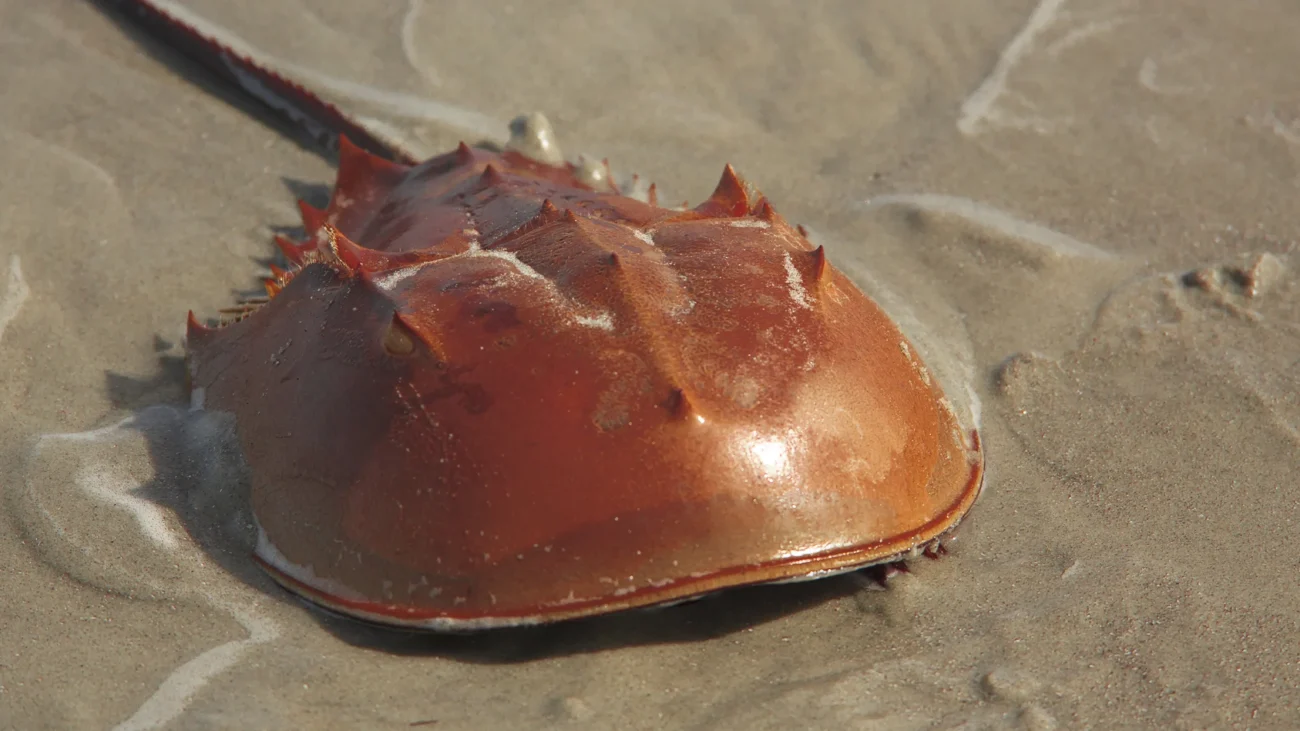
Every spring, thousands of American horseshoe crabs (Limulus polyphemus) appear along the Atlantic coast. These ancient arthropods—more closely related to scorpions than to true crabs—survived the extinction of the dinosaurs, yet paradoxically they may now be threatened by the pharmaceutical boom of the 21st century. A liter of their blood—deep blue thanks to the copper in hemocyanin—is valued on the lab market at roughly USD 15,000, making it one of the world’s most expensive commodities.
How a “living fossil” became a biomedical star
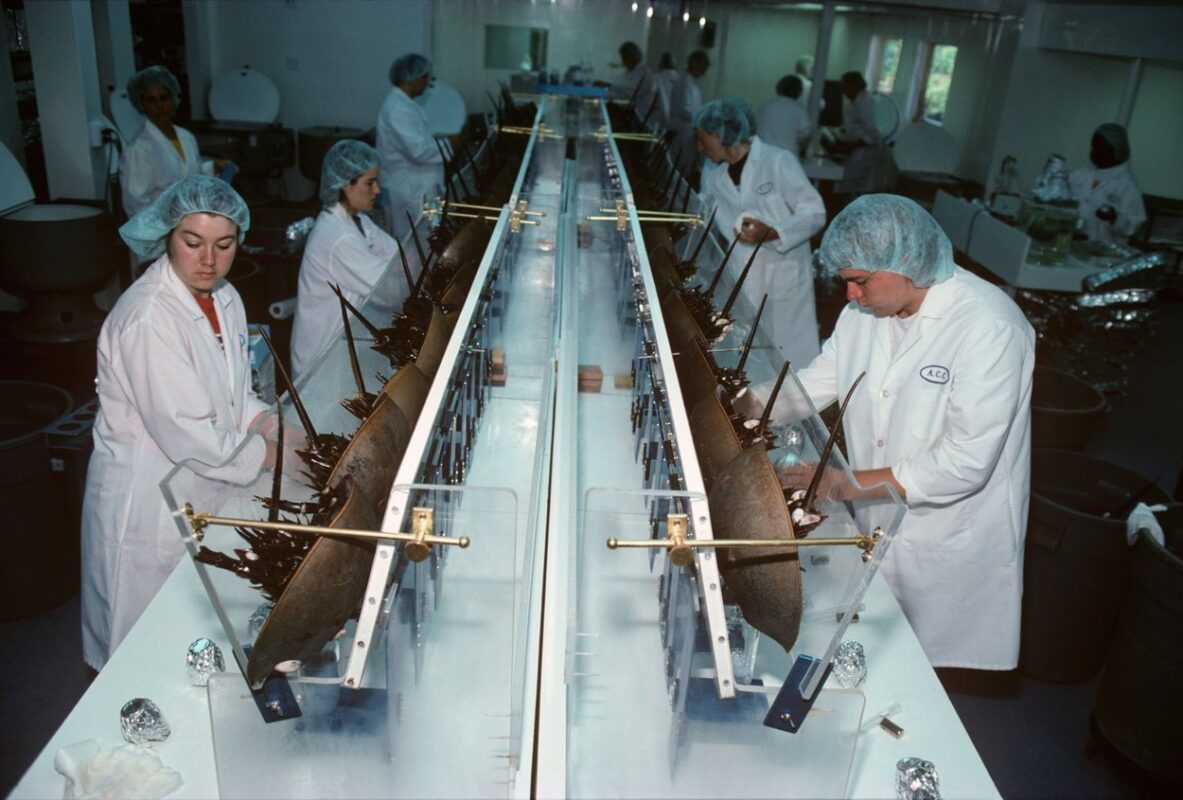
In the 1950s, pathologist Frederic Bang studied the horseshoe crab’s immune response to bacteria in seawater. He found that amebocytes in the bloodstream release a protein that, upon contact with lipopolysaccharides from gram-negative bacteria, instantly forms a gel and isolates the pathogen. This discovery led to Limulus Amebocyte Lysate (LAL)—now the standard method used to test the sterility of every vial of insulin or vaccine before it leaves the production line.
In the 1970s, the LAL method replaced the previously used “rabbit tests”: a drop of lysate can detect endotoxin within hours rather than days, without the need to keep thousands of laboratory animals. For pharmaceutical companies, that meant faster development and significantly lower costs.
Industrial bleeding and the ecological price
The harvesting process is straightforward, but invasive. Fishing boats transport more than 400,000 animals each year from Delaware Bay and the surrounding U.S. coastline. In laboratories, needles draw up to 30% of their blood, and most are released back into the sea; even so, estimated mortality rates range from 10% to 30%.
In 2016, the International Union for Conservation of Nature (IUCN) listed the American horseshoe crab as Vulnerable (VU). The population is weakened not only by blood harvesting but also by the use of crabs as bait in eel fisheries and by extensive loss of beaches suitable for egg-laying.
Studies by marine biologists warn that females lay fewer eggs after bleeding and more often fail to navigate back to spawning grounds, which also threatens shorebird migrations—especially colonies of sandpipers and red knots that rely on horseshoe crab eggs to refuel before their marathon journey to the Arctic.
Three of the four existing horseshoe crab species live in Asia; there, facilities typically do not kill the animals immediately after bleeding, but keep them on production lines until they are completely exhausted, after which they end up as feed for farmed fish. The lack of uniform rules creates a geographic divide in the level of impact on individual populations.
A synthetic alternative that hasn’t yet replaced the original
A potential solution is recombinant factor C (rFC)—a lab-produced version of the key protein in the lysate. The European Pharmacopoeia approved rFC as an equivalent endotoxin test as early as 2016, and Japanese authorities have taken similar steps; the U.S. FDA, however, remains cautious and requires parallel verification, which slows large-scale adoption of synthetics.
Independent comparative studies published in scientific journals show that rFC achieves the same sensitivity with lower variability in results, but industry is wary of disrupting long-established validated procedures.
A promising shift has also been noted in the U.S. Pharmacopeia (USP); a forthcoming revision of chapter <85> Endotoxin Test is expected to label rFC as the “preferred humane alternative,” which could create regulatory pressure to reduce live blood harvesting.
In discussions of synthetic solutions, experiments with bacteria-activated liquid crystals or nanotechnology-based biosensors are also mentioned, but none of these concepts has yet achieved the clinical validation required for the mass market.
Although blood harvesting on the U.S. coast operates under a quota system and mandatory release, scientists warn that sublethal effects—stress, loss of orientation, and reduced reproduction—may trigger a slow population collapse before the market fully pivots to biotechnological solutions.
On the other end of the spectrum are conservation projects such as the Atlantic States Marine Fisheries Commission’s adaptive management program, which adjusts allowable harvest levels each year based on both crab status and the needs of migrating birds.
Old blue blood versus the future of pharma
Without LAL or its perfect equivalent, the pharmaceutical industry cannot imagine safely bringing a new drug or injection syringe to market. Growing pressure to transition to rFC, tighter monitoring of post-bleeding mortality, and protection of spawning grounds suggest the solution does not have to be either-or. The American horseshoe crab has been part of coastal ecosystems longer than the continents have existed in their current form—the challenge of the 21st century is to ensure it doesn’t disappear just as it is helping us the most.
Sources
- The Atlantic: “The Blood Harvest” (2014). The Atlantic
- European Directorate for the Quality of Medicines: Ph. Eur. allows the use of recombinant factor C (2023). edqm.eu
- IUCN SSC Horseshoe Crab Specialist Group Report 2016–2017. iucn.org
- Delaware Bay Horseshoe Crab Harvest Recommendation 2024, Atlantic States Marine Fisheries Commission. asmfc.org
- PDA Letter: Endotoxin Testing Using Recombinant Reagents (2018). Default

Robert
I’m interested in technology and history, especially true crime stories. For three years I ran a fact-based portal about modern history, and for a year I co-built a blogging platform where I published dozens of analytical articles. I founded offpitch so that quality content wouldn’t be hidden behind a paywall.


