
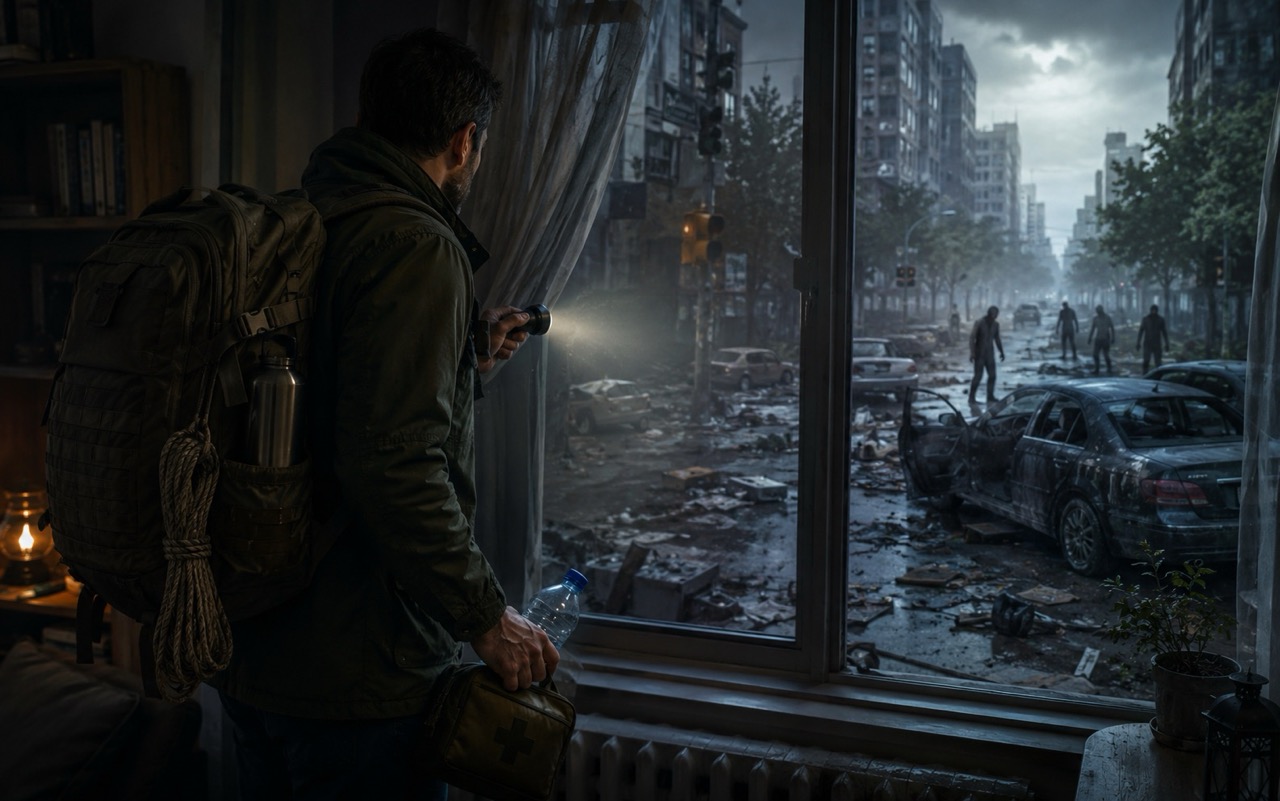
A zombie apocalypse may sound like something from a film, game, or TV series, but that is precisely what makes it a useful model for thinking about emergencies. Take away the zombies themselves, and you are left with a scenario in which transport, shops, electricity, the internet, healthcare, and public order all break down. In other words, it is an extreme version of a pandemic, infrastructure failure, evacuation, or major emergency.
If a zombie apocalypse began, the most important things would be to stay calm, get somewhere safe, avoid crowds, and secure water, food, medicine, information, and contact with loved ones. Do not try to be a hero, seek out conflict, or take unnecessary risks outdoors. The people with the best chance of survival are those who have a plan, supplies, and the ability to make calm decisions.
The zombie apocalypse as a crisis scenario: why consider it at all?
The US Centers for Disease Control and Prevention once used the idea of a zombie apocalypse as a light-hearted way to explain how people could prepare for real disasters. The point was simple: if you are ready for something as extreme as a zombie apocalypse, you will probably be better prepared for a flood, pandemic, prolonged power outage, evacuation, or other emergency as well.
The zombie scenario is useful not because it is literally realistic, but because it forces people to think practically. Where will I shelter? What will I drink? How long can I manage without shops? How will I contact my family if the mobile network goes down? What will I do if chaos spreads through the area and the police or emergency services are not immediately available?
The same basic rule applies to every such crisis: the less you have to improvise under stress, the better. A plan made in advance is always better than a brilliant idea conceived after the power has already failed, you are hungry, and dozens of people are arguing outside a shop.
The first few minutes: what to do as soon as you realise something is happening
Verify the information, but do not get stuck staring at your phone
Most people’s first reaction would be to check their phone, social media, and the news. That is natural, but it can also be dangerous because rumours spread faster than verified information during a crisis. Follow official sources, emergency alerts, radio broadcasts, government websites, and local authorities. If a claim comes only from an anonymous post or a video without context, treat it with caution.
You need to establish three things in particular: whether it is safer to stay home or leave, which direction the danger is spreading in, and whether the authorities have advised evacuation or sheltering in place. If you have a battery-powered radio at home, it may be more valuable than a smartphone in this kind of scenario because mobile networks and the internet could be overloaded or completely unavailable.
Get away from crowds
The biggest mistake would be to rush into the city centre, a shopping centre, or a petrol station without thinking. In the first hours of a crisis, many people act impulsively: they all want to shop, fill their tanks, withdraw cash, or flee without a plan. Those are precisely the places where traffic jams, conflict, and unnecessary risks arise.
If you are at home and it is safe there, your first choice should be to stay inside, lock the doors, close the curtains, and prepare. If you are outdoors, do not try to cross crowded places. Choose side streets and quieter routes, and avoid making noise. In a zombie scenario, noise would attract the threat; in a real crisis, it attracts attention and increases your chances of being caught in crowd panic.
Contact your loved ones briefly and clearly
There is no time for long phone calls during a crisis. Agree on a simple message with your loved ones: where you are, whether you are safe, where you are going, and when you will next make contact. If the networks are still working, send an SMS or use several messaging channels. An SMS often has a better chance of getting through than a call because it places less demand on the network.
Your family should agree on a meeting point in advance. Ideally, choose two: one near your home and another outside the city or risk zone. If everyone simply decides to head “home,” people may travel in opposite directions and miss one another.
Stay home or flee? The most important decision of the entire crisis
When to stay home
In most emergencies, it is better to remain in a safe building initially than to flee immediately. A house or flat provides walls, doors, supplies, hygiene facilities, clothing, information, and an opportunity to think. Outside, you have only what you can carry, and every journey exposes you to unfamiliar surroundings.
Staying home makes particular sense if you have supplies of water and food, can secure the entrances, face no immediate danger nearby, and have not received official evacuation instructions. In that case, prepare an evacuation bag, charge everything you can, fill containers with water, and take stock of everything useful in your home.
However, your home is not a fortress forever. It is a temporary safe zone. If the situation deteriorates, water runs out, or there is a risk of fire, violence nearby, contamination, or the threat directly entering the building, you need to leave before it is too late.
When to leave
You should leave when staying becomes more dangerous than moving. This may be the case if the threat is approaching rapidly, the house has no water, a fire has broken out, the building is damaged, uncontrollable chaos has erupted nearby, or the authorities have ordered an evacuation. In a zombie scenario, another reason would be that the surrounding area has become difficult to monitor and the entrances can no longer be controlled safely.
Leaving without a plan, however, is simply panic in motion. Before you go, take identification documents, medicine, water, enough food for several days, a power bank, warm waterproof clothing, a torch, cash, a map, and basic hygiene supplies. If you have a car, do not assume the roads will be empty. If the main routes are blocked, walking to a prearranged location may be safer than sitting in a traffic jam with no escape route.
Evacuation bag: what you should have ready
The essentials for 72 hours
Many civil protection and emergency organisations recommend keeping enough supplies for at least two or three days. This is not because everything will be resolved after three days, but because the first few days tend to be the most chaotic. Help may not reach every location immediately, and shops may not be open.
The essentials include drinking water, non-perishable food, medicine, identification documents, a torch, a radio, spare batteries, a power bank, hygiene supplies, warm clothing, and basic sleeping equipment. When choosing food, remember that electricity and gas may be unavailable. Tinned food, crackers, snack bars, nuts, instant meals, and foods that can be eaten without cooking are more practical than ingredients that require a kitchen.
Water is more important than food. People can survive far longer without food than without fluids, while thirst quickly impairs decision-making, physical stamina, and mental resilience. If you have time, fill bottles, pots, flasks, water cans, and clean containers. During a crisis, it is better to have extra water than to wonder whether an unknown outdoor source is safe.
What to pack if you have a child, an older person, or a pet
An emergency plan must not be designed only for a healthy adult. If you have a small child, you will need nappies, wet wipes, spare clothing, suitable food, a bottle, medicine, and something comforting. For an older person, the priorities are regular medication, glasses, a hearing aid, medical equipment, and a list of diagnoses or doctors’ contact details.
A pet needs its own food, water, lead, carrier, bowl, and documents, if it has any. In a panic, people often forget their animals, only to return for them later and take much greater risks. If an animal is part of the household, it must be part of the plan from the beginning.
Safe shelter: how to prepare your house or flat
Entrances, light, and noise
When sheltering at home, it is important to make your house or flat as inconspicuous and secure as possible. Lock the doors, close the windows, lower the blinds or draw the curtains, and switch off unnecessary lights. This is not about building cinematic barricades, but taking simple measures that reduce attention from outside and give you more time to react.
Noise is a problem. Do not play the television or music loudly, and do not run a generator right beside a window. If you need to communicate with others in the household, do so calmly and quietly. In a zombie scenario, noise could attract the threat; in a real crisis, it may attract people who are desperate, disoriented, or aggressive.
Water, warmth, and hygiene
If there is a risk that the water supply will fail, fill the bath, buckets, and other containers. This water may not be suitable for drinking, but it can be used for flushing toilets, washing, or basic hygiene. Keep drinking water separate in clean, sealed containers.
Hygiene is often underestimated. Disaster films focus mainly on escape, but in reality, dirty hands, spoiled food, contaminated water, and poor sanitary conditions are major problems. Keep soap, disinfectant, toilet paper, rubbish bags, wet wipes, and a basic first-aid kit at home. If rubbish is not being collected, keep it as far away as possible from food and the room where you sleep.
Travelling outdoors: if you have to go, think it through
Do not go alone, but do not form a large group
If you must leave your shelter, ideally you should not go completely alone. A pair or small group is more likely to handle problems, help if someone is injured, carry supplies, and watch the surroundings. However, a large group is noisy, slow, and finds it harder to make decisions. In a crisis, a small, disciplined group with a clear objective is often the most effective.
Before setting out, choose a route, an alternative route, and a point where you will turn back if the situation is bad. Do not go out “just to have a look.” Curiosity is dangerous during a crisis. Every journey should have a purpose: obtaining water or medicine, reaching a safer place, contacting family, or evacuating.
Avoid high-risk locations
The worst places during chaos are shopping centres, petrol stations, hospitals, major junctions, railway stations, and the main roads out of a city. That is where people, vehicles, stress, and conflict become concentrated. Even if supplies are available there, the risk may outweigh the benefit.
Less conspicuous routes, side streets, the edges of housing estates, country lanes, and places where you can change direction quickly are generally safer. As you move, keep an eye out for escape routes. Do not enter a dead end, underground garage, or enclosed building unless you know how to get back out.
Food and water: what to deal with first
Water first, then calories
Water is the number-one priority. If you are at home, check all drinks, bottles, mineral water, tea, preserved foods, and foods containing liquid. If you are away from home, do not assume that water is safe simply because it looks clean. Water from a stream, lake, or rainwater collection system may contain microorganisms or chemical contaminants.
If possible, use a certified filter, water purification tablets, or boil the water. With any water treatment method, it is important to follow the specific instructions for the product or device. Improvised treatment may reduce the risk, but it may not make the water genuinely safe.
Choose food for practicality
In a crisis, the best food is not the tastiest, but the food that lasts, fills you up, and does not require complicated preparation. Tinned foods, pâté, crispbread, rice, pasta, oats, nuts, dried fruit, energy bars, and baby food are practical supplies. Do not forget a tin opener, spoon, knife, and water container.
If the power goes out, use the most perishable food from the fridge and freezer first. Do not open the freezer unnecessarily, so it stays cold for longer. Spoiled food is a greater risk in an emergency than it may seem, because stomach problems can weaken you precisely when you need energy most.
Health, infections, and first aid
Treat every injury as though it could become a problem
In everyday life, a small wound is an inconvenience. During a prolonged crisis, it can become a serious problem, especially if medical care, clean water, or disinfectant is unavailable. It is therefore worth having a first-aid kit, plasters, bandages, disinfectant, gloves, painkillers, fever-reducing medicine, and any medication you take regularly.
Zombie scenarios often focus on “bites,” but in practical terms, it is more important to consider the general risk of infection. Avoid contact with bodily fluids, wear protective gloves, wash your hands, and do not eat or drink anything that may have been contaminated. If an unknown illness is spreading nearby, distance and isolation are more valuable than bravery.
Your state of mind matters more than you might think
Prolonged stress destroys sound judgement. A person who is sleep-deprived, dehydrated, frightened, and constantly watching bad news will begin to make worse decisions. Even during a crisis, establish a simple routine: one person rests, another monitors information, and another checks supplies. Rotating duties reduces panic and gives the group a sense of control.
Even a very ordinary routine helps. Eat at regular intervals, drink water, record your supplies, monitor the surroundings, and make a plan for the next day. A crisis is easier to manage when you turn it from continuous chaos into a series of smaller tasks.
What to avoid: the most common zombie apocalypse mistakes
Do not play the hero
Films have taught us that the bravest person survives. In reality, the cautious, inconspicuous, and well-prepared person has a better chance. Unnecessary conflict, risky expeditions, attempts to save someone else’s property, or efforts to prove your courage can end badly.
The best strategy is to minimise contact with danger. If you do not have to do something, do not do it. If you do not need to go somewhere, do not go there. If you can avoid a problem, avoid it. Survival is not a contest of style; it is about energy, time, and safe decisions.
Do not rely on a single plan
One shelter, one route, one phone, one torch, and one bottle of water are all potential points of failure. An emergency plan needs backups. If the mobile network fails, you have a radio. If the main road is impassable, you have another route. If your family cannot meet at home, you have a second meeting point. If the drinking water runs out, you know where to find another option.
Backups do not have to be expensive or complicated. Sometimes a paper map, printed phone numbers, cash in small notes, a second power bank, spare batteries, and an agreement with your family about what to do when calls are impossible are enough.
Where to go if the city is no longer safe
The countryside is not automatically the best option
Many people imagine that all they need to do during an apocalypse is flee to a cottage or the countryside. That can be a good plan, but only if you can realistically live there. A cottage without water, heating, supplies, or access may become a trap. The countryside has fewer people, but it also has fewer shops, doctors, petrol stations, and sources of assistance.
If you have a safe place outside the city, prepare it in advance. Keep basic supplies, tools, blankets, water, non-perishable food, and copies of important documents there. Every member of your family should know the route to this place, along with alternative routes.
The best place is one where you can last
A safe shelter is not the one that looks most dramatic, but the one where you have water, warmth, food, hygiene, somewhere to rest, and an escape route. For the first few hours, a small flat may be better than a distant, unprepared cottage. Conversely, a well-stocked house away from the main commotion may be better than a flat in the middle of a crowded housing estate.
It is important not to romanticise survival. The reality involves carrying water, conserving battery power, cooking simple food, waiting for information, moving quietly, and deciding when to do nothing. Sometimes “doing nothing” is the safest choice.
Communication and information during a crisis
Agree on a family communication plan
Every member of the household should know whom to contact, where to go, and what to do if they cannot get through. Print out phone numbers or write them on paper. They may be convenient to store on a phone, but they are useless when its battery is dead. It is also helpful to have a contact outside your region because local networks may be overloaded while a message to another area may still get through.
Communication should be brief. Instead of a long explanation, simply say: “I’m at home, I’m fine, I’m staying here until morning, and I’ll contact you at 8:00 p.m.” A message like this saves battery power, network capacity, and stress. During a crisis, clarity matters more than detail.
Do not believe everything that looks urgent
Chaos produces fake alerts, old videos, edited footage, and panic-inducing messages. The fact that many people are sharing something does not make it true. Check when it was published, its source and location, and whether the information has been confirmed by several trustworthy sources.
If you hear that “everyone has to go to one place,” verify it. A mass movement based on an unverified message can create exactly the situation you want to avoid: a crowd, traffic jams, and chaos.
Video: The CDC and zombie apocalypse preparedness
This short overview shows why the zombie scenario is often used as an entertaining but useful tool for explaining how to prepare for real emergencies.
A practical plan for the first 24 hours
The first hour
During the first hour, do not make decisions based on panic. Verify information, contact your loved ones, stay away from crowds, and secure your current location. Charge your phone, power banks, laptop, and anything else that can serve as a source of light or information. Fill containers with water and prepare your evacuation bag so that you can leave within minutes.
If you are away from home, your goal during the first hour is to reach a safe place. Do not shop for everything you see, film the situation, or argue with people. Returning safely or reaching shelter takes priority over supplies.
The first 6 hours
Check your supplies, ration water and food, choose the room where you will spend most of your time, and agree on some rules. Who will monitor information? Who will rest? Who will watch the surroundings? When will you next decide whether to stay or leave?
If there are several of you, do not all try to do everything at once. A group that exhausts itself at the beginning will make mistakes later. Someone needs to sleep, even if that seems impossible. Fatigue is a silent enemy that makes every subsequent decision worse.
The first 24 hours
Within 24 hours, you should have a clear idea of whether it is safer to stay or prepare to move. Monitor developments, conserve battery power, keep noise to a minimum, replenish water, maintain hygiene, and do not go outside without a clear reason. If the situation appears to be calming down, do not go out immediately just because you are curious. If it is deteriorating, do not wait until leaving becomes impossible.
The best plan is one that can change. A crisis is not a fixed scenario. What is right in the morning may be wrong by the evening. Follow the facts, not your emotions.
Can you prepare for a zombie apocalypse in advance?
Yes, but not in the way films suggest. You do not need a secret bunker or extreme equipment. You need sensible supplies, a family plan, a basic first-aid kit, water, food, light, information, cash, identification documents, and the ability to remain calm. All of this is also useful in far more likely situations, such as power cuts, floods, severe snowstorms, a pandemic, or an evacuation.
The best preparation is boring. Check your torches. Buy a few tins of food. Refill your medication. Store copies of important documents. Agree on a meeting point. Keep water at home. These ordinary measures determine whether you remain calm during the first few days of a crisis or have to rely on chance.
Conclusion: those who do not panic will survive a zombie apocalypse
If a zombie apocalypse began, the zombies themselves would not be the only threat. Chaos, poor decisions, thirst, hunger, injuries, unverified information, and crowd panic would also pose serious dangers. The best plan is therefore simple: stay calm, get to safety, secure water, food, medicine, and information, avoid crowds, and do not travel without a reason.
A zombie apocalypse may be fictional, but the question “What would I do if the normal world suddenly stopped functioning?” is entirely practical. Anyone who asks this question in advance has an advantage in a real crisis—not because they are expecting the end of the world, but because they understand one simple fact: a prepared person does not have to make decisions in a panic.
Sources
- Centers for Disease Control and Prevention – Preparedness 101: Zombie Pandemic
https://stacks.cdc.gov/view/cdc/6023 - Ready.gov – Build a Kit
https://www.ready.gov/kit - Ministry of the Interior of the Slovak Republic – What Should You Pack in an Evacuation Bag?
https://www.minv.sk/?okresne-urady-klientske-centra=&sekcia=dokumenty-na-stiahnutie&subor=524004&urad=11 - American Red Cross – Survival Kit Supplies
https://www.redcross.org/get-help/how-to-prepare-for-emergencies/survival-kit-supplies.html - World Health Organization – Preparing and Preventing Epidemics and Pandemics
https://www.who.int/activities/preparing-and-preventing-epidemics-and-pandemics

Jana
I like turning curiosity into words, and writing articles is my way of capturing ideas before they slip away — and sharing them with anyone who feels like reading.


