
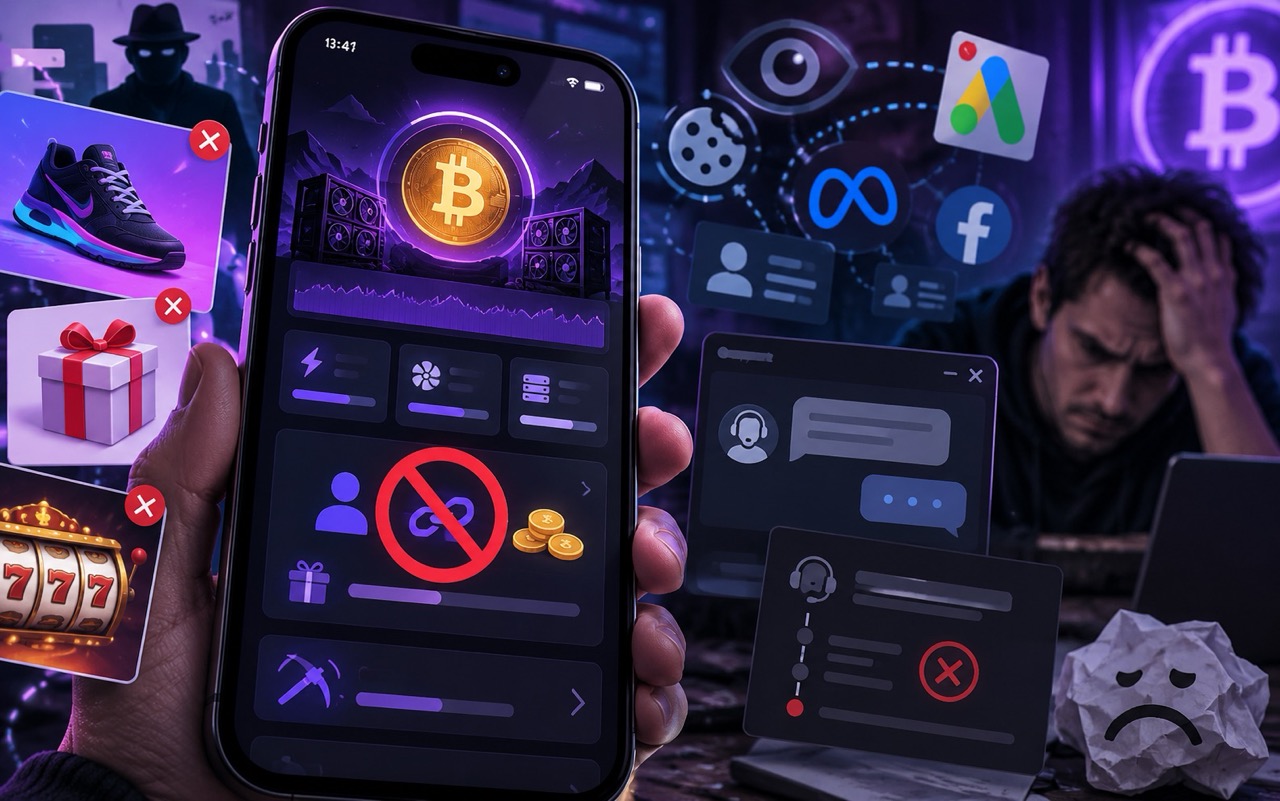
I had known about GoMining for years. Ads for its digital Bitcoin miners kept popping up everywhere, but I never created an account. Only now did I decide to actually try the service: I opened the App Store, found GoMining, installed the app, and signed up.
Then came the absurd part.
Before making my first purchase, I wanted to add a referral code. Instead, the app told me:
You might also like
- The First Bitcoin Transaction for Goods: He Paid 10,000 BITCOINS for Pizza
- Cryptocurrencies: history, how they work, risks, and a practical guide
- Hawk Tuah crypto scandal: what happened with the $HAWK token, the lawsuits, and the SEC inquiry (2024–2025)
- Sweatcoin – earn by walking: how it works and how to redeem rewards (+ $SWEAT token)
“Cannot attach referrer, reason: has-ad-attribution.”
In other words, I could not add a referral because an ad campaign had already managed to “claim” my account.
According to support, GoMining attributed my installation to a paid Moloco ad campaign, even though I did not knowingly sign up through any ad. The system therefore refused to accept the referral, and after I repeatedly explained the issue, support essentially just repeated that “these are the rules.” The result? Instead of buying the miner I had planned to purchase, I requested that my account be deleted.
I wanted to enter the referral before my first purchase
The whole thing is all the more absurd because I had not bought anything yet.
GoMining has a referral program under which a new user can receive 5% extra mining power on their first miner, capped at 25 TH. The app also listed one month of Platinum+.
I had selected a miner for €57.90 and wanted to add a referral code before paying.
Exactly as you are supposed to.
The app even later showed me a screen that said:
“Have a referral code?”
So I entered it.
And the response?
“Cannot attach referrer, reason: has-ad-attribution.”
Great.
GoMining claims I came through an ad
I contacted support and explained something fairly straightforward:
I found and downloaded the app directly through the Apple App Store. I did not decide to register after clicking on an ad. I had known about GoMining for years and signed up on my own.
Support then wrote:
“You did not follow a referral, but a paid Moloco advertising campaign.”
They even gave specific times. According to them, the installation was attributed to the ad campaign at 00:09 UTC and registration took place at 10:18 UTC on the same day.
And for them, that practically settled the matter.
Their system says ad, so it was an ad.
But that is exactly what I disputed
This is probably the most frustrating part of the entire exchange.
I was not telling them:
“There is no ad attribution in your database.”
I was saying:
“That ad attribution does not reflect how I decided to register.”
That is a damn big difference.
Of course, I had seen GoMining ads over the years. And anyone who spends time browsing on their phone knows the aggressive ad formats where you try to hit the X, but instead of closing the ad, another page opens.
I am not claiming I can retrospectively prove that this is exactly how the specific Moloco attribution appeared on my account.
But I am saying something much simpler:
I did not decide to install GoMining because of a Moloco ad.
If a tracking click, cookie, or other attribution data was generated somewhere in the past and the system subsequently linked it to the installation, that is a technical attribution by the ad system.
It was not my decision: “This ad convinced me; I am going to install GoMining.”
Clicking the damn X is not consent to an ad
And that brings us to the broader problem with online advertising.
If a user clicks an ad because they are interested in the product, fine. The ad network can claim the conversion.
But if an ad format opens the landing page when the user is trying to close the ad, then automatically treating that as a relevant marketing conversion is, in my opinion, bullshit.
Clicking the damn X is not the same as deliberately clicking an ad.
And, in my opinion, such a historical attribution certainly should not carry more weight than the explicit decision of a newly registered user:
“I want to use this referral code.”
That is exactly what GoMining refused.
I did not want any trick or double bonus
This was not an attempt to get two referral bonuses.
I did not have any other referral.
I had not bought anything.
I was not creating a second account.
I was not asking them to give me anything extra.
I simply wanted the ad system’s attribution, which I disputed, removed and replaced with the referral code I had deliberately chosen before making my first payment.
GoMining refused.
Support: “These are the rules”
After it was supposedly escalated to a “specialist,” the response essentially repeated the same thing.
Later, another support agent wrote:
“Unfortunately you were registered using the link of the advertising campaign.”
And then:
“These are the rules.”
But that still does not address the problem.
If a customer says they did not knowingly register through an ad campaign, the response “but our system says you did” does not resolve the complaint.
It merely repeats the data the customer is disputing.
It is like a bank incorrectly charging you a fee, you disputing it, and the bank responding:
“There is a fee in the system.”
No shit. That is exactly why I am writing.
And they simply closed the ticket
The cherry on top was that they closed the conversation without resolving the issue.
After opening a new conversation, I had to ask for a human again.
The result?
Once again, an explanation that I had been registered using an advertising link and therefore, under the rules, could not be someone’s referral.
No:
“We understand that you are disputing the attribution; we will investigate its origin.”
No:
“We can remove it manually.”
No:
“We cannot remove it for this specific technical or contractual reason.”
Simply:
The system says ad. End of story.
So I requested that my account be deleted.
GoMining lost a customer before the first payment
And that may be the funniest part of it all.
I was not someone who had come just to complain.
I was prepared to actually pay €57.90 for the first miner and then test the service.
If it worked well, I would probably have bought more power over time. I also run websites, and GoMining has its own referral program, so I planned to write about the real experience and potentially recommend the service further.
Instead, because of an ad attribution I wanted nothing to do with, the company refused to attach the referral I had chosen myself.
Fine then.
So far, this is the real experience.
Is GoMining a scam?
No. At least this particular incident proves nothing of the sort, and it would not be fair to conclude from it that the service itself or GoMining’s Bitcoin mining is a scam.
The problem I am describing is much more specific:
ad attribution was given priority over the user’s explicit choice, and customer support was unwilling or unable to change the situation even after repeated explanations.
And in my view, that alone is a fairly bad sign.
Especially for a service into which people are expected to put tens, hundreds, or even thousands of euros.
If you cannot flexibly resolve something completely trivial before a customer sends you their first €57.90, the prospect of resolving a genuinely serious money-related issue does not inspire much confidence in me.
The most absurd thing is that GoMining actively promotes referrals
Yet GoMining does not hide its referral program away in some corner of the app.
It has its own section, shows the rewards, and encourages users to invite other people.
In my account, the app stated that a new user could receive:
5% extra mining power (TH) on their first miner,
$20 in mining power after meeting the card requirements,
and one month of Platinum+.
But when I actually chose a referral, ad tracking had more say than I did.
That is a system designed around ad-attribution rules.
Not around what the customer wants.
Check your referral before your first purchase
If you still plan to try GoMining despite this experience and want to use a referral, I recommend one thing:
Check that it is assigned before you buy anything.
If you see the message:
“Cannot attach referrer, reason: has-ad-attribution”
you probably have the same problem.
In that case, I personally would not send even a cent until I knew exactly what or whom the account was attributed to for advertising purposes, and why.
Because if, at registration, you cannot even decide whose referral you want to use, it is entirely legitimate to ask:
Who is actually in control of my account here: me or ad tracking?
In my case, tracking won.
And because of that, instead of a new paying customer, GoMining received a request to delete an account.

Robert
I’m interested in technology and history, especially true crime stories. For three years I ran a fact-based portal about modern history, and for a year I co-built a blogging platform where I published dozens of analytical articles. I founded offpitch so that quality content wouldn’t be hidden behind a paywall.


