

Aktualizované 16.09.2026
Legend versus archive
Even during his lifetime, contradictory versions of his story emerged: to some he was a “man of God,” to others a demon and a threat to the monarchy. The following text separates documented facts from myths—and adds lesser-known details not found in commonly cited biographies.
Siberian roots and the first “conversion”
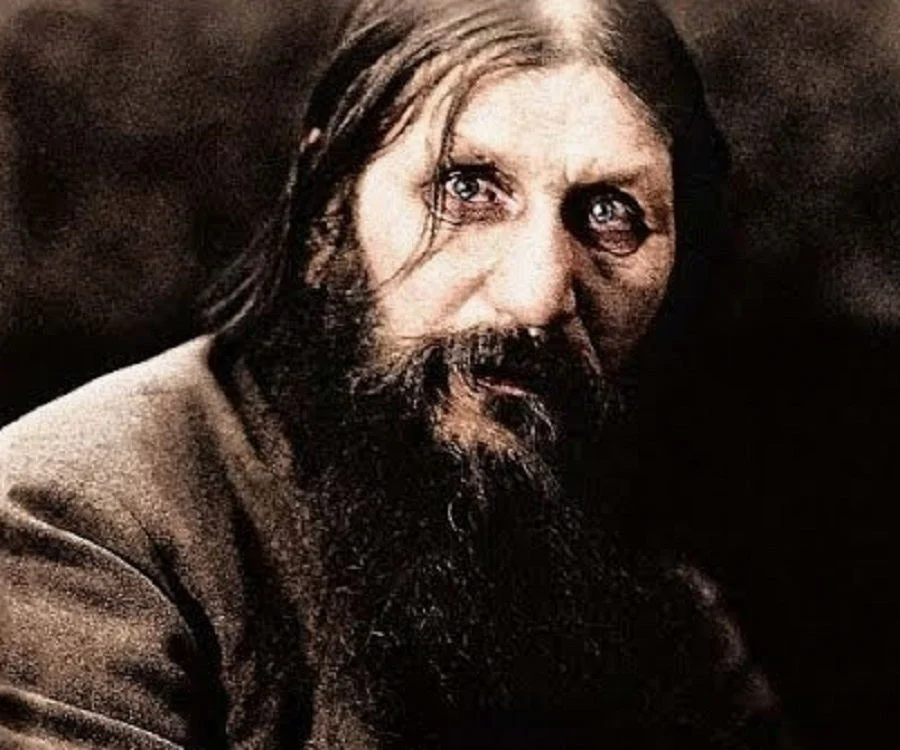
Grigory Rasputin was born on 10 (22) January 1869 in Pokrovskoye near Tyumen. Parish registers list him as the illiterate son of a postman and horse keeper. After a religious ecstasy during a pilgrimage to the Verkhoturye Monastery (1887), he began travelling across Russia as a “starets”—a lay penitent who prayed for sinners. At the same time, however, local police records linked him to suspicions of theft and brawling, reinforcing his nickname rasputny —“debauched one.”
A “teacher” without schooling: how a pilgrim became a guest at court
- 1903 – he arrived in St Petersburg, where he impressed church intellectuals with his humility, ascetic appearance and penetrating gaze.
- 1905 – through ladies-in-waiting Anna Vyrubova and Milica of Montenegro, he was introduced to Tsar Nicholas II and Tsarina Alexandra.
- 1906 – the first of several miraculous interventions in Tsarevich Alexei’s haemophilia; modern medical analyses suggest that Rasputin may simply have forbidden the use of aspirin, which further reduced blood clotting.
A double life: charismatic healer versus tavern bohemian
Although he behaved modestly before the monarch, away from court Rasputin held wild nocturnal “biblical seminars”—in reality involving sweet wine, ecstasy and casual sex—which he explained through the theory that “sin is a bridge to purification” (a frequently quoted but biblically unsupported statement). The senior hierarchy of the Orthodox Church and Duma deputies repeatedly called for an investigation, but the tsar dismissed the requests as gossip.
The first assassination attempt, which “gave him a halo”
On 12 July 1914, the fanatic Khioniya Guseva travelled to Siberia to stab Rasputin in the abdomen with a dagger; the monk survived a complicated operation, and the incident further enhanced his reputation for being “indestructible.” Interestingly, after the attack the secret police discovered letters from the radical former monk Iliodor, who likely incited Guseva to act—showing that Rasputin was already dividing even ultraconservative circles.
Political influence during the First World War
From 1915, when Nicholas II moved to the front, the government was effectively left in the tsarina’s hands. Alexandra regarded Rasputin as the “voice of God” and consulted him on the appointment of ministers and generals, including the famous dismissal of the military professional Polivanov. These counterproductive personnel reshuffles deepened public distrust of the dynasty—the reason even moderate monarchists eventually concluded that the starets had to be removed.
The night at the Moika: more versions than participants
| Version | Key points | Points of dispute |
|---|---|---|
| Memoirs of Prince Yusupov | poisoned cakes, three shots, drowning in the Neva | cyanide combined with sugar may not be effective; the autopsy report cites a fatal gunshot wound to the head |
| Police report | no evidence of food; three gunshot wounds, death by exsanguination | the report was later “altered” by censorship |
| MI6 theory | the final shot was allegedly fired by British agent Oswald Rayner to prevent Russia from withdrawing from the war | British archives contain no explicit link to Rayner; the hypothesis remains circumstantial |
Forensic analyses displayed at the State Archive of the Russian Federation (2004) confirmed that a gunshot wound, rather than drowning, was the more likely cause of death; the lungs showed no typical signs of cold-water inhalation.
A prophecy of the dynasty’s fall
A month before his murder, he allegedly wrote to the tsarina: “If I am killed by one of your relatives, none of your blood will survive for more than two years.” Nineteen months later, in July 1918, the Bolsheviks murdered the entire Romanov family. Historians disagree, however, on whether the letter was written before the assassination or created afterward as part of the legend.
The later lives of Rasputin’s children
The eldest daughter Maria Rasputin fled to France after the revolution and later to the United States, where she earned extra money as a circus lion tamer —under the pseudonym “the daughter of the mad monk.” Between 1929 and 1977, she published three memoirs in which she defended her father’s reputation and challenged the poisoned-cake version, claiming that her father did not eat sweets.
Rasputin in popular culture
In addition to films such as (Rasputin, 1996, Alan Rickman) and the animated film Anastasia (1997), he also served as loose inspiration for the comic-book series Hellboy and the hit song “Ra-Ra-Rasputin” by the German group Boney M. His bearded silhouette has thus moved from archives to T-shirts and TikTok, ensuring that the myth is constantly reincarnated.
What does today’s science say about the “miraculous healer”?
- Haemophilia and the placebo effect: modern haematologists point out that calm and reduced stress lower blood pressure and slow internal bleeding. Rasputin’s long, calming prayers may have had a psychosomatic effect, although they did not prove any actual “healing.”
- Hypnosis: a publication in the American Journal of Hematology (2006) describes the hypothesis that a hypnotic trance helps relieve pain and stop minor bleeding—supporting the accounts of courtiers who saw the tsarevich’s swelling subside after a telephone call with Rasputin.
An indestructible (and seductive) legend
Rasputin embodies several archetypes at once: the peasant saint, the decadent magician and the political intriguer. It is precisely this combination of opposing faces that makes him an endless source of stories—one need only choose an angle, and the “mad monk” is born again.
Video to set the mood
Sources
- Encyclopaedia Britannica – “Grigory Yefimovich Rasputin” Encyclopedia Britannica
- The National Archives (UK) – blog The Murder of Rasputin The National Archives
- Wiley Online Library – study on hypnosis and haemophilia (American Journal of Hematology, 2006) Wiley Online Library
- Smithsonian Magazine – “What Really Happened During the Murder of Rasputin?” (updated 2024) Smithsonian Magazine
- BBC History Extra – “Did a British agent murder Rasputin?” (2022) HistoryExtra

Robert
I’m interested in technology and history, especially true crime stories. For three years I ran a fact-based portal about modern history, and for a year I co-built a blogging platform where I published dozens of analytical articles. I founded offpitch so that quality content wouldn’t be hidden behind a paywall.


