
Aktualizované 30.08.2026
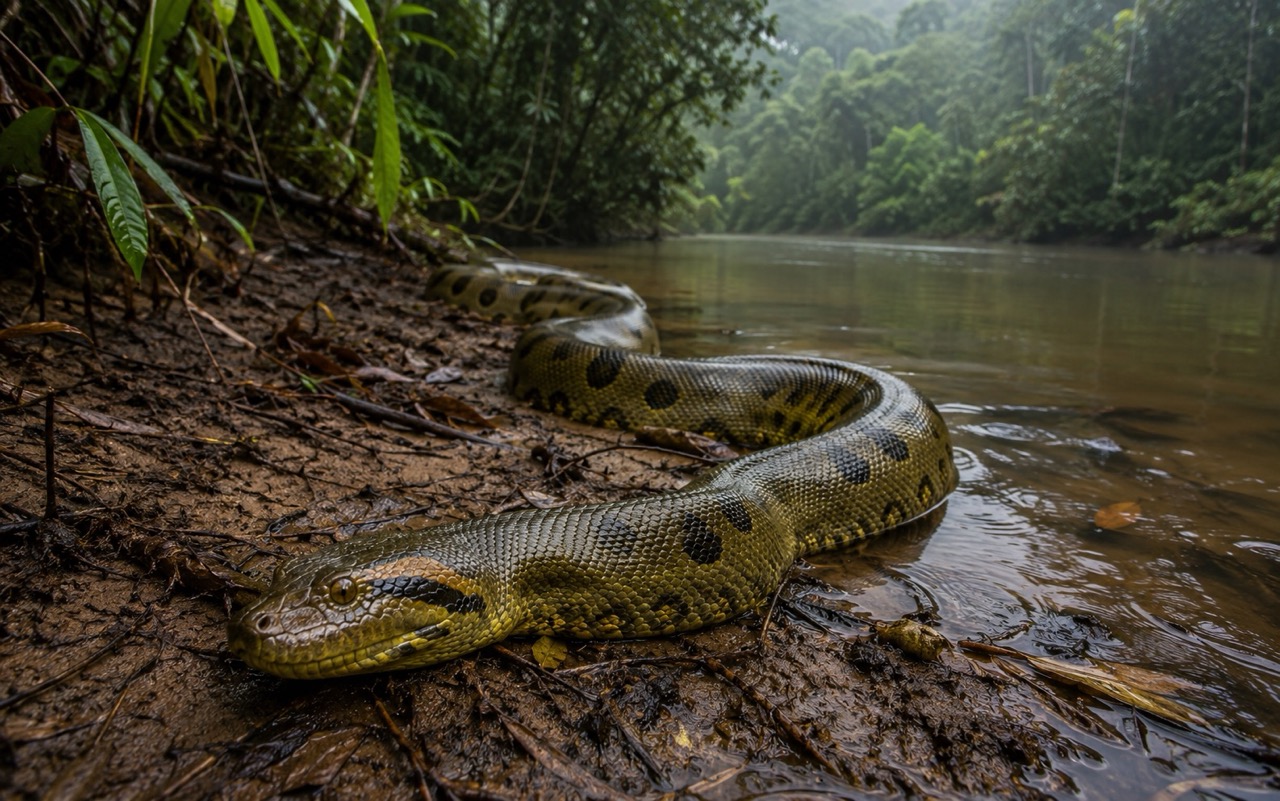
Anacondas are among the animals whose true size is often blurred by legends and movie portrayals. Although there is no reliable evidence of anacondas measuring dozens of meters long, real specimens can still grow to an impressive size. The largest of them, the green anaconda, is considered the heaviest living snake in the world.
The largest anacondas can weigh approximately 227 to 250 kilograms. One exceptionally large, reliably recorded specimen weighed 227 kilograms, measured 8.43 meters long, and had a circumference of 1.11 meters at its thickest point. Most anacondas are considerably smaller, however, and record-breaking sizes are reached primarily by adult female green anacondas.
How much does an anaconda weigh?
An anaconda’s weight depends on its species, sex, age, food availability, and environment. When people refer to an anaconda without specifying the species, they usually mean the green anaconda. This is the species that reaches the greatest weight.
Zoological sources put the weight of the largest specimens at approximately 227 to 250 kilograms. The figures differ mainly because some represent recorded measurements, while others describe the species’ maximum possible size. Exceptionally large anacondas are also rare, and weighing them accurately in the wild is difficult.
The heaviest specimen mentioned by London’s Natural History Museum weighed 227 kilograms. It measured 8.43 meters long and had a circumference of 1.11 meters. Smithsonian’s National Zoo states that the largest green anacondas can reach approximately nine meters in length and weigh around 250 kilograms.
Females are significantly larger than males
Anacondas display one of the most pronounced differences in size between the sexes among snakes. An adult male green anaconda is often around three meters long, while a large female may reach five to six meters. The largest females can weigh several times as much as adult males.
A large body gives females an advantage when reproducing. A larger female can produce more offspring and has greater energy reserves during the approximately seven-month gestation period, when she may eat very little or nothing at all.
Why can’t an anaconda’s weight be determined by length alone?
Two anacondas of the same length may not weigh the same. Weight is heavily influenced by body thickness, muscle mass, sex, age, and whether the snake has recently eaten large prey. An anaconda that has swallowed a capybara or another large animal may temporarily be considerably heavier.
Large females have powerful, broad, muscular bodies. This is why an anaconda can be significantly heavier than a longer python. When comparing records, it is therefore important to distinguish between the longest and the heaviest snake.
Is the anaconda the largest snake in the world?
The green anaconda is considered the heaviest living snake in the world. The record for length, however, generally belongs to the reticulated python, which can grow longer but has a more slender body. By comparison, the anaconda is considerably bulkier.
It is estimated that an anaconda measuring approximately 5.2 meters may weigh about the same as a reticulated python around 7.3 meters long. The difference is mainly due to the anaconda’s much broader torso, which is adapted for moving through water and hunting robust prey.
The title of “largest snake” therefore depends on what is being compared:
- the green anaconda is the heaviest living snake,
- the reticulated python is generally the longest living snake,
- the largest confirmed anacondas can weigh more than two adult humans,
- unverified stories of anacondas measuring 15 to 30 meters long have no reliable scientific basis.
How long can an anaconda grow?
The largest credibly documented anacondas measure approximately eight to nine meters long. Reports of longer specimens appear in historical accounts, stories told by local people, and the media, but they often lack a body, an accurate measurement, or other verifiable evidence.
Measuring large snakes is not easy, even after they have been captured. A living snake twists, contracts its muscles, and can change its body position. Old skins may stretch after being removed and processed, so they do not provide a reliable indication of the animal’s original length.
An ordinary adult is therefore not nine meters long. Males tend to be significantly shorter and lighter, while females most commonly measure around four to six meters. Specimens approaching eight meters are exceptional.
What is an anaconda?
Anacondas are semiaquatic snakes of the genus Eunectes, belonging to the boa family. They live in South America and are close relatives of boas. They are nonvenomous and kill prey with their powerful, muscular bodies.
The name Eunectes can be translated roughly as “good swimmer.” This name reflects the anaconda’s way of life far better than its movie portrayal as a clumsy monster moving across land.
The best-known anacondas include:
- green anaconda – Eunectes murinus,
- yellow anaconda – Eunectes notaeus,
- Bolivian anaconda – Eunectes beniensis,
- dark-spotted anaconda – Eunectes deschauenseei.
In 2024, scientists proposed classifying northern populations of the green anaconda as a separate species, Eunectes akayima. However, this taxonomic split remains a subject of scientific debate. The Reptile Database currently treats the name provisionally as a synonym of Eunectes murinus, so the number of recognized species may vary between sources.
Where do anacondas live?
Anacondas occur naturally in tropical and subtropical regions of South America. The green anaconda mainly inhabits the Amazon and Orinoco basins, the flooded areas of the Llanos, swamps, slow-moving rivers, lakes, and flooded grasslands.
It is found in countries and territories including Brazil, Venezuela, Colombia, Peru, Ecuador, Bolivia, Guyana, Paraguay, French Guiana, and on the island of Trinidad. Individual species have different ranges, with some confined to much smaller areas.
Although anacondas can climb onto riverbanks and smaller specimens may also appear in vegetation, much of their life is closely associated with water. Their massive bodies are supported by the water, allowing them to move more smoothly and stealthily than on solid ground.
Its eyes and nostrils are positioned on top of its head
An anaconda’s eyes and nostrils are positioned high on its head. This allows the snake to remain almost entirely submerged, with only a small part of its face above the surface. Similar adaptations are found in crocodilians and other animals that hunt in water.
Its olive-green coloring and dark spots provide effective camouflage among aquatic plants, mud, and the shadows of shoreline vegetation. As a result, prey may not notice the enormous snake until the moment it strikes.
What does an anaconda eat?
The anaconda is a carnivore and an opportunistic predator. It does not specialize in a single type of prey but hunts animals it can overpower and swallow. Smaller anacondas mainly eat fish, amphibians, birds, turtles, and small mammals.
Large adult females can capture considerably bigger prey. Their diet may include:
- capybaras,
- caimans,
- deer and other ungulates,
- large waterbirds,
- turtles,
- fish,
- smaller snakes,
- domestic animals found near water.
Anacondas do not hunt every day. They have a slow metabolism and may spend several weeks digesting a large meal. Large prey provides enough energy for an extended period, during which the snake does not need to risk hunting again.
How does an anaconda kill its prey?
An anaconda first seizes its prey with its mouth and then coils one or more loops of its body around it. Its muscles gradually exert powerful pressure that disrupts the prey’s circulation. Constrictors were traditionally said to kill by suffocation, but research on boas has shown that rapidly restricting blood flow to the heart and brain may be the key mechanism.
The snake may also respond to the prey’s heartbeat and adjust the force of its constriction. Once the animal has been immobilized, the anaconda swallows it whole, usually headfirst.
An anaconda does not dislocate its jaw
A widespread myth claims that a snake dislocates or detaches its jaw when swallowing large prey. In reality, the jaws do not become dislocated. A snake’s skull consists of several movably connected bones, and the two halves of the lower jaw are joined by a flexible ligament.
This structure allows the snake to open its mouth widely and gradually move each side over the surface of its prey. Backward-curving teeth help hold the food in place and prevent it from slipping out during swallowing.
Is an anaconda dangerous to humans?
An anaconda is an exceptionally powerful wild snake, so people should neither approach nor attempt to catch one. Despite its fearsome reputation, however, attacks on humans are not a normal part of its behavior. Anacondas generally try to avoid conflict and escape into water or mud when threatened.
A large female could theoretically inflict serious or even fatal injuries on an adult human. However, zoological sources do not report any reliably documented cases in which a green anaconda killed and then swallowed a person.
That does not mean an anaconda is harmless. It has backward-curving teeth, a powerful grip, and a heavily muscled body. The risk is greatest when handling the snake, protecting livestock, or in situations where the anaconda feels cornered.
How do anacondas reproduce?
Anacondas do not lay eggs in a nest like many other snakes. Their young develop in eggs inside the female’s body and are born live. The gestation period lasts approximately seven months.
During the mating season, one female may be surrounded by several males. This creates what is known as a breeding ball, which observations suggest may contain as many as 13 males. Mating and competition for access to the female may continue for several weeks.
A female usually gives birth to approximately 20 to 40 young, although considerably larger litters have also been recorded. The largest reported litter contained 82 young. The number of offspring is related to the female’s size and physical condition.
Newborns may measure approximately 60 to 90 centimeters and are immediately independent. Their mother neither feeds nor protects them after birth. Despite their relatively large size, young anacondas may become prey for caimans, large birds, wild cats, and other predators.
A female may eat a male
Sexual cannibalism has also been observed in anacondas. After mating, a large female may consume one of the smaller males. This does not happen during every mating, but it may provide the female with energy during the demanding gestation period.
The pronounced size difference between the sexes means that an adult male may be manageable prey for a large female. Females need a long time to recover after reproducing, so anacondas often breed only every other year.
How long does an anaconda live?
The average lifespan of a green anaconda in the wild is estimated at approximately ten years. Many young individuals do not reach adulthood because they are eaten by predators or die as a result of environmental changes.
Anacondas can live considerably longer in human care. Some individuals have been recorded living for more than 20 to 30 years. In captivity, they are not threatened by natural predators, droughts, or food shortages, but they require ample space, suitable temperatures, and an adequate body of water.
An anaconda is not a suitable pet. It grows quickly, requires specialized care, and an adult can be dangerous even to an experienced keeper. International trade in anacondas and products made from their skin is also regulated.
How does an anaconda locate its prey?
An anaconda does not rely on sight alone. It uses its forked tongue to collect chemical particles from its surroundings and transfers them to the Jacobson’s organ in the roof of its mouth. This enables it to detect prey or another anaconda.
It is also highly sensitive to vibrations in the ground and water. Heat-sensitive pits on its upper lip help it detect the body heat produced by mammals and birds. These abilities are particularly useful in murky water and at dusk, when visibility is limited.
Anacondas are most active in the late afternoon and evening. They often lie concealed in the water and strike only when prey comes within close range.
Can an anaconda survive the dry season?
Anacondas living near large rivers may remain active throughout the year. Those in seasonally flooded areas, however, must seek out the remaining bodies of water during the dry season.
If they cannot find suitable water, they may burrow into wet mud and greatly reduce their activity. This allows them to conserve energy and protect their bodies from drying out and overheating. When the rains return and the landscape floods again, they become more active and resume hunting.
The most common myths about anacondas
Anacondas grow to lengths of 20 or 30 meters
No anaconda of this length has been reliably documented. Stories of giant snakes may result from misjudging distance, stretching a removed skin, or gradually exaggerating an original sighting.
An anaconda can swallow anything
Even a flexible mouth and mobile skull have their limits. The snake must assess whether it can safely kill and swallow its prey. An animal that is too large or dangerous may injure the anaconda, so even large specimens often feed on considerably smaller prey.
Anacondas hunt humans
Humans are not normal prey for anacondas. Conflicts are possible, but movies greatly exaggerate the snake’s willingness to pursue people. An anaconda is an ambush predator that prefers prey naturally found in its environment.
An anaconda crushes all of its prey’s bones
The purpose of constriction is not to crush the skeleton. The pressure primarily restricts the prey’s circulation and movement. Fractures may occur, but they are not the main cause of the animal’s rapid immobilization.
Video: The anaconda, a heavyweight among snakes
Footage from National Geographic shows both the green anaconda’s immense bulk and how it moves through an aquatic environment.
Interesting facts about anacondas
- The green anaconda is the heaviest living snake, but not always the longest.
- Females can weigh several times as much as males.
- Its eyes and nostrils are on top of its head, allowing it to remain submerged.
- It does not use venom but constricts prey with its muscular body.
- It swallows prey whole and cannot chew it.
- After a large meal, it may not need to hunt for several weeks.
- It gives birth to live young that are independent from birth.
- A single litter may contain several dozen young.
- It can detect chemical traces with its tongue, as well as vibrations and the body heat of its prey.
- It lives for approximately ten years in the wild and may survive for more than 30 years in human care.
- It is considerably more agile and mobile in water than on land.
- During the dry season, it may shelter in mud and reduce its activity.
- Reports of anacondas measuring dozens of meters long have not been scientifically confirmed.
Summary
The largest anacondas can weigh approximately 227 to 250 kilograms and measure more than eight meters long. Record-breaking sizes are reached primarily by female green anacondas, which are significantly bulkier than males. Although the anaconda may not be the world’s longest snake, its broad, muscular body makes it the undisputed record holder by weight.
Despite its movie reputation, it is not a creature that deliberately hunts humans. The anaconda is a perfectly adapted aquatic predator whose strength, camouflage, senses, and reproductive behavior make it one of the most remarkable snakes on Earth.
Sources
- Smithsonian’s National Zoo – Green anaconda
https://nationalzoo.si.edu/animals/green-anaconda citeturn737646view0turn737646view1turn737646view2 - Natural History Museum – What is the biggest snake in the world?
https://www.nhm.ac.uk/discover/what-is-the-biggest-snake-in-the-world.html citeturn401123view3 - Animal Diversity Web, University of Michigan – Eunectes murinus
https://animaldiversity.org/accounts/Eunectes_murinus/ citeturn737646view3turn737646view4turn737646view5 - San Diego Zoo Wildlife Alliance – Anaconda
https://animals.sandiegozoo.org/animals/anaconda citeturn401123view2 - The Journal of Experimental Biology – Snake constriction rapidly induces circulatory arrest in rats
https://journals.biologists.com/jeb/article/218/14/2279/14389/Snake-constriction-rapidly-induces-circulatory citeturn271789search0 - Natural History Museum – Snakes: Super senses, stretchy jaws and deadly venom
https://www.nhm.ac.uk/discover/snakes-senses-stretchy-jaws-deadly-venom.html citeturn660523search0 - Diversity – Description of the Northern Green Anaconda: What Is in a Name?
https://www.mdpi.com/1424-2818/16/7/418 citeturn401123view4 - The Reptile Database – Eunectes murinus
https://reptile-database.reptarium.cz/Eunectes/murinus citeturn356452search0

Jana
I like turning curiosity into words, and writing articles is my way of capturing ideas before they slip away — and sharing them with anyone who feels like reading.


