
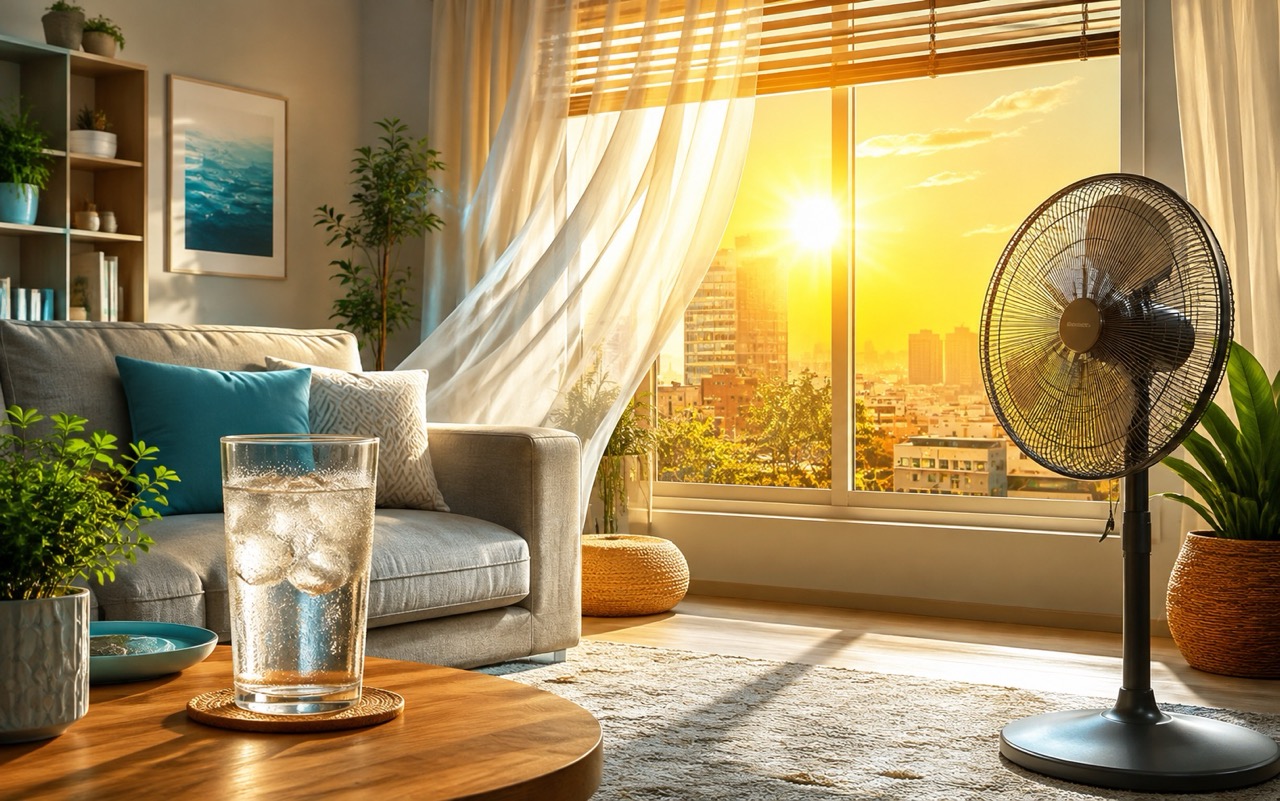
During summer heatwaves, even a comfortable home can become difficult to work, sleep and relax in within just a few days. The biggest mistake is often waiting to tackle the heat until the air, furniture, walls and floors have already warmed up. It is much more effective to prevent heat from entering in the first place, then use proper ventilation and suitable cooling devices.
The best summer heat-busting solutions are not always the most expensive. Exterior blinds or shutters, effective window shading, properly timed ventilation, a fan and sensible use of air conditioning can make the biggest difference. A thermometer by the window, reflective film, a shade sail, cooling textiles and the simple rule of not generating unnecessary extra heat indoors during the day can also help.
1. Shading your windows matters more than buying a more powerful fan
Sunlight passing through glass can heat a room significantly. If you leave south- or west-facing windows unshaded on a sunny afternoon, a fan will merely alleviate the effects of heat you have already allowed inside.
Exterior blinds and shutters
If you can install exterior blinds, shutters or window shutters, they are among the most effective passive solutions. They block solar radiation before it reaches the glass and begins heating interior surfaces.
For a house, an awning, roof overhang or exterior shade sail can serve a similar purpose. The key difference compared with an ordinary indoor curtain is that the heat remains outside the building.
Blackout and thermal curtains
In a rented apartment or anywhere the facade cannot be altered, light-colored blackout or thermal curtains are also worthwhile. They should remain closed when the sun is strongest, particularly over south- and west-facing windows.
The U.S. Department of Energy notes that windows are a major route for heat transfer, and that suitable glazing, coatings and shading can significantly reduce the amount of solar heat entering a building.
2. Reflective window film can save an overheating room
Solar-control window films are an appealing option, especially in apartments where exterior blinds cannot be installed. Their purpose is to reduce the amount of solar energy passing through the glass.
However, not every film is suitable for every type of window. With modern insulated double or triple glazing, or glass with special coatings, it is advisable to check the recommendations of both the window and film manufacturers. An unsuitable film can alter the way the glass heats up.
If you have a room exposed to direct sunlight throughout the afternoon, window film may be more useful than another desk fan.
3. A cheap digital thermometer tells you when to open the windows
Paradoxically, one of the most practical summer gadgets is an ordinary thermometer. Ideally, use two sensors: one inside the room and one outdoors in the shade.
The rule is simple. If it is warmer outside than inside, opening a window will generally not help. When the outdoor temperature falls below the indoor temperature in the evening or early morning, it is time to ventilate thoroughly.
During hot weather, the WHO recommends taking advantage of cooler nighttime air. During the day, when it is hotter outside than inside, windows should be closed and covered with blinds or shutters. This is not merely an old rule of thumb without supporting evidence—properly timed ventilation is one of the basic recommendations for coping with heat.
4. Create a strong cross-breeze in the evening
Leaving one window slightly open all night may not be the most effective approach. If the layout of your apartment or house allows you to open windows on opposite sides, you can create cross-ventilation and move air through the rooms much faster.
A fan placed near one of the windows can also help. When it is cooler outside, it can push warm air out or draw cooler air in. In a multi-story house, you can also take advantage of the fact that warm air rises by ventilating the lower and upper floors at the same time.
In the morning, however, the process should be reversed. Once the temperature outside begins to rise, close the windows and keep the shades down.
5. A fan does not cool the room, but it can make people feel much cooler
A fan does not produce cold air. Air movement increases the evaporation of sweat and the transfer of heat away from the skin, making the same room temperature feel more comfortable.
That is why there is little point in leaving a fan running for hours in an empty room. If no one is there and the fan is not being used to exchange air through a window, it consumes electricity without cooling the walls or furniture.
Ceiling fan
In larger rooms, a ceiling fan may be more comfortable than a small desk fan because it moves a greater volume of air without creating a single intense stream directed straight at a person.
Tower or pedestal fan
This is a good option if you want to move the appliance between a home office, living room and bedroom. Models with timers and night modes are especially useful because they do not need to run at full power all night.
However, a fan should not be considered a substitute for air conditioning in extreme conditions. The CDC warns that during very high temperatures, a fan alone may not prevent heat-related health problems.
6. Air conditioning does not need to be set to 18°C
With air conditioning, an extremely low temperature setting is not automatically better. Besides cooling the air, air conditioning also reduces humidity, which can significantly improve how the temperature feels.
In its hot-weather guidance, the WHO gives an air-conditioning setting of around 27°C combined with a fan as an example. The airflow can make the room feel considerably more comfortable without forcing the air conditioner to run continuously at maximum output.
At home, it is therefore often more sensible to maintain a comfortable, stable temperature and shade the windows than to let the room overheat and then try to cool it rapidly.
7. A clean air-conditioning filter is not a minor detail
If you use air conditioning throughout the summer, do not forget about the filters. A clogged filter restricts airflow and forces the unit to work harder.
According to the U.S. Department of Energy, regularly cleaning or replacing air-conditioning filters can reduce energy consumption by approximately 5 to 15 percent. The appropriate interval depends on the type of unit, the amount of dust in the environment and the manufacturer's instructions.
Before the first major heatwave, it is therefore worth checking the filters, evaporator and condensate drain rather than waiting to service the air conditioner only after it stops cooling properly.
8. Beware of “mini air conditioners” with water tanks
Small desktop devices marketed as personal air conditioners are often not air conditioners at all. Most are evaporative coolers that blow air through damp material.
Water evaporation can cool the air, so these devices may feel pleasant at close range. However, their effectiveness depends heavily on air humidity. They work considerably better in dry conditions than on a muggy, humid summer day.
They also add moisture to the room. If high humidity is already part of the problem, a small evaporative cooler may not deliver the results promised by its name or advertising.
9. A cooling mat or pillow can help, especially at night
You do not always need to cool the entire home. If sleeping is the main problem, it may be more effective to focus directly on the bed.
Cooling mats, gel pillow inserts and breathable mattress protectors can draw heat away from the body for a while. Do not expect them to perform like air conditioning, but they can make it easier to fall asleep.
Lighter bedding also helps, as does removing unnecessary blankets and decorative pillows that only retain more heat during summer.
10. A water spray bottle may be more useful than it looks
A fine-mist spray bottle filled with clean water is an inexpensive aid that works through simple evaporation. Lightly dampening the skin while using a fan can provide faster relief.
Damp towels and cooling towels designed for the neck work in a similar way. Among its recommended ways to cool the body during hot weather, the WHO includes wetting the skin, using a wet cloth and taking a cool shower or bath.
This will not solve a high indoor temperature, but unlike many online “hacks,” it directly helps cool the body.
11. Switch off appliances that are quietly heating your home
Almost all the electricity consumed by ordinary appliances in a room eventually turns into heat. A powerful gaming computer, television, multiple monitors or older light bulbs can therefore make a small room even hotter on a sweltering afternoon.
You do not need to unplug every charger at night. It is far more important to limit the use of high-power appliances and switch off equipment you do not currently need.
If possible, it can also help to move energy-intensive computer work to a cooler part of the day.
12. An oven produces exactly what you do not want in summer
Baking or cooking for long periods can generate a substantial amount of heat in the kitchen. This is rarely a problem in winter, but during hot weather the heat is absorbed by the walls and furnishings and remains indoors long after the cooking is finished.
Among its recommendations for people without air conditioning, the CDC advises limiting the use of stoves and ovens on hot days. Preparing cold meals, cooking early in the morning or using appliances that do not require heating a large oven cavity for long periods can help.
If your extractor hood actually vents outdoors, it can remove some heat and moisture while you cook. A recirculating hood with a filter, however, simply returns the air to the room.
13. A shade sail or awning can help cool a house
Homeowners have the advantage of being able to prevent overheating before the sun even reaches the facade. An awning over a terrace, a shade sail in front of large windows or a pergola can reduce direct sunlight on windows and walls.
West-facing surfaces deserve the most attention because they are exposed to the low afternoon sun at a time when the building is already warm from the entire day.
Suitable vegetation also helps in the long term. A tree or climbing plants can provide natural shade for the facade, although this solution cannot be created overnight.
14. Insulation is not just for winter
Insulation is often discussed only in relation to heating bills. However, thermal insulation slows heat transfer in both directions.
A well-insulated roof or attic therefore helps in summer too. In detached houses and attic apartments, the roof can be one of the main reasons the interior continues to overheat on sunny days.
If your attic turns into a sauna every evening despite shaded windows, another small fan will probably not solve the problem. In this case, it makes sense to inspect the roof insulation, the shading on skylights and the overall ventilation system.
15. Start creating a cooler bedroom during the day
By evening, it is often too late to start thinking about how to cool the bedroom. If the sun shines into it all day and the window remains open to hot outdoor air, the mattress, floor and walls will all absorb and retain heat.
Keep the bedroom shaded and, if possible, closed during the day. Once the temperature outside drops, ventilate it thoroughly.
A fan with a timer, light bedding, a cool shower before bed and the removal of unnecessary textiles often make a bigger difference than a supposedly miraculous cooling product.
What does not help much during hot weather
A bowl of ice in front of a fan
A cold object placed in front of a fan can produce a more pleasant stream of air at close range. However, it cannot replace air conditioning or effectively remove heat from an entire room.
Moreover, the ice first had to be made in a freezer, which releases heat into the surrounding space as it operates. It may feel pleasant as a short-term personal aid, but it is not a way to cool an entire apartment.
Leaving windows open all the time
This is one of the most common mistakes. If it is 25°C inside and 34°C outside, an open window allows warm air to flow into the home continuously.
Open the window only when the outdoor conditions will actually help.
A fan in an empty room
A fan primarily cools people, not rooms. The exception is when you deliberately use it to exchange air through an open window while it is cooler outside.
A portable air conditioner without proper venting
A genuine portable air conditioner needs to vent warm air outdoors. If you simply put the hose through a wide-open window without a sealing kit, some hot outdoor air may flow back inside, reducing the unit's efficiency.
The seal around the exhaust hose is therefore more than just a cosmetic accessory.
What to do before the next heatwave
Start by addressing window shading, because any heat that does not enter will not need to be removed later by air conditioning. Then get indoor and outdoor thermometers so you can time ventilation correctly.
If the apartment remains unbearably hot, the next step is a fan or air conditioning, depending on the household's conditions and options. In a detached house, it is also worth examining facade shading, the roof, the attic and insulation.
This approach makes more sense than buying several small devices and hoping they will collectively solve the problem of an overheating building.
When heat becomes more than a matter of comfort
Extreme heat can lead to heat exhaustion or heatstroke. Warning signs include severe weakness, dizziness, headache, nausea, confusion and loss of consciousness.
Young children, older adults and people with certain chronic conditions require particular attention. If someone shows signs of severe overheating, move them to a cooler environment. If heatstroke is suspected, seek emergency medical assistance.
During a heatwave lasting several days, the goal is not merely to make your home more comfortable. Cooling the interior effectively can also be important for your health.
The best strategy combines several simple measures
One fan will not solve the problem of sun-baked west-facing windows, and even air conditioning will not work optimally if sunlight and hot outdoor air stream into the room all day.
The best results come from combining daytime shading, closed windows during the hottest hours, intensive ventilation in the evening and early morning, and then using a fan or air conditioning as needed.
The simplest summer solutions often work best. A digital thermometer can show in seconds whether it is worth opening the windows, properly closed blinds can prevent hours of overheating, and a sensibly used fan can significantly improve comfort. Instead of battling a home that is already sweltering, it is best to act before the heat builds up inside.
Sources
- World Health Organization – Tips for Keeping Cool
WHO: Beat the Heat – Tips for Keeping Cool - U.S. Department of Energy – Energy Saver 101: Home Cooling
Energy Saver 101: Everything You Need to Know About Home Cooling - Centers for Disease Control and Prevention – Heat and People Without Air Conditioning
CDC: Heat and People Without Air Conditioning - U.S. Department of Energy – Window Types and Technologies
Department of Energy: Window Types and Technologies

Jana
I like turning curiosity into words, and writing articles is my way of capturing ideas before they slip away — and sharing them with anyone who feels like reading.


