
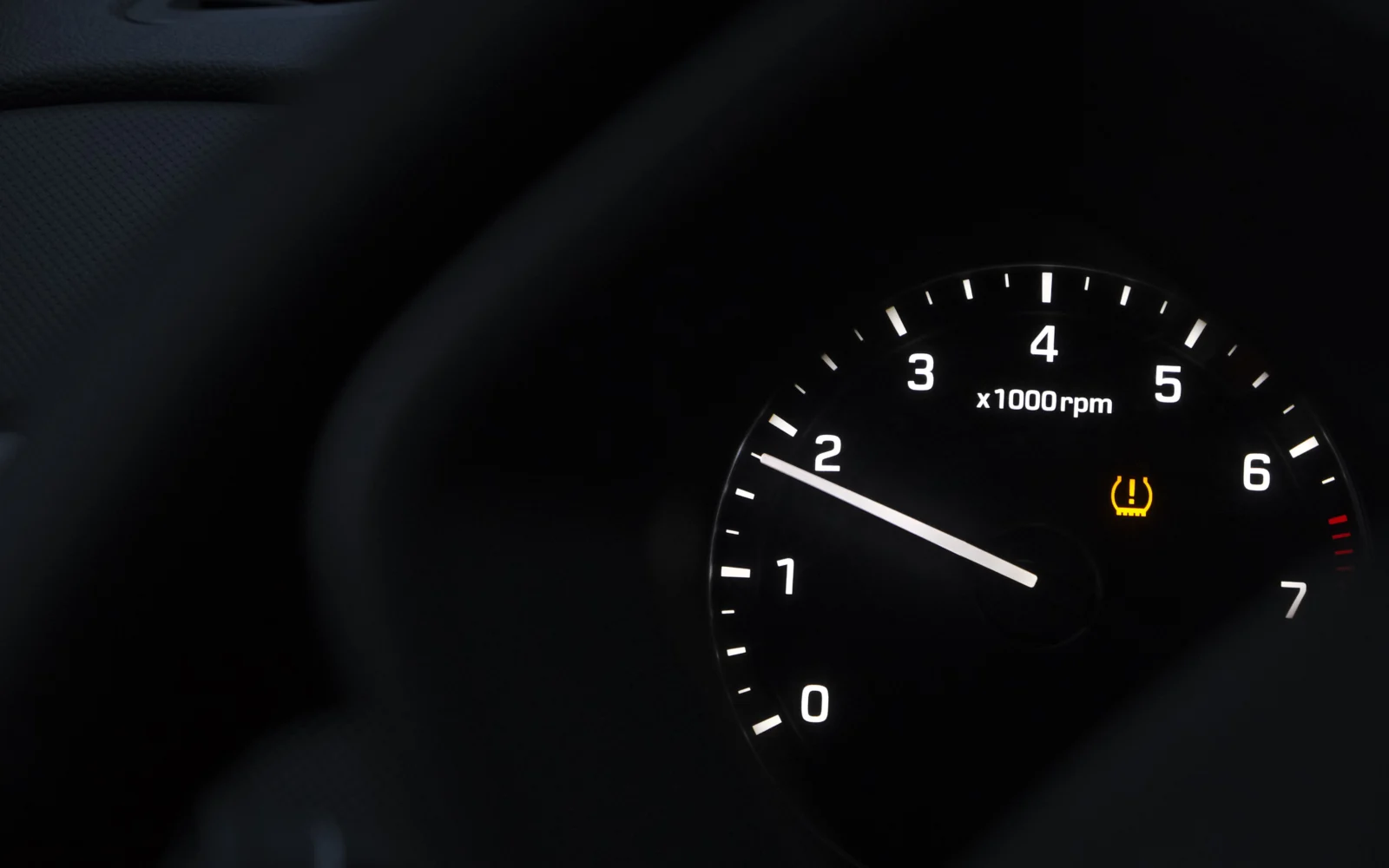
The yellow icon shaped like a tyre cross-section with an exclamation mark may come on while driving, in the morning after a cold spell, or shortly after changing tyres. It is often tempting to simply press reset and carry on. However, this confuses the warning with its cause: the system may be reporting insufficient pressure, but it may also be reporting a fault of its own. First, you need to determine the actual condition of the tyres.
The tyre pressure warning light most often indicates that at least one wheel has insufficient pressure or that the system has detected an unusual change. Pull over safely, inspect the tyres and use a pressure gauge to measure all wheels according to the vehicle manufacturer's specifications. If the icon flashes first and then remains continuously illuminated, there may be a monitoring system fault. Only reset the system after correcting the cause, not instead of checking.
What does the yellow icon with an exclamation mark mean?
The TPMS, or Tyre Pressure Monitoring System, is designed to alert the driver to a pressure problem. Depending on the vehicle, it either uses sensors in the wheels or assesses differences in wheel rotation through other vehicle systems. Both approaches can provide warnings, but they do not operate in the same way. Some cars display a specific reading for each wheel, while others show only a general icon.
The US National Highway Traffic Safety Administration (NHTSA) explains that an illuminated symbol means tyre pressure should be checked as soon as possible. You may not be able to identify an underinflated tyre just by looking at it. Even a modern monitoring system therefore does not replace regular checks with a handheld or compressor pressure gauge.
If a tyre looks completely flat, the vehicle pulls strongly to one side, or you can hear air escaping, do not continue driving normally. Stop away from traffic and follow the vehicle manual, use the repair kit if appropriate, or call for assistance. Driving on a severely underinflated wheel can damage the tyre even without an immediate blowout.
Why does the warning appear mainly in the morning or in autumn?
Gas pressure changes with temperature. When it gets colder outside, tyre pressure generally falls. If it was already close to the lower limit, the system may trigger a warning after a cold night and switch it off later once the wheels have warmed up. NHTSA also describes this pattern.
However, a warning light going out after a few kilometres is not proof that everything is fine. Measure the tyre pressure when the tyres are cold and inflate them to the recommended value. What matters is the information for the specific vehicle, wheel size and load, not a universal figure found online. For a fully loaded vehicle, the manufacturer may specify a different pressure than for normal driving.
A slow leak caused by a nail, valve or damaged rim can look similar to a seasonal drop in temperature. It is therefore useful to check the pressure again after inflating the tyres and visit a tyre shop if the pressure continues to fall.
What to do step by step
- Find a safe place and check whether any tyre is visibly damaged or flat.
- Find the recommended pressure on the vehicle placard, usually on the driver's door pillar, or in the owner's manual. The figure on the tyre sidewall may not be the recommended pressure for your vehicle.
- Measure the pressure of all road wheels when cold. If you have just been driving, follow the manufacturer's instructions and do not release air from a hot tyre simply because the gauge shows a higher reading.
- Inflate the tyres to the pressure stated on the placard, fit the valve caps and check for a possible puncture.
- Only then, following the vehicle manual, calibrate the system, save the reference pressure or take a short drive if the model requires it.
This procedure helps distinguish an actual fault from a system that simply needs to be reset. If the icon returns after the tyres have been correctly inflated and the system calibrated, do not limit the solution to repeatedly resetting it.
Direct and indirect TPMS: why cars behave differently
A direct system generally uses pressure sensors installed in the wheels. It can provide specific readings if the vehicle displays them. The sensors have their own electronics and batteries, so their service life or damage during maintenance can affect them. After changing wheels, the sensors may need to be paired or relearned.
An indirect system assesses the effects of changes in wheel circumference and rotation. After adjusting tyre pressure or changing tyres, it often needs a new reference state to be stored. If you save the reference with underinflated tyres, the system will use an incorrect baseline. This is exactly why manufacturers require the pressure to be checked before calibration.
It is not safe to assume that a “SET” or “RESET” button always does the same thing. In some cars, it starts calibration; in others, it is used to manage sensor data. The exact procedure varies by make, model and model year.
Why does the warning light flash and then stay on?
In many systems, initial flashing followed by a continuously illuminated light indicates a fault in the monitoring system itself. NHTSA describes this pattern for systems used in the US market. Check your vehicle manual to confirm the exact warning pattern; not every make uses exactly the same combination of indications.
Possible causes include an issue with a sensor, its battery, pairing after a wheel change or the vehicle's electronics. Even if the monitoring system has a fault, pressure should be measured manually, as the system may no longer reliably warn you about a further leak. Diagnostic servicing is worthwhile if the signal recurs and normal calibration according to the manual does not help.
When should you visit a tyre shop?
Do not delay an inspection if one wheel repeatedly loses pressure, has a foreign object in it, shows a crack or has a sidewall bulge. A tyre may be damaged even if it can be reinflated. Leave puncture repairs and an assessment of sidewall damage to a tyre shop.
After changing tyres, check that all four wheels are correctly inflated and that the system recognises the fitted set. If the issue is only sensor communication, the diagnosis will differ from the solution for a puncture. In neither case should the driver start by guessing: the first step remains a physical tyre inspection.
Conclusion
The yellow tyre pressure warning light is an alert, not a diagnosis. It can be triggered by a cold morning, an actual leak or a TPMS fault, and not every situation is resolved with the same button. Measure pressure according to the vehicle's specifications, check the condition of the wheels and reset the system only after setting the pressure correctly. If a tyre repeatedly loses pressure or the system flashes or reports a fault, have the cause addressed by a service centre.
Sources
- NHTSA – Tire Safety Ratings and Awareness / TireWise (meaning of the TPMS indicator, temperature effects and system faults) – https://www.nhtsa.gov/vehicle-safety/tires
- MICHELIN Connected Fleet – What is TPMS? Tyre Pressure Monitoring Guide for Fleets (pressure checks and calibration according to the manufacturer) – https://connectedfleet.michelin.com/blog/tpms-guide/

Gabriel Čatár
I'm interested in everyday things we encounter but don't always understand. From technology and personal finance to practical guides and fascinating facts about the world. At Offpitch, I focus on topics worth exploring in greater depth, checking the facts and explaining them in a clear, accessible way. My goal is to make sure readers take away something useful from every article.


