
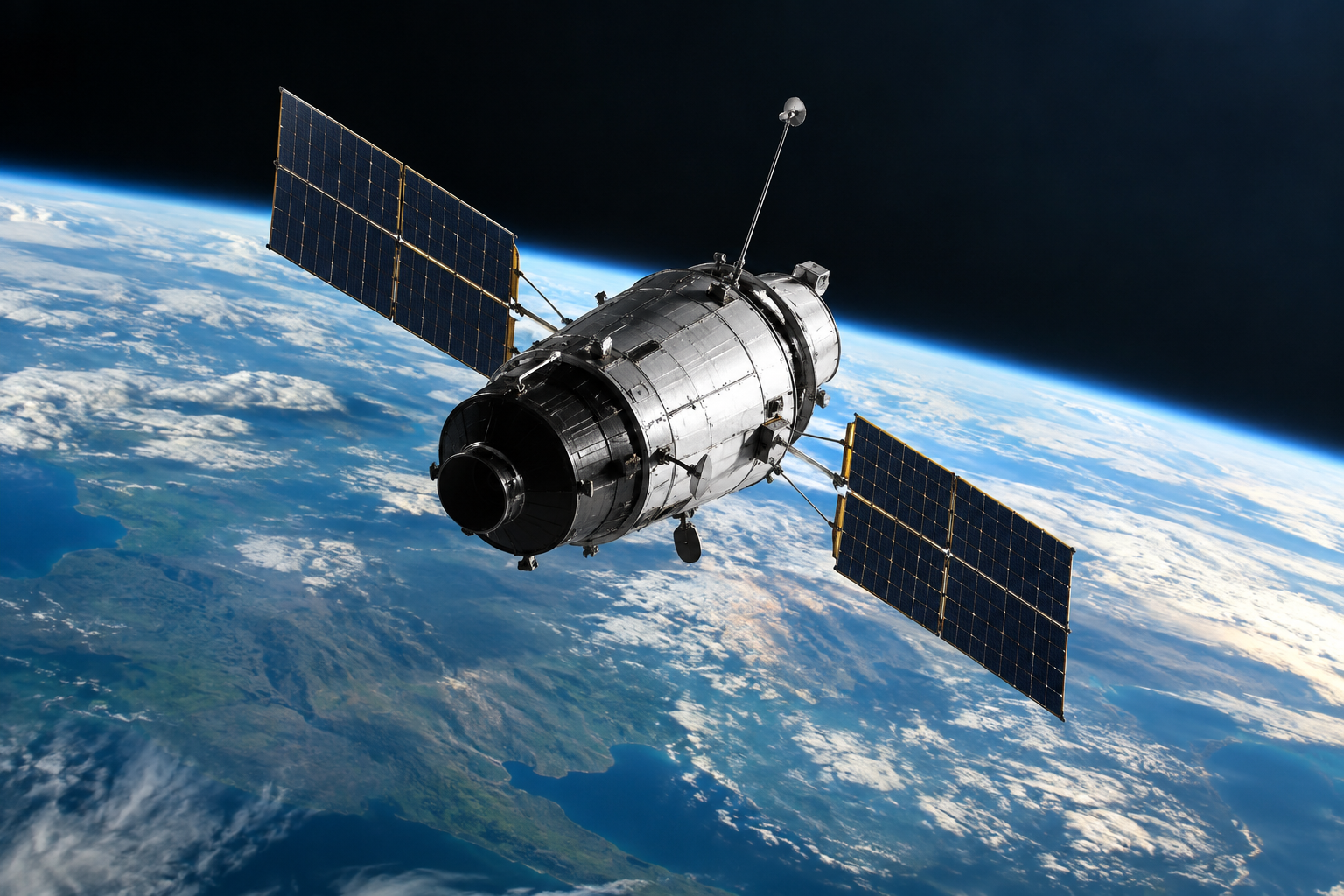
U.S. intelligence and military institutions attribute to Russia the development of a satellite intended to carry a nuclear anti-satellite weapon. German media have now reported that the device could be launched by the end of 2026. However, this part of the report currently has no publicly available evidence or officially confirmed date.
It has not been confirmed that Russia will launch a nuclear weapon into space in 2026. Official U.S. documents refer to the development of such a capability, not to a scheduled December launch. The name Sputnik-S, its alleged location near Moscow, and its readiness for launch come from anonymous intelligence information described by German media.
What German media report and what U.S. authorities say
A joint investigation by German public broadcasters WDR and NDR and the daily newspaper Süddeutsche Zeitung says that Western intelligence services warned in early November of a possible launch within 60 days. According to their anonymous sources, the system is called Sputnik-S and was reportedly ready near Moscow.
However, the public has not seen photographs of the device, technical documentation, or evidence that a nuclear warhead has been prepared for the satellite. Germany’s Ministry of Defence declined to comment on classified assessments. The Russian embassy said it was unaware of the preparations described and called the accusations propaganda.
These new claims should be distinguished from public assessments by U.S. authorities. In its 2026 threat assessment, the Office of the Director of National Intelligence said that Russia is developing a new satellite designed to carry a nuclear weapon as an anti-satellite capability. The U.S. Space Force has also published similar information.
Neither of these U.S. documents confirms the name Sputnik-S, a December date, or the presence of a nuclear warhead on a specific satellite. They constitute an officially published U.S. assessment of the Russian programme, not public proof of a completed weapon waiting on a launch pad.
The purpose U.S. authorities attribute to the system is also important. They describe it as an anti-satellite weapon. Publicly available materials do not refer to a system designed to bomb cities or other targets on Earth’s surface. The reports therefore do not confirm preparations for an imminent nuclear attack on Earth.
How a nuclear weapon could damage satellites
A nuclear explosion in space would not have the same effects as one in the atmosphere or on the ground. In a vacuum, there is no conventional blast wave travelling through the air. Satellites would be threatened primarily by intense radiation and charged particles.
Satellites near the explosion could be damaged by immediate radiation. A high-altitude detonation could also create artificial radiation belts around Earth. Satellites repeatedly passing through them would then receive higher radiation doses, and their electronics, solar panels, and other components could gradually fail.
Such an effect cannot be reliably targeted at one selected military satellite. Civilian and commercial satellites in the affected area or passing through the resulting radiation belts would also be at risk. The weapon would not distinguish between a military communications satellite, a weather satellite, and a commercial network providing connectivity.
The precise scale of the damage cannot be calculated without technical data. It would depend on the altitude of the explosion, the yield of the device, the distance between individual satellites, and their radiation shielding. Publicly available information therefore does not support the claim that one explosion would certainly and immediately destroy all satellites in low Earth orbit.
The ability of a nuclear explosion to damage satellites is not merely theoretical. The U.S. Starfish Prime test in 1962 took place at an altitude of about 400 kilometres and damaged several satellites of the time as well as some electronic systems on Earth. Today’s situation would be different, however: there are far more objects in orbit, and their designs, resilience, and orbital paths vary substantially.
Satellite failures would also be felt on Earth
Satellites are used for more than television signals or internet access. They support navigation, precise timing, communications, weather and Earth observation, military links, and early warning. Widespread damage to satellites would therefore affect services that may not appear connected to space at first glance.
GPS is the best-known example. It is used by drivers, aircraft, ships, and emergency services, but the system also provides highly precise timing. Mobile networks use it to synchronize their equipment, power grids use it to manage operations, and financial systems use it to timestamp transactions.
Disruption to satellite navigation would therefore not simply mean that a map on a phone stops working. Depending on the extent of the damage, services run by mobile operators, banks, or energy companies that depend on precise satellite timing could deteriorate or temporarily fail. This would not automatically mean a complete global outage: the consequences would depend on the number of damaged satellites, available backups, and each network’s ability to switch to alternative solutions.
Damage to communications satellites would affect long-distance links in areas without terrestrial infrastructure. Failures of Earth-observation satellites would limit some meteorological data and the monitoring of fires, floods, and other natural events. Military consequences would include problems with secure communications, navigation, and early-warning systems.
Civilian and military uses often overlap. The same navigation signals are used by armed forces, transport companies, and ordinary phones. An attack aimed at military satellites could therefore damage services used by people and businesses in several countries, including states with no direct involvement in the conflict.
A treaty prohibits placing nuclear weapons in orbit
The Outer Space Treaty, in force since 1967, prohibits placing in orbit objects carrying nuclear weapons or other weapons of mass destruction. Russia is a party to the treaty. Launching a satellite with a nuclear warhead into orbit would therefore violate Article IV of the treaty.
The claim that such a system is being developed does not itself prove that Russia has placed a nuclear weapon in orbit. Likewise, the launch of a satellite would not by itself mean its immediate use. The decisive questions would be what the device actually carries and what it is intended for—details that have not been publicly confirmed in the case of the alleged Sputnik-S.
More than the operation of a few satellites would be at stake. A nuclear anti-satellite weapon could affect a large number of civilian and military systems, without any way to precisely separate intended targets from everything else. For now, however, it is necessary to distinguish between the publicly acknowledged U.S. assessment that Russia is developing such a capability and the new anonymous claim that a specific device could launch as early as December 2026.
Sources
- Tagesschau – Intelligence services warn: Russia reportedly preparing a nuclear weapon in space: https://www.tagesschau.de/investigativ/ndr-wdr/satellit-russland-100.html
- Office of the Director of National Intelligence – Annual Threat Assessment of the U.S. Intelligence Community 2026: https://archive.dni.gov/files/ODNI/documents/assessments/ATA-2026-Unclassified-Report.pdf
- U.S. Space Force – Space Threat Fact Sheet: https://www.spaceforce.mil/About-Us/Fact-Sheets/Fact-Sheet-Display/Article/4297159/space-threat-fact-sheet/
- United Nations – Outer Space: https://www.un.org/en/global-issues/outer-space
- Center for Strategic and International Studies – High-Altitude Nuclear Explosions: Myths and Reality: https://www.csis.org/analysis/high-altitude-nuclear-explosions-myths-and-reality
- U.S. House of Representatives – Written testimony on threats to satellites and GPS-dependent infrastructure, 2 September 2026: https://docs.house.gov/meetings/IG/IG00/20260902/119497/HHRG-119-IG00-Wstate-JonesS-20260902.pdf

Marcel Macko
I’m most interested in technology, the internet, bizarre news, and stories that make you stop and think, “There’s no way this can actually be true.” I follow what’s happening both at home and around the world and pick the topics I think are worth paying attention to. On Pitchoviny, I try to present them simply, factually, and without unnecessarily sensational headlines.


