
In Central Europe, Christmas is associated with early darkness, lit-up windows and a longing for snow that does not always arrive. On the other side of the world, however, December falls during a period of long days and summer holidays. A decorated tree may still stand in the living room, but after opening presents, the whole family might head to the ocean. The differences extend beyond the weather: they affect food, ideas about Christmas time off and the plants that have become symbols of the season.
In Australia, New Zealand and South Africa, Christmas is celebrated on the same dates in December, but during the local summer. Alongside traditional trees, gifts and church services, celebrations may include outdoor gatherings, barbecues, seasonal fruit and time by the water. Specific customs vary by country, region and family background.
Why December Does Not Mean Winter Everywhere
The reason is the tilt of the Earth's axis. When the Northern Hemisphere tilts away from the Sun in December, the Sun's rays strike the south at a more favourable angle, and days are longer there in areas farther from the equator. It is not because Australia is closer to the Sun than Europe. Everyone on Earth lives on the same planet, whose position relative to the Sun is the same for all at any given moment.
Christmas, however, is a date on the calendar, not a natural phenomenon tied to winter. Christian communities that celebrate it on 25 December do not need to move the holiday by half a year for its atmosphere to resemble a European Christmas. Someone born in Sydney may grow up with snowy Christmas scenes from films and postcards, even though their own holiday memories involve sunshine and light clothing.
Nor is the Southern Hemisphere climatically uniform. In tropical parts of Australia, the rainy season can affect December plans; elsewhere, drought or extreme heat may do so. In New Zealand, weather can be shaped by winds from the ocean. In South Africa, coastal areas and the interior differ markedly. White Christmases are not a common sight there, but clear skies or temperatures suitable for swimming should not be assumed automatically either.
Australia: Morning Gifts, a Festive Lunch During the Day
While a Slovak family may regard dinner on 24 December as the highlight of the holidays, many Australians have their main celebration the following day. The government information portal Study Australia describes 25 December as the central day of the Australian festive season. Families may gather in the morning, exchange gifts and spend several hours sharing a meal. Church services and carol singing are also important for believers.
Summer weather makes it possible to move part of the celebration onto a patio or into the garden. Yet it would be inaccurate to assume that Australian festive tables feature only food from the grill. Roast poultry with potatoes and vegetables is still prepared, much as it is in British tradition. Cold salads and seafood are alternatives well suited to a meal served on a warm day.
The combination of older and newer desserts is also interesting. Families may serve rich fruit puddings, but also pavlova, whose crisp meringue base is topped with whipped cream and fresh fruit. The fruit season allows festive desserts to look different from those in Central Europe, where this is not the season for freshly picked garden strawberries. Pavlova is also well known in New Zealand, and the question of its national origin has been disputed for decades.
Eating outdoors also changes how the meal is organised. Instead of finding extra chairs for the dining room, a host may need to consider whether there will be enough shade, where to put containers of drinks, or how to carry prepared food without leaving it in the sun for too long. The refrigerator plays a different role during such holidays than it does at a family dinner in a snow-covered house. These practical details are part of how tradition adapts to its surroundings.
New Zealand Has a Living Christmas Symbol
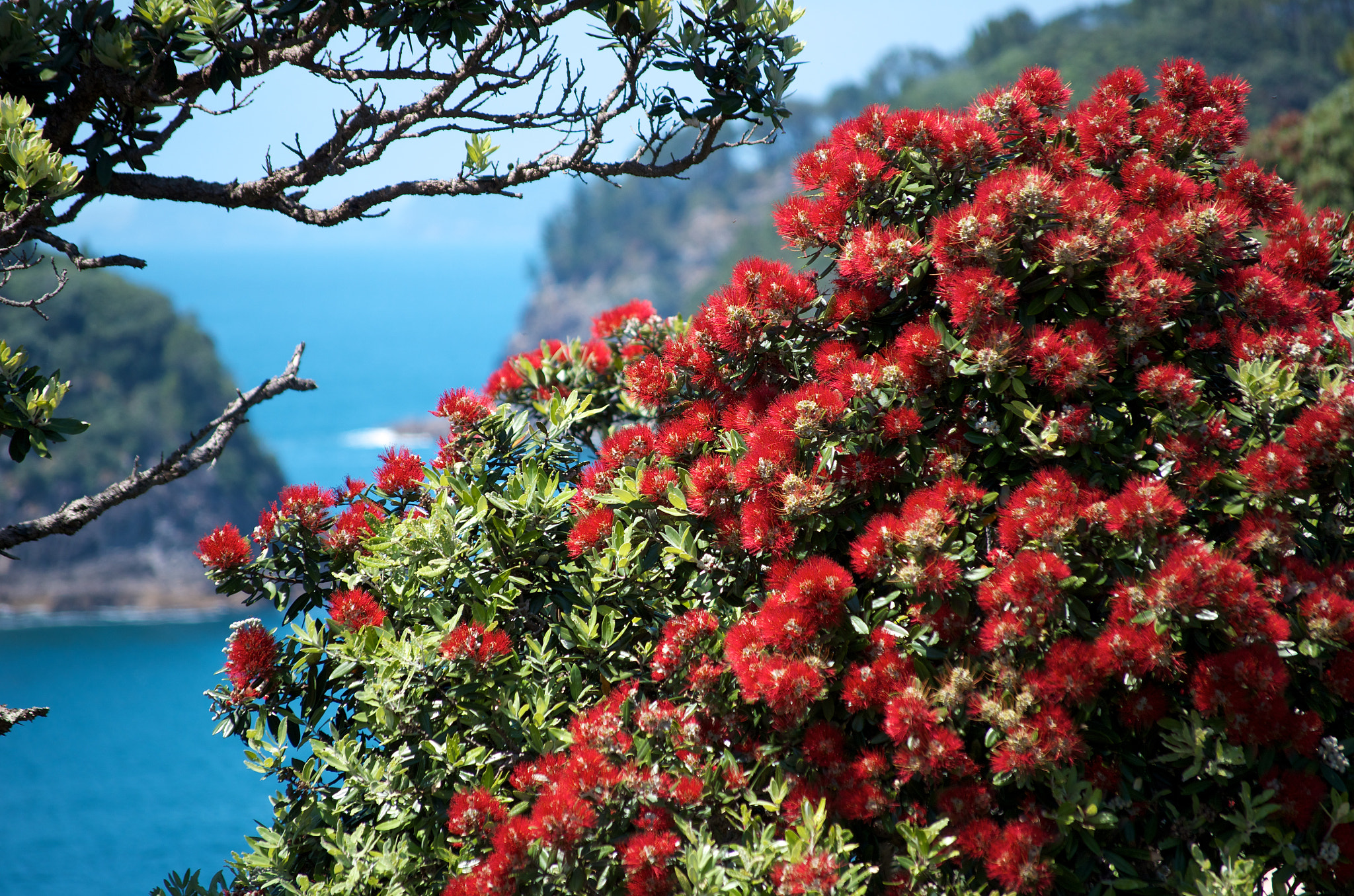
While the European Christmas tree is usually a conifer, the pōhutukawa, or Metrosideros excelsa in Latin, has gained a special place in New Zealand. The tree grows, among other places, in coastal environments, and its striking red flowers appear during summer. Their colour recalls the festive decorations familiar from green branches and red ornaments.
The national museum Te Papa traces this plant's association with Christmas back to sources from the mid-19th century. European settlers brought with them the custom of decorating interiors with greenery and began using local plant species as well. This was not a one-off decision to replace fir trees with another kind of tree, but a long-term blending of imported customs with the New Zealand landscape.
At the same time, the pōhutukawa has significance in Māori culture that cannot be reduced to Christian Christmas. It is also associated with beliefs about the departure of the dead and with sacred places. When the tree became part of festive imagery, its older cultural symbolism did not disappear. A single natural motif can therefore carry different meanings depending on who speaks about it and the historical context they come from.
A New Zealand household does not necessarily have to place a branch from this tree in its living room. Traditionally decorated indoor Christmas trees are also common. The pōhutukawa can instead be seen as a festive emblem of the country that presents itself naturally: on a walk, people may see red flowers without anyone having to arrange artificial decorations.
Summer Holidays as an Extension of the Festive Season
The New Zealand history portal NZHistory notes that at the end of December, many people prepare for a longer summer break. This may involve travelling to the coast or to a holiday cottage called a bach in New Zealand, and a crib in some regions. Such stays are not a distinct religious custom. They are part of a holiday lifestyle that coincides with Christmas and New Year.
In Australia and New Zealand, December falls within the summer school holiday period. Exact dates vary by location and school calendar. For a family with school-age children, however, it may be far more natural to combine a Christmas visit to relatives with a few days away from home than in Slovakia, where the summer break falls at another time of year. The holidays thus overlap with a period when people enjoy activities typical of summer.
Playing in the yard, having a picnic or swimming does not require anyone to give up traditional festive customs. A Christmas visit to grandmother can be just as important whether people travel there on a snowy road or in a sweltering car. Clothing and the meeting place may change, but the family significance of the occasion can remain the same.
South Africa: From Roast Meat to a Braai
South Africa's Christian population is culturally diverse, and festive customs cannot be assigned uniformly to every household. Alongside families maintaining traditions inherited from British and other European settings, there are many different family, linguistic and church traditions. Celebrations may take place on Christmas Eve or mainly on Christmas Day.
Local church sources describe festive menus featuring roast meat, vegetables and fruit pudding. British Christmas crackers may also appear at the table: paper tubes that snap when pulled and contain a small gift or a paper crown. For a Slovak guest, this table ritual may be more unfamiliar than the fact that it is warm outside.
An alternative to roasting food in the kitchen is a braai, the shared preparation of food over a fire, which has a broader social significance in South Africa beyond the festive season. Rather than being a quick dinner, it is an occasion for people to spend time outdoors, talk and eat over the course of a longer gathering. On the coast or in a home with a pool, spending time by the water may also be part of the day. Not everyone, however, has the opportunity to spend the holidays this way.
Why People Buy Snowmen Even in Summer
Images of snow-covered villages and reindeer do not stop at the equator. Through films, advertising, toys and wrapping paper, they have spread far beyond the regions where they originated. Their meaning need not be literal. Artificial snow in a shopping centre is decoration, not a forecast of the weather awaiting visitors outside.
There are also local versions of this symbolism. NZHistory documents New Zealand Christmas parades that began to develop in the early 20th century in connection with department stores. Santa Claus's arrival provided an opportunity for a public event and drew families into shops. Over time, such parades became part of the local festive calendar. The figure in the red suit therefore appears naturally on streets where the trees have green leaves.
An interesting comparison would be a visit to Slovakia in July. Even if someone held a dinner beside a Christmas tree that month, many Slovaks would see it as a themed celebration because their personal memories are associated with December and winter. For someone from the Southern Hemisphere, however, warm weather in December has been normal since childhood. They are not celebrating the holiday on an alternative summer date. They are celebrating it when it actually arrives according to their calendar.
Christmas in the Southern Hemisphere is therefore not simply a European holiday transplanted to the beach. It is the result of migration history, local cultures, climatic conditions and individual family choices. One person may head to the water after a festive lunch, another may stay at home, and a third may spend the day at a church service or with relatives. To understand these Christmas celebrations, it is more useful to consider which customs people have preserved and which they have adapted to their surroundings than to look for a single exotic way of celebrating.
*Preview: A flowering pōhutukawa by the coast, Paul Jackson, Wikimedia Commons.jpeg), CC BY 3.0. Photograph from December 2011; may be cropped.*
Sources

Gabriel Čatár
I'm interested in everyday things we encounter but don't always understand. From technology and personal finance to practical guides and fascinating facts about the world. At Offpitch, I focus on topics worth exploring in greater depth, checking the facts and explaining them in a clear, accessible way. My goal is to make sure readers take away something useful from every article.


