

If you have recently come across bizarre images on social media, endless videos with artificial voices, or articles that sound polished but do not actually say much, you may have encountered the term “AI slop.” The expression emerged to describe one of the side effects of the mass adoption of generative artificial intelligence.
AI slop primarily refers to low-quality content created cheaply and at scale using artificial intelligence. It does not mean that every text, image, or video created with the help of AI is automatically “slop.” What matters is the combination of low quality, minimal human oversight, mass production, and an effort to generate as many clicks, as much attention, or as much revenue as possible.
What exactly does AI slop mean?
In English, the word “slop” can roughly mean mush, waste, or something with little value. In connection with artificial intelligence, it has come to refer to digital content that may look convincing at first glance but, on closer inspection, feels generic, nonsensical, or simply poorly made.
Merriam-Webster defines this meaning as low-quality digital content produced using artificial intelligence, usually in large quantities. The term became so popular that Merriam-Webster named “slop” its 2025 Word of the Year. The American Dialect Society also selected it as its Word of the Year.
Importantly, however, it is an evaluative term. There is no precise technical threshold at which AI content suddenly becomes AI slop. The same generative tool can be used for a high-quality illustration that its creator has spent hours refining, or to automatically generate thousands of images a day without any review.
What does AI slop look like in practice?
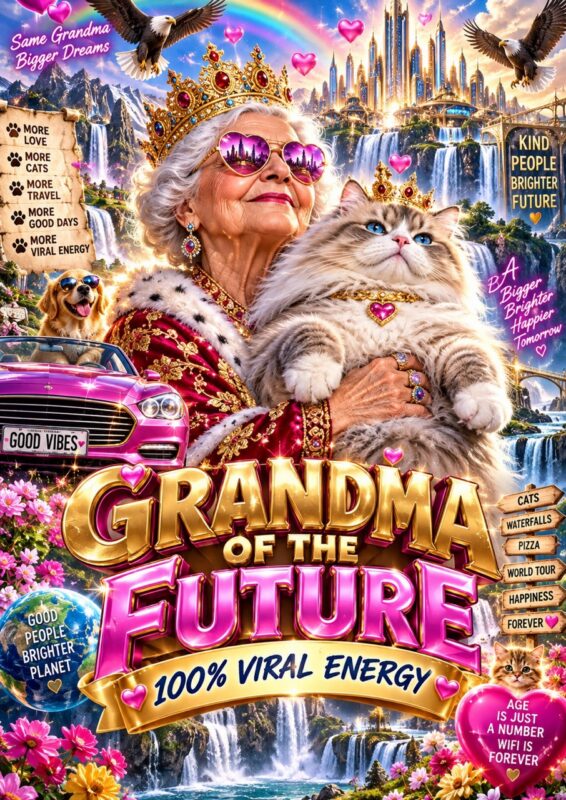
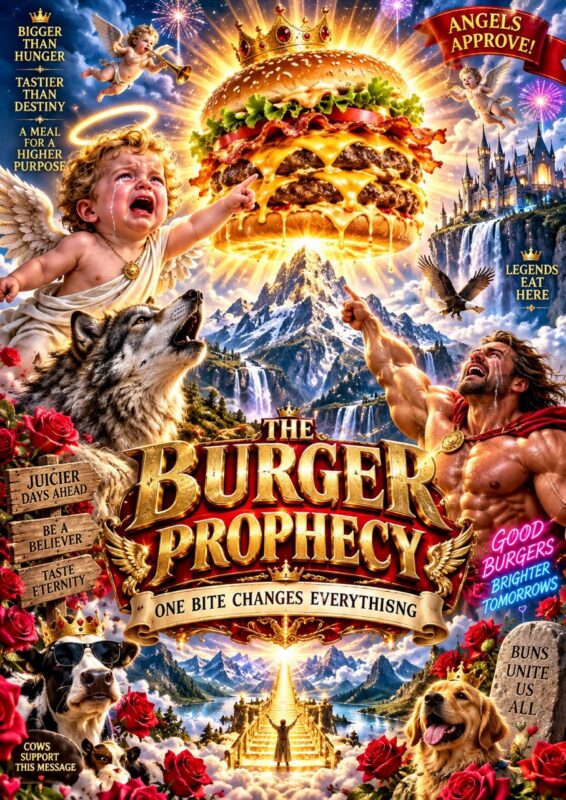
The most visible examples are on social media. Users may encounter a photorealistic image of an enormous animal rescued by firefighters, a nonexistent historical photograph, an incredible house built on a cliff, or an emotional image of a child accompanied by a story that never happened.
Content is often not created because its author is trying to say something. Its primary purpose is to provoke a reaction.
AI images
Typical examples include images combining things that never actually happened. They may be visually striking, emotional, or deliberately absurd. Common signs include illogical details, distorted objects, nonsensical text, or strange anatomical errors.
As image generators steadily improve, however, such flaws are disappearing. Identifying AI images solely by errors in hands or faces is therefore becoming increasingly unreliable.
AI videos
Another major category consists of videos generated almost entirely automatically. A language model creates the script, a synthetic speech generator provides the voice, a video generator creates the visuals, and another tool can then automatically assemble the individual parts.
The result can be dozens or hundreds of similar videos every day.
These are often short videos designed to capture attention in the first few seconds. The content may not be entirely fabricated, but it tends to be repetitive, superficial, or produced without fact-checking.
AI articles and websites
AI slop does not have to be visual. Text can also be produced very easily.
A site operator can automatically generate hundreds of articles covering numerous search queries. The problem arises when the articles provide no original information, nobody reviews them, and their only purpose is to attract users from search engines.
Such text may be grammatically flawless, contain headings and seemingly expert explanations, yet still offer readers almost no value.
Why is there so much AI slop?
The reason is simple: creating content has become dramatically cheaper.
In the past, creating an article required someone to research the topic, write the text, edit it, and publish it. A video needed a script, voice, visuals, editing, and often several people.
Generative AI can automate a large part of these steps.
If one high-quality article or video requires several hours of work, an automated system can produce dozens to hundreds of outputs in the same time. Even if each one receives only a small amount of traffic, this strategy can pay off at a sufficiently large scale.
It is precisely the combination of low costs and social media algorithms that has created favorable conditions for mass production.

Algorithms do not necessarily know whether content has value
Social networks try to show users content that is likely to trigger a reaction. But that does not necessarily mean satisfaction or quality.
A bizarre AI image may receive thousands of comments precisely because people are debating whether it is real. A nonsensical video can succeed because users spend a few seconds watching to figure out what is happening.
Research by AI Forensics published in 2025 examined TikTok and Instagram search results for selected topics in Spain, Germany, and Poland. The authors found a significant presence of synthetic images and also highlighted accounts specializing in the automated production of AI content.
This creates an unusual contest: the algorithm rewards content that can capture attention, while the generator can produce it virtually without limits.
AI slop does not have to be false
One of the most common mistakes is to confuse AI slop with disinformation.
Not every piece of AI slop contains a lie. A recipe may be technically correct, an article may state true facts, and an image may be clearly fantastical.
The problem may be the lack of value itself.
Imagine ten articles explaining the same question. All repeat the same five general points, offer no original data, experience, expert input, or new explanation. The information may not be wrong, but it gives the user almost nothing extra.
The Reuters Institute at the University of Oxford highlighted a similar problem as early as 2024. AI slop can take the form of vague text full of general phrases that looks like a regular article at first glance but lacks a clear purpose or informational value.
Not all AI-generated content is AI slop
This is probably the most important distinction.
Using AI alone says nothing about the quality of the result.
A photographer can use a generative tool to remove a distracting object from a photo. A programmer can have part of their code explained. A journalist can use a tool to transcribe an interview. A writer can use AI for research, grammar checks, or outlining the structure of a text.
The resulting content can still be thoroughly edited, verified, and created with a clear purpose.
AI slop refers more to the opposite extreme: content in which automation replaces the creator’s thought, oversight, and responsibility.
How can you recognize AI slop?
There is no single reliable test. The better generative models become, the less useful simple rules such as “AI always writes this way” or “AI images have bad fingers” become.
Still, there are several warning signs.
Text may repeatedly say the same thing in different words, avoid specific details, and use a great deal of generic phrasing. An article may appear extensive, but after reading it, you may realize that you have learned virtually nothing new.
For factual topics, it is suspicious when sources are missing or when the text refers to organizations and studies that cannot be found.
In images and videos, you can look for physical inconsistencies, changing objects, inconsistent text, or strange transitions. However, these signs are no longer conclusive either.
The best question, then, is not “Was this created by AI?” but rather “Can I trust this content, and does it give me anything useful?”
AI slop can also be a problem for artificial intelligence itself
Massively filling the internet with synthetic content creates another interesting problem.
Generative models learn from vast amounts of existing data. If an ever-larger share of the available internet consists of outputs from previous generations of AI, there is a risk that new models will increasingly be trained on synthetic content.
This does not automatically mean that synthetic training data is bad. In some fields, it is used deliberately and very successfully. The difference is whether it is created in a controlled way or simply collected from the internet along with low-quality content.
That is also why the value of trustworthy, curated sources is being discussed more and more.
AI slop has also reached educational content
The problem is not limited to entertainment.
A study published in 2025 analyzed more than a thousand biomedical educational videos on YouTube and TikTok. Researchers identified some of the videos as likely low-quality AI-generated content.
The share was not high enough to claim that such content had taken over the platforms as a whole. However, the researchers pointed to specific shortcomings that can be problematic in education.
For topics related to health, finance, law, or safety, the difference between entertaining nonsense and incorrect information is much more important.
Why did the term AI slop catch on so quickly?
Because it gave a name to a problem that users had already noticed.
The internet has always contained spam, clickbait, automatically generated pages, and low-quality articles. Generative AI, however, has dramatically increased the speed at which such material can be produced.
One person no longer has to write a hundred articles. They only need to create a system that writes them for them.
That is why the term “slop” gradually began to be used even without the AI qualifier. When selecting it as its 2025 Word of the Year, the American Dialect Society said the label had come to be understood more broadly as a term for mass-produced content of low value.
Does AI slop mean the end of quality content?
On the contrary, it may increase its value.
If the internet fills up with large amounts of cheaply made content, users will probably seek out sources they trust more actively. An author, expert, editorial team, or website with a long-standing good reputation may become more important than in a period when creating content itself was technically difficult.
Value may shift from the question “Can someone create an article?” to “Why should I trust this particular article?”
AI can create text, images, or video in seconds. But it is still necessary to decide what is worth creating, which information is correct, and whether the result is worth the time of the person on the other side of the screen.
Video: Why is AI slop a problem?
Computerphile explores why the mass production of AI content can affect both the quality of the internet and the data used in further artificial intelligence development.
Sources
- American Dialect Society – 2025 Word of the Year Is “Slop”
https://americandialect.org/2025-word-of-the-year-is-slop/ - Reuters Institute for the Study of Journalism, University of Oxford – AI-generated slop is quietly conquering the internet
https://reutersinstitute.politics.ox.ac.uk/news/ai-generated-slop-quietly-conquering-internet-it-threat-journalism-or-problem-will-fix-itself - AI Forensics – AI Generated Algorithmic Virality
https://aiforensics.org/work/gen-ai-slop - Journal of Medical Internet Research / PubMed Central – AI-Generated “Slop” in Online Biomedical Science Educational Videos
https://pmc.ncbi.nlm.nih.gov/articles/PMC12634010/

Robert
I’m interested in technology and history, especially true crime stories. For three years I ran a fact-based portal about modern history, and for a year I co-built a blogging platform where I published dozens of analytical articles. I founded offpitch so that quality content wouldn’t be hidden behind a paywall.


