
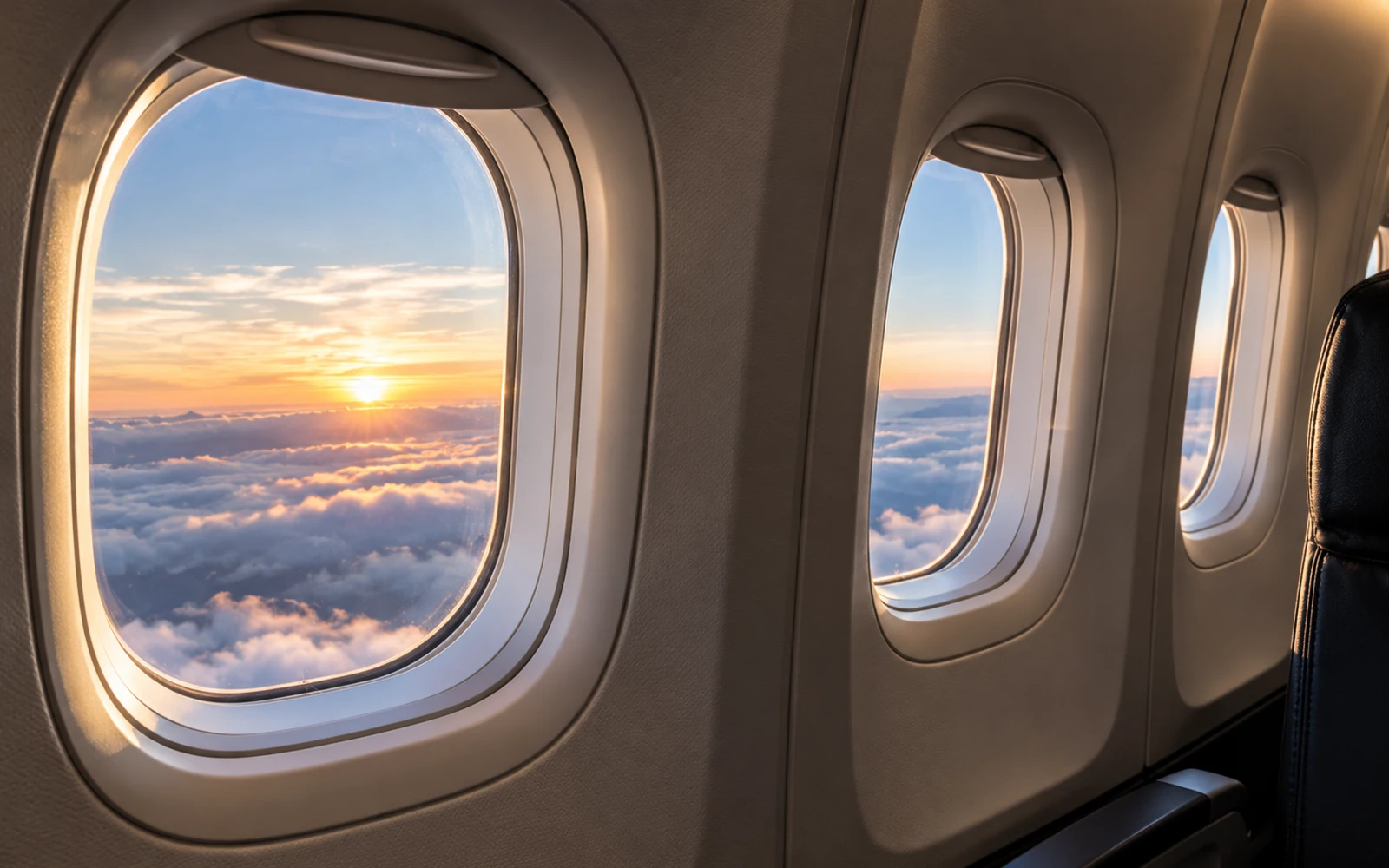
When flying, people tend to focus more on the view through the window than on its frame. But if you look more closely, most windows in an airliner’s cabin have rounded corners and a shape close to an oval. This is neither a coincidence nor merely a design trend. It is connected to what happens to pressure and the fuselage structure at high altitude.
Airliner windows have rounded corners primarily to prevent mechanical stress from increasing at the sharp corners of openings during repeated cabin pressurization. The pressure difference between the cabin and the outside environment places stress on the fuselage during every flight. Sharp corners can concentrate that stress, while a rounded shape distributes it more favorably. The importance of this design principle was also demonstrated by tragic experiences from the early days of jet travel.
Why pressure matters so much at altitude
Airliners fly at altitudes where the outside air pressure is substantially lower than it is on the ground. To make breathing and travel safe in the cabin, its pressure is artificially maintained at an acceptable level. This creates a difference between the pressure inside and outside, which acts on the entire pressurized fuselage, including the areas where openings have been made.
An aircraft fuselage is a compromise: it must be strong enough, but also relatively lightweight. Every opening for a window or door interrupts the continuity of the structure, which is why its shape, reinforcement, and method of attachment are subject to strict requirements. Rounded corners do not ensure safety on their own; they are one part of the overall design.
Why sharp corners are a problem
Imagine a thin sheet of metal with an opening in it. When a force acts on it, the material is not stressed equally everywhere. Higher stress concentrations can arise around a sharp corner. Under repeated loading, such areas can create conditions for fatigue cracks to form and grow unless the structure is adequately designed and reinforced.
An oval window or a rectangle with rounded corners does not have an abrupt change in contour at a right angle. Forces are distributed more favorably around the opening. The Smithsonian National Air and Space Museum explains that rounded corners reduce the stress concentration caused by pressurization, and that this knowledge became firmly established after accidents involving early jet aircraft.
So why don’t we see perfectly round windows?
A purely circular opening is advantageous in terms of stress distribution, but airliners also have practical requirements: passengers want a good view, engineers need to make sensible use of the space between frames, and the manufacturer must design the entire window assembly with its seals. This is why a vertically elongated oval shape or a rectangle with large rounded corners is often used. What matters is that sharp notches do not form at the corners.
The exact shape of a window may vary among aircraft types. The thickness and composition of the transparent layers, the frame design, and the way forces are transferred into the fuselage are equally important. Safety cannot be judged solely by whether a window in a photograph looks more round or more oval.
What happened to the de Havilland Comet
The British de Havilland Comet was among the pioneers of jet passenger travel. Its early versions had cabin windows with a more distinctly angular shape. After two tragic accidents in 1954, an extensive investigation began, including tests of the fuselage under repeated pressure loading. They revealed a serious problem involving structural fatigue and stress concentration around openings and other design details.
It would not be accurate to reduce the entire investigation to the simple statement that “the planes crashed because they had square windows.” It involved a combination of design, structural details, and repeated loading whose dangers were not sufficiently understood at the time. However, the square corners of the windows became one of the best-known examples of why stress concentration matters in pressurized structures.
In its description of airliner construction, the Smithsonian notes that rounded corners and improved load distribution came to the forefront after these accidents. The lessons learned were incorporated into structural development and more rigorous fatigue-life testing.
What is the small hole in an airplane window?
Some passengers notice a tiny opening in one of the window’s layers when looking closely. It is not damage, nor is it an opening through which air is meant to flow freely from the cabin to the outside environment. In a typical multilayer assembly, it is a breather hole in the inner layer that helps equalize pressure between parts of the window assembly and directs the critical pressure load to the layer designed for that purpose.
The exact arrangement of the individual panes may vary by design. It therefore makes no sense to try to determine from a single photograph which layer carries which force on a particular aircraft type. The Smithsonian explains the principle of the small hole as a way to regulate pressure between layers, not as a reason for passengers to worry.
Why does an airplane window have several layers?
Passengers generally look through an assembly of several transparent layers, rather than a single pane set into thin sheet metal. The individual layers perform different functions, and the entire system is designed to withstand pressure, temperature changes, and other flight conditions. The inner layer accessible to passengers can also protect the main assembly from touching and scratching.
Modern aircraft do not rely on a single “magic” safety trick. Rounded corners, structural calculations, reinforced openings, material inspection, and scheduled checks form an interconnected whole. This is why the shape of a window only makes sense in the broader context of a pressurized fuselage.
Video: Why airplane windows are not square
This brief explanation explores the connection between window shape, pressure cycles, and the historical Comet aircraft accidents. The visual demonstration complements the physical principle of stress concentration.
Does that mean a square window can never be safe?
No. It depends on the size of the opening, the material, reinforcement, pressure difference, and other conditions. For example, a window in an unpressurized vehicle operates in an entirely different environment from an opening in an aircraft fuselage that undergoes thousands of pressure cycles during its service life. In practice, this is not a universal ban on all angular windows, but a matter of carefully designing a specific structure.
The next time you sit by a window, its rounded corners may remind you that even an apparently small detail in aircraft design has a technical reason. Behind it lie the physics of materials, the history of accident investigations, and decades of experience designing pressurized cabins.
Sources
- Smithsonian National Air and Space Museum – Why are pressurized windows rounded at the corners? – https://howthingsfly.si.edu/ask-an-explainer/why-are-pressurized-windows-rounded-corners
- Smithsonian Air & Space Magazine – Anatomy of an Airliner: oval windows and metal fatigue – https://www.smithsonianmag.com/air-space-magazine/anatomy-of-an-airliner-38863113/
- Smithsonian National Air and Space Museum – Why don't airplane windows shatter due to pressure differences? – https://howthingsfly.si.edu/ask-an-explainer/why-dont-windows-planes-shatter-due-pressure-difference-inside-and-outside-cabin

Gabriel Čatár
I'm interested in everyday things we encounter but don't always understand. From technology and personal finance to practical guides and fascinating facts about the world. At Offpitch, I focus on topics worth exploring in greater depth, checking the facts and explaining them in a clear, accessible way. My goal is to make sure readers take away something useful from every article.


