
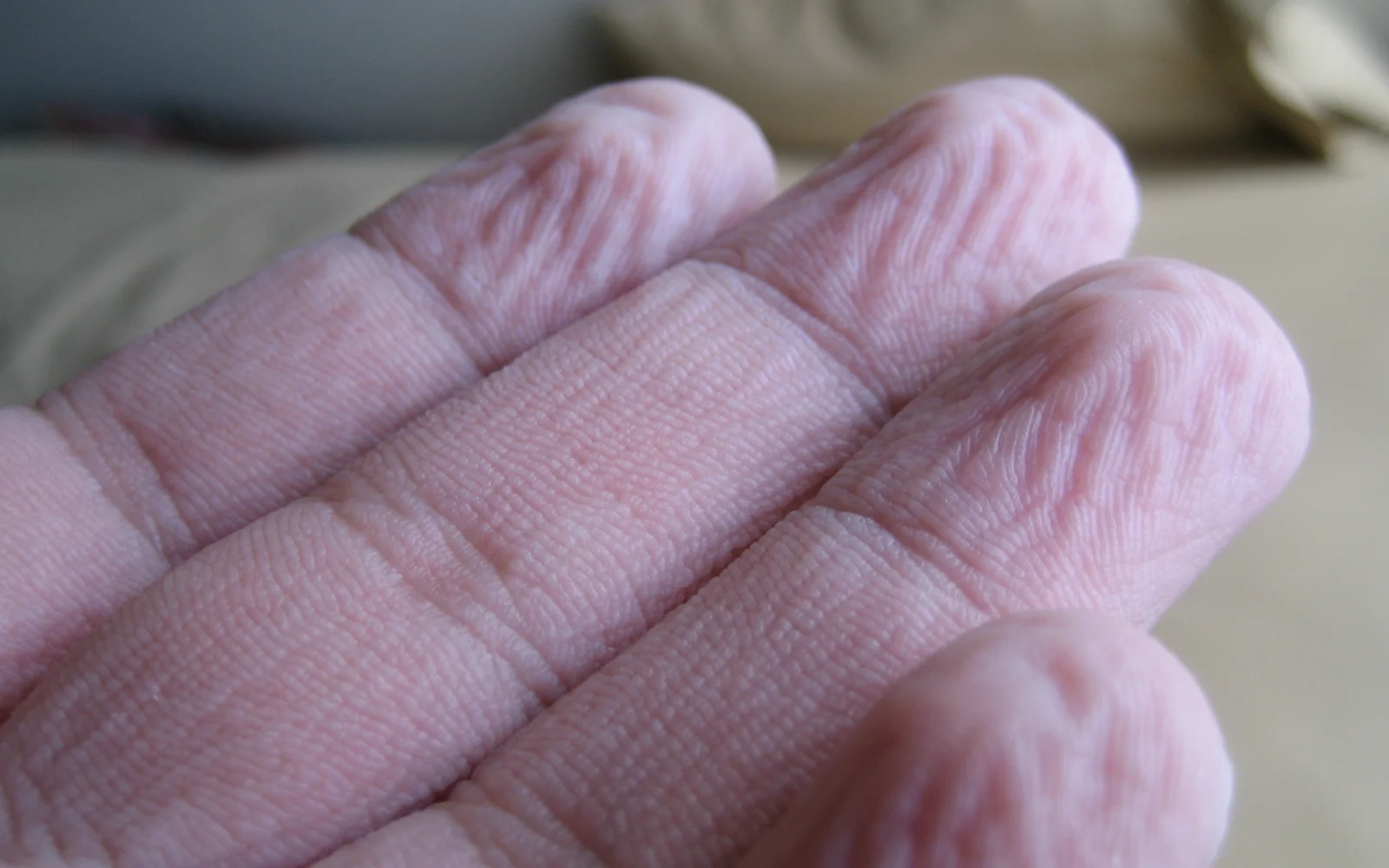
After a long bath or washing dishes, the pads of your fingers look like tiny wrinkled maps. Most people have a simple explanation: the skin absorbs water and expands. However, modern experiments show that the autonomic nervous system and changes in the volume of tissue beneath the skin play an important role in the typical wrinkling that occurs after immersion. The possible evolutionary function is still debated.
After prolonged time in water, fingers wrinkle mainly because nerve-mediated constriction of tiny blood vessels changes the volume of tissue beneath the skin of the fingertip pads. Absorption of water by the surface layer alone does not explain the entire phenomenon. Some studies indicate improved handling of wet objects, while others have not confirmed this result, so the exact purpose of the wrinkles has not been definitively established.
What happens beneath the skin after your hand is immersed in water?
The skin on the pads of the fingers does not have the same structure as the skin on the forearm. When fingers remain in water for an extended period, they develop distinctive grooves and ridges. A key part of the mechanism is linked to the autonomic nervous system, which is not directly controlled by conscious will.
Research links this process to constriction of tiny blood vessels and the resulting reduction in the volume of soft tissue in the fingertip pad. The outer layer of skin then forms folds relative to the tissue beneath it. This differs from the ordinary expansion of a material after it absorbs liquid.
Earlier neurological research showed that typical wrinkling can be impaired when nerve supply is damaged. This is an important argument for why the phenomenon cannot be explained solely by the passive physics of the skin’s outer layer. However, this does not mean people should test their nerves or diagnose themselves by soaking their fingers at home.
Why do wrinkles occur mainly on fingers and soles?
The most noticeable changes occur in hairless skin on the fingers and soles of the feet. It is adapted for touch, friction, and repeated contact with objects or the ground. Researchers therefore examine whether wrinkling after immersion is also related to how fingers behave in wet environments.
The time it takes wrinkles to develop can vary depending on water temperature and other conditions. Wrinkles are therefore not a precise timer that can reveal how many minutes someone spent in a pool. They may look different in photos from different baths even when the person is completely healthy.
A brief handwashing session typically does not produce the same effect as a longer bath. After drying, the appearance of the fingers normally gradually returns to its original state. If unusual or persistent skin changes occur outside of time spent in water, they are not automatically caused by the same mechanism.
Are wrinkles like tire tread?
One hypothesis suggests that grooves may help when handling wet objects, for example by changing the contact between the skin, water, and the surface. However, the illustrative comparison with tire tread should be viewed as an idea of a possible mechanism, not as proof that the two systems are identical.
A study published in the journal Biology Letters in 2013 found that participants with wrinkled fingers moved wet objects faster than those with smooth fingers. Researchers found no equivalent advantage with dry objects. This was an experiment involving a specific task, not proof that every type of grip improves in water for every person.
A subsequent 2014 study did not confirm the advantage in its manual-dexterity test. The authors also measured tactile ability and found no relevant difference. Scientific evidence therefore does not justify simply saying, “Scientists proved that wrinkles evolved to improve swimming.” That conclusion would be stronger than the available findings.
What did further grip measurements show?
In 2021, a study examined not only handling speed but also the force required to hold a wet object. The results suggested that grip with wrinkled fingers could be more efficient: the force required approached that needed to hold a dry object.
Such findings support the possibility of a functional advantage, but they do not determine a definitive evolutionary cause. Finding an advantage in a laboratory experiment does not prove that this particular advantage was the sole reason the mechanism evolved. Research examines function and cause from different perspectives.
That is why it is useful to distinguish between the questions of “how wrinkles form” and “what they may be for.” The answer to the first is relatively well supported by nervous regulation and blood vessels. The answer to the second requires more cautious language.
Does the absence of wrinkling indicate a health problem?
Not necessarily. The speed of the reaction varies between people and conditions, and brief soaking may not cause pronounced grooves. Scientific assessment of the autonomic nervous system uses controlled conditions that a bath at home cannot replace.
However, if loss of sensation, weakness, pain, or a pronounced one-sided change occurs suddenly, it is sensible to consult a healthcare professional. The appearance of skin in water alone is not a sufficient basis for a neurological diagnosis. Do not try to trigger the reaction with extremely hot or chemically treated water.
After an ordinary bath, dry your fingers and use appropriate skin care if they are dry. Water-induced wrinkles are an interesting example of the connection between nerves, blood vessels, and skin mechanics, not a reason to panic.
Another common misconception is that a hand must always wrinkle in the same way in fresh and salt water, or that the higher the temperature, the better this phenomenon can be studied. Researchers regard temperature and the properties of the solution as important experimental conditions. Do not turn an ordinary bath into a comparative health test or a home physiology experiment. If the wrinkles are merely the usual temporary kind and occur without other symptoms, their presence alone says nothing about water quality or the hydration of the body as a whole.
Sources
- Royal Society Biology Letters / PubMed Central – Water-induced finger wrinkles improve handling of wet objects (experiment involving the handling of wet objects) – https://pmc.ncbi.nlm.nih.gov/articles/PMC3639753/
- PLOS ONE – Water-Induced Finger Wrinkles Do Not Affect Touch Acuity or Dexterity in Handling Wet Objects (did not confirm part of the hypothesis) – https://journals.plos.org/plosone/article?id=10.1371%2Fjournal.pone.0084949
- PLOS ONE – Water-immersion finger-wrinkling improves grip efficiency in handling wet objects (grip-force measurement) – https://journals.plos.org/plosone/article?id=10.1371%2Fjournal.pone.0253185
Article photo: Brenderous, licensed under CC BY 2.0. When the photo is used, WordPress may automatically resize or crop it.

Gabriel Čatár
I'm interested in everyday things we encounter but don't always understand. From technology and personal finance to practical guides and fascinating facts about the world. At Offpitch, I focus on topics worth exploring in greater depth, checking the facts and explaining them in a clear, accessible way. My goal is to make sure readers take away something useful from every article.


