
Aktualizované 16.08.2026
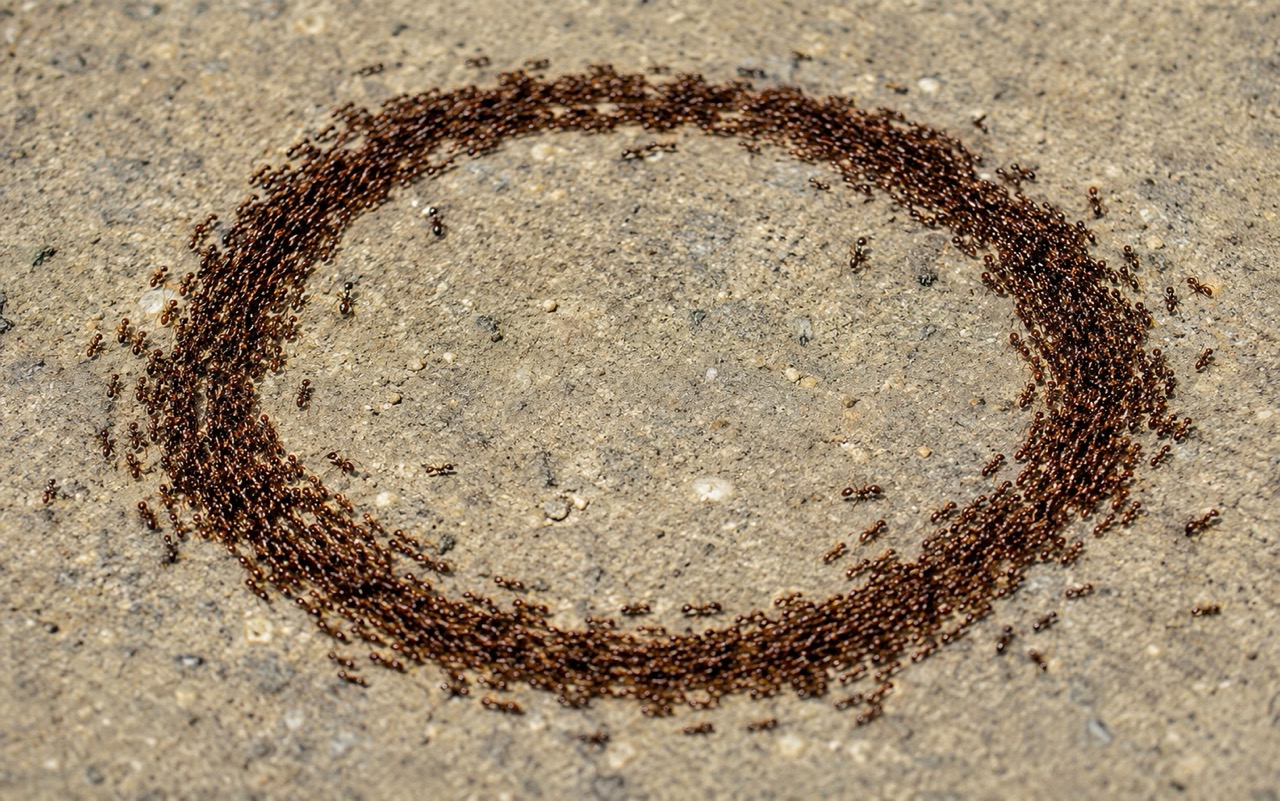
Disturbing footage of thousands of ants marching in an almost perfectly closed circle regularly appears online. None of them changes direction, and the entire procession may continue circling for hours. However, this is not a mysterious ritual or deliberate mass death, but a rare failure in the way some ant species navigate.
Ants die in a circle when they become separated from the main column and begin following one another’s scent trails. This creates a closed loop that more ants continually reinforce with pheromones. If the circle is not broken, they may march until they are completely exhausted. This phenomenon is known as an ant mill or ant death spiral.
What is an ant death spiral?
The scientific term for this phenomenon is “ant mill.” It is also sometimes called a “death spiral.” It is most commonly associated with nomadic ants, also known as army ants, which travel in large, densely packed columns while searching for food.
Ants in such a formation do not necessarily create a geometrically perfect circle. The route may be oval or wavy, or it may wind between rocks, roots, and plants. From above, however, it looks like a closed ring in which each ant follows the one ahead while also leading the ant behind it.
A spiral may consist of just a few dozen ants, but enormous circular columns containing thousands of ants have also been recorded. Unless they find a way out or something disrupts their route, they keep returning to the same place.
Why do ants start walking in circles?
They navigate mainly by chemical trails
Many ants use pheromones to navigate. These are chemical substances that they deposit on surfaces and that other ants can detect with their antennae. In this way, one group can mark a route to food, to a temporary nest, or back to the main part of the colony.
Army ants are highly specialized in collective movement. Workers of some species have very limited vision and rely heavily on scent trails, physical contact, and the movement of other ants to navigate. Under normal circumstances, this system is extremely effective because it allows vast numbers of ants to coordinate without centralized control.
Problems arise when part of the colony becomes separated from the main stream or the original scent trail is broken. The lost ants begin searching for the route and may encounter pheromones left moments earlier by other lost ants. If the emerging trail forms a closed loop, the ants begin following it in circles. citeturn798554view2
Each ant follows the one in front
An individual ant does not know where the group as a whole is going or whether the column is approaching its destination. It responds only to immediate cues in its surroundings. If it detects a sufficiently strong scent trail and sees or senses another ant ahead, it continues in the same direction.
The first ant may therefore unintentionally follow the last ant in the same procession. At that point, the column no longer has a true beginning or end. Every ant has another ant in front of it whose movement it interprets as the correct direction.
The result is a closed system in which no one leads, yet everyone follows someone. The ants have no idea that they are returning to the same place.
Why does the circle grow stronger over time?
As an ant follows a route, it may leave additional chemical signals along the way. The more ants travel along the same path, the stronger the trail becomes and the more likely other ants are to follow it. This is a positive feedback mechanism.
The same principle allows a colony to quickly establish busy routes to abundant food sources. A path used by many successful workers grows stronger, while unused scent trails gradually fade. In a closed circle, however, this mechanism works against the ants because every additional lap reinforces the wrong route.
Research into army ant movement has shown that simple rules governing individual behavior can create organized traffic flows and separate “lanes” without a leader. An ant mill is the opposite outcome of the same system: instead of an efficient route, it creates a stable but pointless loop. citeturn856732search4
Why don’t the ants simply turn away?
From a human perspective, it seems that one ant would only need to leave the circle for the others to follow. Ants, however, cannot assess the entire situation from above. Their decisions are based on local signals, which continue to tell them that the strongest and most frequently used route lies directly ahead.
Under normal circumstances, straying from a strong pheromone trail may be disadvantageous. An ant that routinely ignored the colony’s scent trail would be more likely to become lost, fail to find food, or be unable to return to the others. Natural selection has therefore favored behavior that is beneficial almost all the time, even though it can create a deadly trap in rare cases.
Moreover, not all ants respond in exactly the same way. Some may accidentally stray from the loop, especially where the trail is weaker or the terrain offers an alternative route. If enough ants begin following them, the circle may break apart.
Do all the ants in the circle die?
The name “death spiral” sounds dramatic, but not every circular march ends with the entire group dying. A small ant mill may break up on its own when some ants randomly change direction or the pheromone trail begins to fade. Rain, wind, an obstacle, a passing animal, or a change in the surface can also disrupt the circle.
If the loop remains stable, however, the ants may march for a very long time. They gradually use up their energy reserves, slow down, and begin dropping food, larvae, or other loads. The weakest ants eventually become unable to continue and collapse along the route, while the rest of the column keeps moving.
The ants are therefore not killed by the circular shape itself or by a strange poison. They die mainly from prolonged exertion and complete exhaustion. In hot or dry environments, dehydration and overheating can make the situation worse.
The largest recorded ant circle measured about 370 meters
One of the best-known historical cases was described by American naturalist William Beebe in his 1921 book Edge of the Jungle. In the jungle of what was then British Guiana, he observed an enormous circular column of army ants belonging to the genus Eciton.
According to his measurements, the route had a circumference of about 1,200 feet, or roughly 366 meters. An ant carrying a load took approximately two and a half hours to complete a single circuit. In some places, the column was as many as six ants wide, and many workers carried eggs, larvae, or captured food as though they believed they were moving to a new nest.
The circle continued through the afternoon, overnight, and into the following morning. Heavy rain temporarily weakened the column, but once the weather improved, the ants regrouped and carried on. Only after marching for a long time did the exhausted ants begin dropping their loads, and some eventually left the original route, disrupting the loop’s formation. citeturn866306view0turn866306view1turn866306view2
Does an ant mill prove that ants are unintelligent?
An ant colony can solve tasks that would be impossible for a single ant. Together, ants find food, build nests, defend their offspring, regulate traffic, and respond to environmental changes. This ability is known as collective or emergent behavior.
However, this does not mean that the colony thinks like one large brain. Complex outcomes arise from the combination of many simple decisions. No ant needs to know the overall plan; it only has to respond to pheromones, physical contact, and the movement of nearby ants.
An ant mill is therefore not evidence of complete stupidity, but an illustration of the limits of collective intelligence. The rules that allow a colony to function with extraordinary success can become a trap under unusual conditions.
Why hasn’t evolution eliminated this dangerous behavior?
Death spirals occur only under specific circumstances, while collectively following scent trails benefits army ants every day. It allows them to organize mass raids, transport prey, protect larvae, and move the entire colony even in environments with limited visibility.
From an evolutionary perspective, the benefits of collective trail-following therefore far outweigh the risk of occasionally forming a circle. Natural selection does not create perfectly safe behavior; it favors traits that improve the chances of survival and reproduction in most situations.
Scientists therefore describe the ant mill as an extreme side effect of a specialized collective lifestyle. It is a rare price paid for a system that is normally exceptionally stable and successful. citeturn863714search0
Can a death spiral also form among garden ants?
The best-known and best-documented cases involve army ants, which form large moving columns. Common European ants may also follow a circular pheromone trail or wander chaotically around an obstacle for a time. However, large, long-lasting, deadly circles are much less typical among them.
A small group of ants circling food, a flowerpot, or a hole in the ground is therefore not necessarily doomed to die. They may be temporarily searching for the right route, reacting to a strong smell, or moving along the edge of an object. A true ant mill is characterized by a closed stream that continues in the same direction for an extended period without any apparent destination.
If someone finds such a circle, breaking it does not necessarily require killing the ants. Disrupting a small section of the scent trail, placing a natural obstacle in their path, or redirecting several ants out of the loop may create an alternative route. However, ants should not be handled with bare hands, especially if they belong to an unknown or aggressive species.
An ant death spiral caught on video
The footage shows a dense column of ants continuously following the same circular route, with no visible beginning or end.
It is neither a ritual nor deliberate suicide
The ants in the circle have not consciously decided to die, nor are they performing a funeral or religious ritual. Each ant is simply responding to signals that would normally guide it safely to the other members of the colony. In a closed loop, however, every available signal points in the wrong direction.
That is precisely what makes an ant mill so fascinating. It shows how a very simple rule can create an impressively organized system, but also a catastrophic failure. The ants do not die because they have lost the will to live, but because their otherwise highly effective collective instinct has become trapped in an imperfect situation.
Sources
- A Unique Case of Circular Milling in Ants, Considered in Relation to Trail Following and the General Problem of Orientation – American Museum of Natural History
- Army Ants Trapped by Their Evolutionary History – PLOS Biology
- Self-organized Lane Formation and Optimized Traffic Flow in Army Ants – Proceedings of the Royal Society B
- Edge of the Jungle – William Beebe, Project Gutenberg

Jana
I like turning curiosity into words, and writing articles is my way of capturing ideas before they slip away — and sharing them with anyone who feels like reading.


