
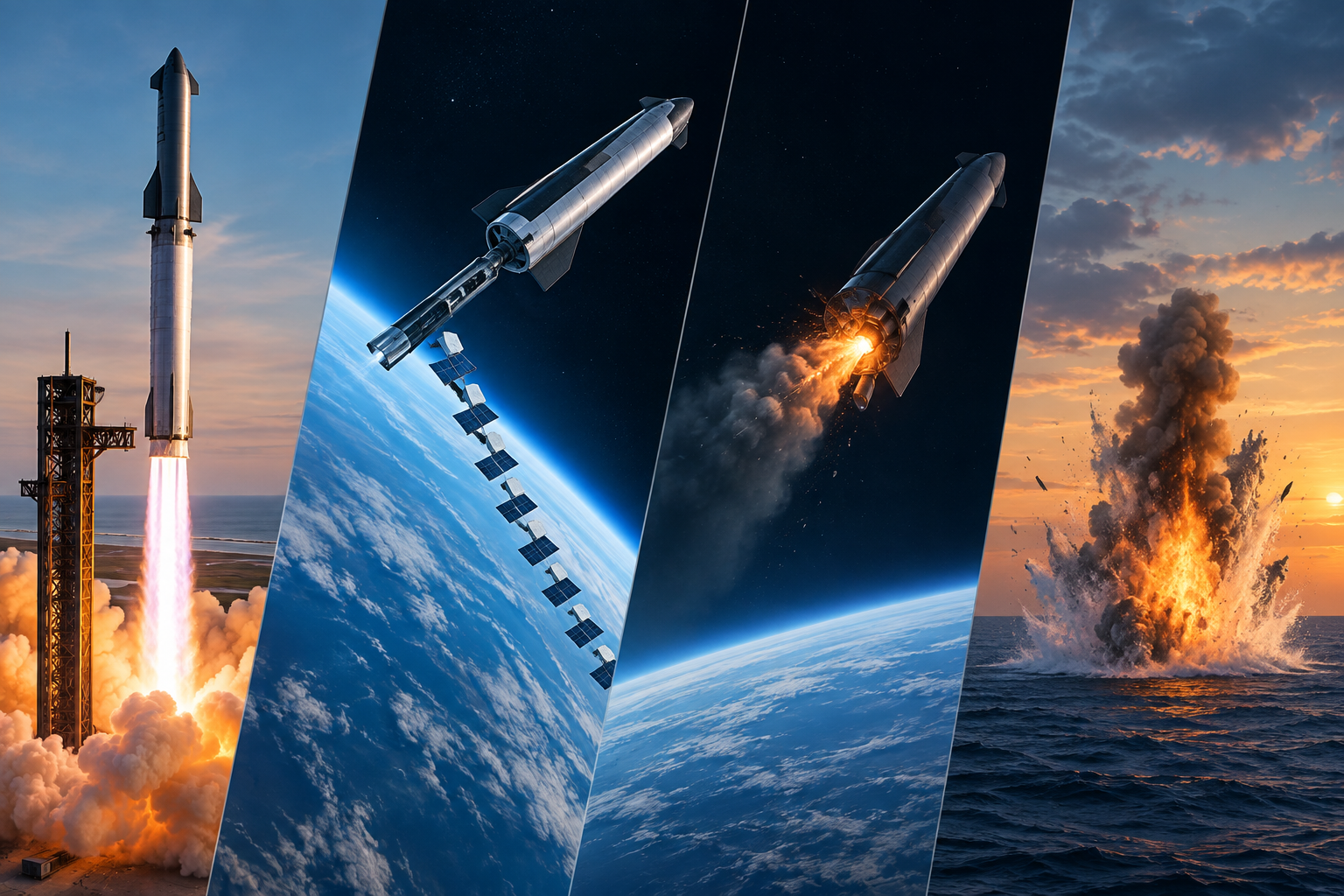
During Flight 14, SpaceX placed Starship into orbit for the first time and deployed operational Starlink satellites from it. However, the mission did not proceed as originally planned. Due to an engine problem, the spacecraft returned early and, after splashing down in the Pacific Ocean, tipped over, broke apart and caught fire.
The flight achieved its main transportation objectives: Starship reached orbit, deployed all 26 satellites and made a controlled descent toward the designated ocean area. However, an engine failure shortened the mission from nearly 10 hours to around three. The explosion occurred only after contact with the water, not during flight, and did not affect the deployed payload.
How Starship reached orbit
Flight 14 launched from the Starbase facility on September 28, 2026, at 12:48 UTC. It was the 14th integrated test flight of the system, consisting of the Super Heavy booster and the Starship upper stage. It was also the first attempt to place Starship into an actual orbit.
Problems emerged during ascent. One of the 33 Raptor engines on the Super Heavy booster shut down. During later return maneuvers, 31 of the planned 33 engines ignited, while 11 of the planned 13 ignited for the landing burn. Despite this, the booster continued its guided return and made a controlled splashdown in the Gulf of Mexico.
A separate issue occurred on the upper stage. One of its vacuum Raptor engines shut down prematurely. The remaining five engines ran longer to compensate for the loss and placed the spacecraft onto the planned safe suborbital trajectory.
Mission control then checked the three center engines and authorized the flight to continue. About 25 minutes after launch, one of them ignited for 19 seconds. This placed Starship into orbit at an altitude of around 276 kilometers.
This brief burn distinguishes successfully reaching orbit from simply climbing to a great altitude. Without it, Starship would have continued along a suborbital path and eventually re-entered the atmosphere naturally. Flight 14, however, gained sufficient velocity to orbit Earth and later had to perform a separate deorbit maneuver.
Why the mission ended early
The original plan called for approximately six orbits of Earth, a flight lasting nearly 10 hours and a return to an area west of Chile. After the vacuum engine shut down prematurely, SpaceX changed this plan. Following payload deployment, it sent Starship back to a prepared and cleared area of the North Pacific.
The spacecraft performed a deorbit burn, left orbit and passed through the atmosphere. It reached the designated ocean area about three hours and eight minutes after launch. SpaceX thus demonstrated that Starship can lower its orbit in a controlled manner after reaching orbit and head toward a selected area.
However, the flight did not confirm that the spacecraft can handle the planned nearly 10 hours in orbit. Nor were all activities prepared for the originally intended mission duration carried out. The cause of the vacuum engine's premature shutdown has not yet been disclosed, so it is not possible to determine whether the problem involved the engine itself or another part of the system.
The failures on the two stages should be distinguished. One engine shut down on the Super Heavy booster during initial ascent. Another engine failed on the Starship upper stage, which continued to orbit. The early return was related specifically to the upper-stage issue.
The explosion occurred only after the return
Footage from the end of the mission showed a large fiery explosion. However, it did not occur in orbit or during atmospheric re-entry. Starship first reached the designated area of the North Pacific and made it all the way to the surface.
After contacting the ocean, the spacecraft tipped over, broke apart and caught fire. The explosion therefore did not prevent the satellites from being deployed or the deorbit maneuver from being carried out. However, it also showed that Starship did not remain intact during this flight.
The result therefore cannot be described as either a complete success or a complete failure. SpaceX completed the first orbital flight, payload transportation and a guided return to the designated area. It did not achieve the originally planned flight duration, and the upper stage did not survive the splashdown.
This is also important when assessing reusability. The program aims to reuse both the booster and the spacecraft, but Flight 14 did not confirm full reusability. A controlled ocean splashdown is also not the same as a landing after which the vehicle could be prepared for another launch.
Twenty-six Starlink V3 satellites reached orbit
During the flight, Starship deployed all 26 Starlink V3 satellites. SpaceX subsequently announced that it had established contact with every unit through ground stations, user terminals or laser links between satellites.
The satellites still need to undergo checks and raise their orbits. Their deployment alone therefore does not mean they are already providing regular commercial service. For the Starlink network, however, it is important that the large V3 satellites were placed into orbit for the first time using Starship.
The new generation is larger than the satellites SpaceX routinely launches on Falcon 9 rockets. According to company data, one Starlink V3 is expected to provide approximately 1 Tb/s of network capacity. Once the satellites enter service, Flight 14's payload would therefore amount to approximately 26 Tb/s in total.
In its official prospectus, SpaceX states that a future Starship could launch up to 60 V3 satellites in a single mission. The company also expects roughly 20 times the network capacity delivered compared with one Falcon 9 launch. These are planned parameters for future missions, not a capability that Flight 14 has already demonstrated.
For Starlink users, a single flight will therefore not bring an immediate broad change. The satellites must complete their transfer and technical checks, and a more substantial capacity increase will require further successful launches. Flight 14 did, however, show that Starship can carry V3 satellites to orbit and deploy them as an operational payload.
What the result means for future flights
The biggest advance is the transition itself from short suborbital tests to orbital transportation. During a single mission, SpaceX collected data on engine performance, time in orbit, satellite deployment, the deorbit burn and atmospheric return.
However, unresolved tasks remain before regular cargo flights can begin. The company needs to explain the engine problems on both the booster and upper stage, reliably handle longer stays in orbit, and preserve both stages in a condition suitable for reuse. Flight 14 confirmed Starship's basic transportation capability, not the readiness of the entire system for routine operations.
Sources
- SpaceX – Starship Flight 14: https://www.spacex.com/launches/starship-flight-14
- Ars Technica – SpaceX’s Starship goes orbital, deploying first next-gen Starlinks: https://arstechnica.com/space/2026/09/starships-first-orbital-launch-gives-lift-to-spacexs-next-gen-starlinks/
- Associated Press – SpaceX's supersized Starship launches into orbit for the first time but flight ends early: https://apnews.com/article/262d3c58d56bf7a525b49115d6c5dfe8
- SpaceX – EU Prospectus (Approved by BaFin), June 5, 2026: https://content.spacex.com/cms-assets/FINAL_Documents%20and%20Updates/SpaceX%20-%20EU%20Prospectus%20%28Approved%20by%20Bafin%29%20-%20June%205%2C%202026.pdf

Marcel Macko
I’m most interested in technology, the internet, bizarre news, and stories that make you stop and think, “There’s no way this can actually be true.” I follow what’s happening both at home and around the world and pick the topics I think are worth paying attention to. On Pitchoviny, I try to present them simply, factually, and without unnecessarily sensational headlines.


