
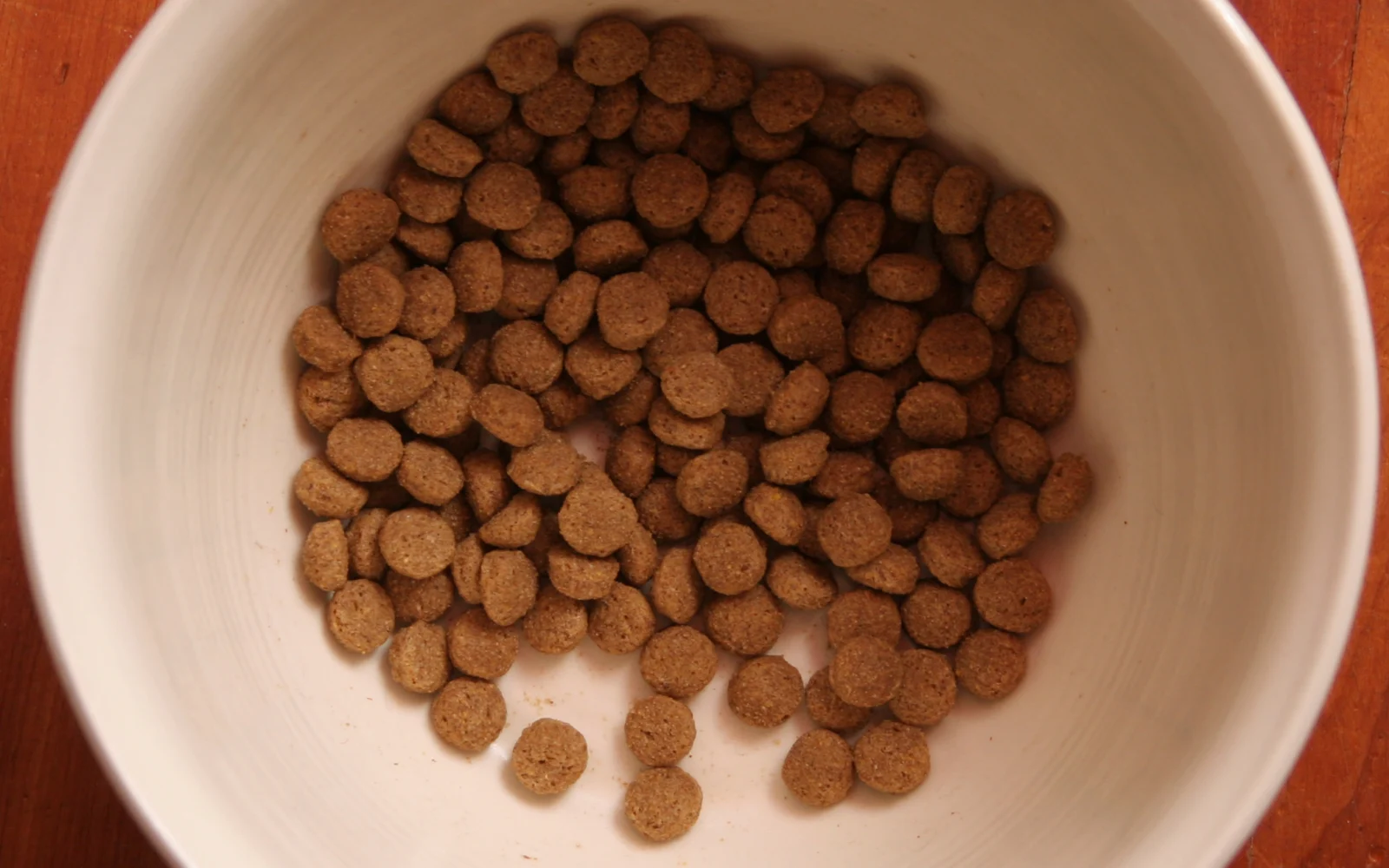
In the morning, you pour kibble into the bowl; in the evening, you repeat the same ritual. Yet your dog can sometimes make it seem as though it would happily accept a third lunch. While some owners split food into several portions, others feed an adult dog only once a day. In 2022, a study linked this seemingly ordinary detail to differences in the health of pet dogs.
For a healthy adult dog, two appropriately sized meals a day are often a practical starting point, but the routine should be adapted to the animal's age and health. Research from the Dog Aging Project found a favorable association between feeding once daily and some health indicators, but it did not prove that reducing the number of meals improves health. Do not change your dog's routine based on this study alone.
Scientists looked beyond what was in the bowl
Nutrition discussions usually focus on what food contains. Owners choose among different kinds of kibble, canned food, and other forms of diet. Meal timing can easily get lost among information about protein, fat, and total energy content. But scientists decided to look specifically at whether the number of meals is related to how dogs age.
A paper by Emily Bray and her colleagues in the journal GeroScience drew on a U.S. project that collects data on companion dogs living in households. This type of research is interesting because the animals do not spend their lives in controlled laboratory conditions. Each has its own family, daily routine, and health history.
For health indicators, the researchers were able to use data from more than 24,000 adult dogs. The assessment of cognitive function used a smaller group of approximately 10,500 animals. The data were provided by owners who completed questionnaires about their pets.
This was not a measure of how happily a dog jumps when a can of food is opened. The research tracked selected health categories and behavioral signs used to assess cognitive functioning. It asked whether there was a statistical relationship between these indicators and feeding frequency.
What the once-daily feeding results showed
In the population studied, once-daily feeding was associated with more favorable average cognitive assessment results. It was also linked to a lower prevalence of certain categories of health problems. These included diseases of the digestive system, musculoskeletal system, oral cavity, urinary system, and liver or pancreas.
However, not every health area assessed showed a convincing difference. The results cannot support a general claim that a dog fed once a day will avoid cancer or live longer. Nor does a favorable association in one disease category tell us what result a change in routine would produce for an individual animal.
It is similar to finding in a survey that healthy people are more likely to engage in a certain activity. Comparing the groups alone is not enough to make that activity a treatment. We would need to know what happens when others begin doing it as well, under comparable conditions.
When reading the results, it is also important to remember that a summary figure describes a group. If your dog were included in similar research, you could not predict its individual outcome from the average alone. A statistical finding can prompt further research without serving as instructions for an immediate change at home.
Why the direction of the association matters so much
Imagine two owners. The first has a healthy adult dog that has tolerated an established one-meal routine well for years. The second has an animal with digestive problems and, after consulting a veterinarian, has split its daily ration into smaller portions. In a one-time data collection, the first dog would be among the animals fed once a day and the second among those fed more frequently.
If researchers did not know their earlier history, more frequent feeding could appear on paper to be the cause of the problems. In reality, in this hypothetical example, the number of portions changed only after the problem arose. That is precisely why it is important to distinguish an effect from a cause.
The authors of the paper openly acknowledged this issue. Their analysis could not reconstruct the full history of the feeding routine. Some of the associations may therefore have arisen because people adjusted the diets of sick animals to suit their needs. This is not a minor footnote, but a fundamental limitation in interpreting the results.
Much stronger evidence would come from comparing changes in health over time under carefully controlled conditions. Scientists would need to track which animals were healthy at the outset, what routine they actually followed, and whether their health outcomes later began to differ. At the same time, it would be essential to protect animals from inappropriate interventions.
The number of bowls is not the same as the amount of food
Imagine a kitchen scale, a bag of food, and two empty bowls. You can put the daily ration into one bowl or divide it into halves. The total amount of food can remain the same. But if, instead of dividing it, you fill the bowl by eye each time, the final intake can change substantially.
This difference is easy to overlook in a household where several people care for the dog. One family member gives breakfast, another gives a treat during a walk, and someone adds a piece of food from the table in the evening. If nobody knows what the others have given, the number of main meals captures only part of the animal's actual diet.
The original study lacked sufficient information to calculate total energy intake. The researchers therefore could not reliably separate the effect of meal timing from the effect of food quantity. They also did not know the energy content of all treats. It would be overly optimistic to assume that one feeding-frequency figure precisely captures an animal's diet.
If you want a better overview of your own dog, it may be useful to record, over several ordinary days, what food it receives, who gives it, how much is left over, and which treats the animal gets. This is not a diet or a fasting experiment. It is about finding out what actually happens in the household, so that you have specific information for your next consultation with a veterinarian.
Why a puppy is not simply a smaller adult dog
A young animal is growing, and its needs change. What suits a healthy adult dog cannot simply be applied to a puppy. One large meal may not be suitable for a young animal. At this stage, it is important to pay attention not only to feeding frequency but also to food intended for its life stage.
Adult dogs are not a uniform group either. One may spend most of the day at home, while another regularly plays sports or does physically demanding work. Body size, body condition, the specific food, and medical history may matter more when assessing a feeding routine than an average cited in an online article.
Animals already receiving medication or following a nutrition plan set by a veterinarian deserve special attention. Meal timing may be linked to treatment. In that case, it is not safe to skip a portion simply because an owner has read about new research. For a sick animal, its own treatment plan takes priority over general findings from observations of a population.
In an older dog, a change in appetite can be a useful signal. If the animal suddenly stops eating, changes weight, or has repeated digestive problems, this does not automatically mean the number of portions needs to be adjusted. The cause should be understood first, and a professional examination may help.
A routine that works in everyday life
Veterinary guidance from VCA emphasizes the importance of regularity and individual needs. For many adult dogs, dividing food into two portions is a sensible routine. However, there is no need to change meal timing for a contented, healthy animal without a specific reason. If a change is appropriate, it is best to discuss how to make it with a veterinarian.
A daily plan has to work in a real household. Someone who works shifts needs a different organizational solution from a family working from home. It can be helpful to agree on who is responsible for giving each portion. With several animals, it is also worth keeping track of whether each dog ate its own ration or got access to another's food.
If you keep a simple feeding schedule, you can also note changes to the routine during holidays or when the dog stays with relatives. Such a record helps distinguish a long-term habit from a temporary exception. If a problem arises later, the veterinarian does not have to rely only on imprecise memories of when the diet changed.
Water is a separate matter. Considerations about meal frequency should not be extended to limiting access to drinking water. A dog must have fresh water available unless a veterinarian recommends a different approach in a specific situation.
During a veterinary visit, you can ask how to assess appropriate body condition, whether the plan fits the dog's life stage, and how to count treats. This is more practical than asking for one universal answer for every breed. A good decision comes from observing the individual animal, not from a competition among owners to have the fewest meals.
What to take away from the study
The research is valuable in part because it shows which questions about everyday care have not yet been adequately answered. Feeding is not just about choosing a product. The total ration, how it is divided, the animal's life stage, and the circumstances of its health condition may all matter.
One interesting paper does not have to change everything an owner does at home. But it can help formulate better questions. If further research succeeds in demonstrating a causal effect of a particular routine, recommendations can become more specific. Until then, there is no reason to mistake an observed association for a promise of a healthier or longer life.
Preview: James Redekop, original Wikimedia Commons, CC BY-SA 2.0. The preview may be cropped. Modified version under the same license.
Sources

Gabriel Čatár
I'm interested in everyday things we encounter but don't always understand. From technology and personal finance to practical guides and fascinating facts about the world. At Offpitch, I focus on topics worth exploring in greater depth, checking the facts and explaining them in a clear, accessible way. My goal is to make sure readers take away something useful from every article.


