
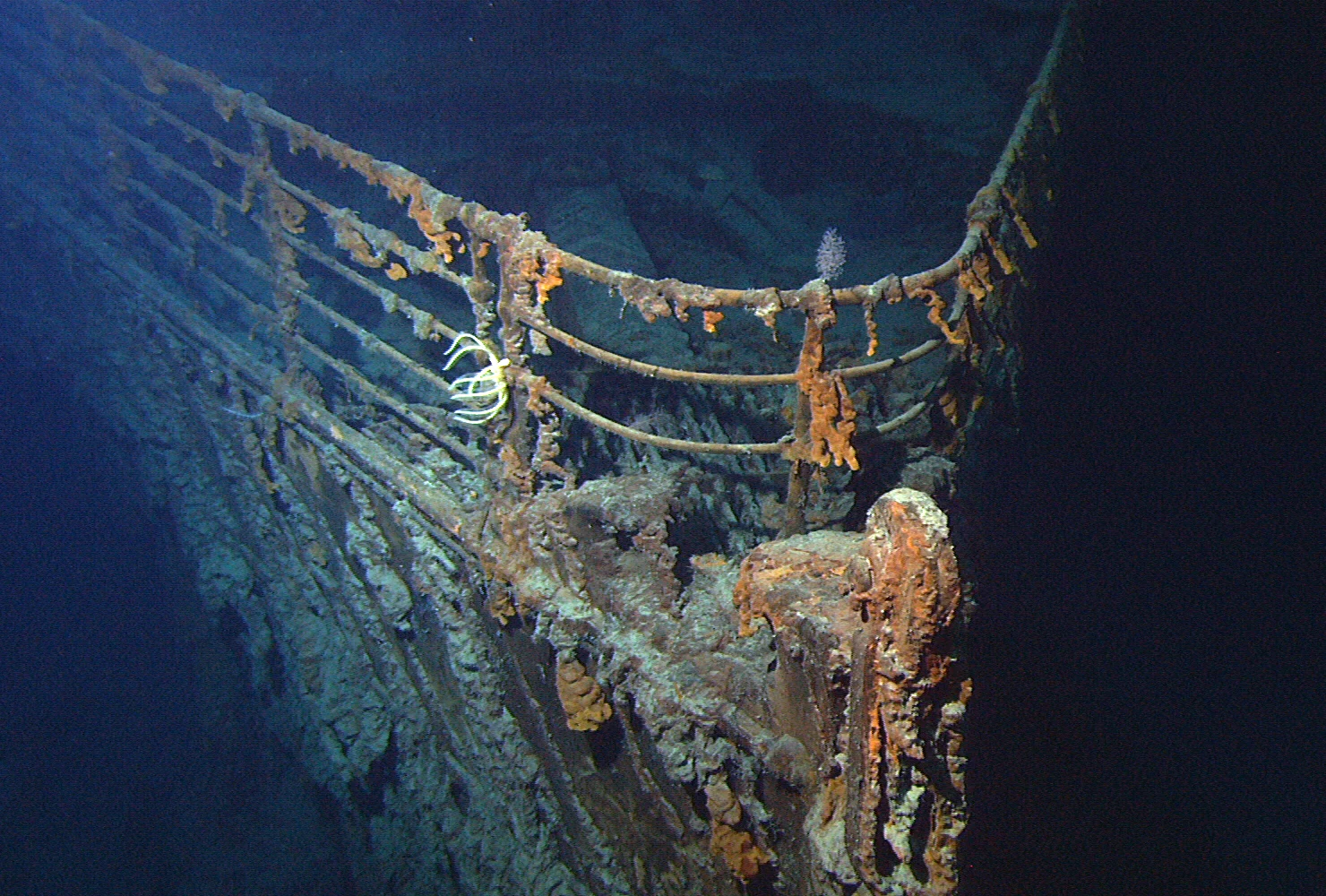
Images of the Titanic’s bow on the Atlantic seabed still reveal the ship’s distinctive prow, railings, and parts of its deck. When the Titan submersible was lost while descending to the wreck in 2023, the public began comparing two very different maritime disasters. If deep-sea pressure can destroy a specially designed vessel, how can recognizable parts of an ordinary ocean liner remain on the same seabed? The answer is not that old steel was miraculously resilient.
As it sank, the Titanic gradually filled with water, equalizing pressure inside and outside many of its spaces. By contrast, Titan had to protect a dry cabin with low internal pressure from the ocean’s high pressure. When its pressure hull failed, it collapsed inward. The Titanic, however, did not escape extensive damage or localized effects of pressure.
What Matters More Than Depth
Water pressure increases with depth because there is a column of liquid above every point below the surface. The taller the column, the greater the force it exerts per unit area. The U.S. oceanographic agency NOAA uses an approximate rule of thumb: in seawater, pressure increases by one atmosphere for every ten meters of depth. At the surface, the atmosphere above the ocean must also be included.
The Titanic wreck lies about 3.8 kilometers below the surface. The surrounding pressure is therefore on the order of 380 atmospheres. This is an approximate figure, not a universal constant for every meter of ocean depth. Seawater density varies with temperature, salinity, and pressure. For understanding the difference between the two vessels, however, this rounding is sufficient.
Pressure is a physical quantity that does not, by itself, tell us what stress a particular wall must withstand. What matters is what acts on the other side. If there is water at a similar pressure on the inside of a wall as on the outside, much of the effect of the two forces is balanced out. If there is instead air at approximately surface pressure, the situation changes dramatically.
The same difference can be seen in everyday use of doors. A closed interior door has atmospheric air pressing on both sides. Although this is a considerable absolute pressure, it does not cause the door to collapse. The point of this comparison is not to compare the strength of wood and steel, but to distinguish between absolute pressure and a pressure difference.
An Ocean Liner Is Not a Deep-Sea Submarine
The Titanic was designed to travel on the surface. It was kept afloat by buoyancy, which depends on the volume of water displaced. Much of its hull consisted of air-filled spaces. Unlike a deep-sea cabin, however, it was not required during normal operation to withstand hundreds of atmospheres of external pressure.
Its designers addressed entirely different types of loads. The long hull had to withstand motion in waves, changing cargo distribution, engine vibrations, and water pressure on sections submerged while underway. The ship’s bulkheads were intended to limit the spread of water after damage. Their purpose was to keep the vessel afloat in certain emergency situations, not to create a system of compartments capable of remaining on the Atlantic seabed.
Large ships therefore cannot simply be turned into submarines by sealing their windows and doors. Their shape, dimensions, and internal layout serve a different purpose. Moreover, a structure’s greatest strength may not be expressed in the same way under forces acting from within and from outside. A wall may resist tension well but buckle under compression.
A crewed deep-sea vehicle must preserve habitable conditions in its cabin during descent. It is not enough simply to be able to dive and return. It must have a pressure compartment that safely separates two very different physical worlds throughout the journey.
What Happened as the Titanic Flooded
The Titanic struck an iceberg in April 1912. After its hull was damaged, seawater entered its interior spaces. According to research published by the U.S. National Institute of Standards and Technology, failures in riveted joints may have contributed substantially to the leaks. This was not a case of ocean pressure suddenly destroying the entire liner. First, it gradually lost its ability to stay afloat.
Flooding changed the distribution of mass and the volume of spaces that had previously been filled with air. The ship listed, and major mechanical stresses developed within it. It eventually broke apart. The bow and stern then descended separately, with their internal spaces in different conditions.
For the bow, it was significant that many rooms already contained water. As they descended to greater depths, the water pressure inside them rose along with the pressure of the water outside. They remained exposed to currents, deformation, and impact when they reached the seabed. But they were not subjected everywhere to the same stresses as a sealed, dry cabin.
The role of air also changed during this process. Under ordinary pressure changes, water compresses far less than gas. Air trapped in a flooding compartment can therefore shrink in volume as water advances farther into the room. If there is an escape route, some of the air may leave. The course of events depends on the shape, position, and openings of the particular compartment.
The Stern Looks Different
The bow of the Titanic can give the impression that the ship reached the seabed relatively intact. That is misleading. The bow suffered substantial damage, while the stern is far more deformed. An extensive debris field lies between them.
It is important to distinguish between damage that occurred during sinking near the surface, damage that occurred during descent, and damage caused by impact with the seabed. Air pockets may have remained in some insufficiently flooded spaces. During descent, external pressure could then have deformed their walls inward. Such local collapses are consistent with the fact that other spaces remained partly recognizable.
The final shape of individual pieces of wreckage cannot, without further evidence, precisely establish the sequence of all events. Reconstructions use images, material analyses, historical plans, and calculations. Even detailed imaging of the wreck’s current condition does not automatically reveal what happened during every second of its descent.
Titan and the Failure of Its Pressure Cabin
The physical situation in the 2023 Titan tragedy was different. The cabin contained an environment intended for people, while ocean pressure increased outside. The crew were not in a space freely flooding with seawater. They were separated from the high pressure by the vehicle’s pressure hull.
In its 2025 findings, the U.S. National Transportation Safety Board attributed the disaster to OceanGate’s inadequate engineering process. According to investigators, the actual strength and service life of the composite pressure hull had not been adequately established. The structure sustained layer damage and later additional damage of unknown origin. The board concluded that this resulted in localized buckling of the hull followed by implosion.
The investigation’s conclusions also show the importance of monitoring technical condition during operation. A vehicle’s ability to complete one descent does not prove that it can withstand another. A material may be repeatedly stressed, while some damage may not appear as a visible change on the outer surface. Proper interpretation of data collected during operation is a separate issue.
An implosion is a violent collapse inward. In this sense, it is the opposite of an explosion, in which the effects of released energy typically move outward. In a deep-sea cabin, the large pressure difference itself provides the energy for collapse. Once the barrier is breached, water begins to occupy the space from which it was previously excluded.
Why Not Everything on the Ocean Floor Is Destroyed
The underwater world is full of objects that can operate under high pressure. Some do not have large air-filled cavities, while others use specially designed pressure housings. In technical equipment, different components can be protected in different ways depending on whether they need a dry environment or can operate in contact with water.
This is what makes underwater cameras, sensors, and remotely operated research vehicles possible. Their designers do not have to protect the entire volume of the equipment as a single room where people breathe air. Each component has its own requirements and a different function.
The Woods Hole Oceanographic Institution notes that finding the Titanic wreck in 1985 was an important step in the development of deep-sea imaging. Research equipment made it possible for people to observe a place they cannot reach without protection. The photographs are therefore not evidence that pressure is harmless, but the result of technology designed for such conditions.
Comparing photographs with one another also helps with interpretation. Image mosaics from several expeditions show which parts of the wreck remained in place and which changed position. A photograph of the bow alone therefore cannot represent the condition of the entire ship.
Recognizable Does Not Mean Intact
The ocean still acts on the wreck today. In addition to pressure, chemical processes, microorganisms, and local conditions affect the state of the materials. Steel structures weaken over time, and individual elements can fall away or collapse. Recognizing the outline of the ship in a photograph does not mean it is safe to enter its interior spaces or restore its original function.
Comparing the Titanic and the Titan is most useful as a lesson in pressure differences. In both cases, the ocean followed the same physical laws, but acted on structures with different purposes and internal environments. A flooded part of a wreck can remain on the seabed even though the same structure could not maintain a dry, habitable space. These tragedies are not examples of a contradiction in physics. They are a reminder that a vessel’s safety depends on the entire system, its intended design, and its actual operating conditions.
Preview: NOAA/Institute for Exploration/University of Rhode Island, original via Wikimedia Commons, public domain – PDM 1.0 designation, according to Commons, a NOAA work in the public domain in the United States. Preview may be cropped.
Sources

Gabriel Čatár
I'm interested in everyday things we encounter but don't always understand. From technology and personal finance to practical guides and fascinating facts about the world. At Offpitch, I focus on topics worth exploring in greater depth, checking the facts and explaining them in a clear, accessible way. My goal is to make sure readers take away something useful from every article.


